


Bless the Olympic break. #Canucks fans get to go from watching the worst team in the league to cheering on Team Canada on the international stage. Polar opposite of talent pools.

CanucksArmy has no direct affiliation to the Vancouver Canucks, Canucks Sports & Entertainment, NHL, or NHLPA
The Statsies: Canucks play 40 minutes of solid hockey in 5-2 loss to Golden Knights

Photo credit: © Stephen R. Sylvanie-Imagn Images

By Michael Liu
Feb 5, 2026, 13:00 ESTUpdated: Feb 5, 2026, 13:06 EST
All eyes to Milano now.
The Vancouver Canucks lost their final game before the Olympics by a 5-2 scoreline to the Vegas Golden Knights. Despite the scoreline, the Canucks were actually in the thick of it through the first and second periods, something that seems a little absurd to say. But after that second intermission, this Vancouver team just seemed to be looking towards the light at the end of the tunnel – too bad it ended up being a train and not the end.
Here’s the loss, by the numbers.
As always, you can find our glossary guide of advanced stats here.
Game Flow
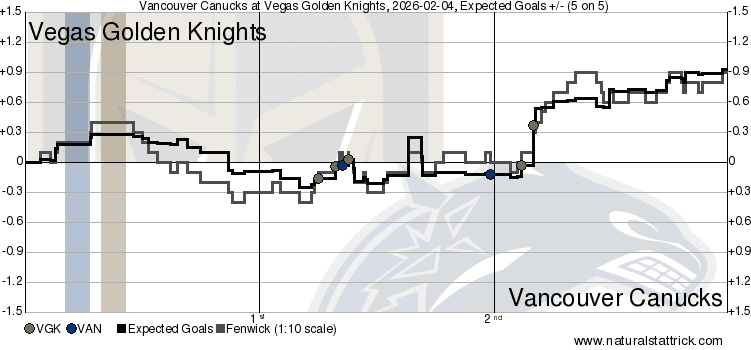
Reiterating the point, the first two periods of this contest hung very much in the balance between the two teams. Vancouver actually held the controlling xGF% shares through the first and second, with a CF% advantage in the first as well. The high-danger scoring chances were split 6-6 for both teams going into the second intermission, and a 3-2 contest looked like it was going down to the wire. Unfortunately, the Cannucks just lost whatever good momentum they built coming out for the third, giving up an early goal and then letting the flow of the game get away from them entirely. The third would finish with Vancouver posting a mere 31.03 CF% and 15.28 xGF%.
Heat Map
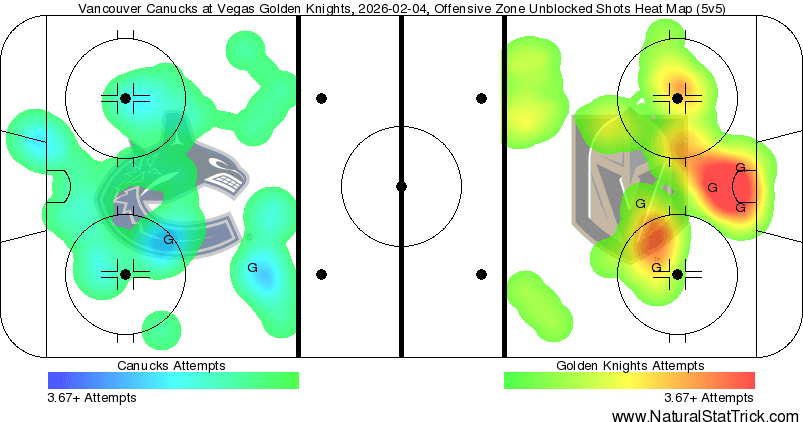
It’s quite interesting to look at this heat map knowing that the Canucks and Golden Knights were even through 40 when it came to high-danger chances. The third was so tilted in Vegas’ favour that they managed a 7-0 HDCF advantage in the period alone, resulting in a 13-6 5v5 HDCF lead reflected on this heat map. Overall, the scoring chances were 23-18 for the Golden Knights, but the Canucks were actually in front after 40 by a 16-14 margin. Goes to show what a bad 20 minutes can do for an entire game’s worth of stats.
Individual Advanced Stats
Corsi Champ: Conor Garland followed up a strong performance in Utah with another strong game in Nevada. Leading the Canucks with a 60.00 CF%, he was on ice for the only two goals that Vancouver managed to generate all night, posting the team’s third-best xGF% at 47.20. Garland’s 0.78 xGF was also the third-best tally on the team. One thing that was interesting to see was that despite these numbers and being on ice for a 7-6 lead in scoring chances, Garland actually finished the game in a 1-5 hole in high-danger chances. Regardless, he and his linemates in Teddy Blueger and Liam Ohgren seem to be clicking when all else is failing on the team.

#Canucks last 2 games: Blueger 1+3 Garland 3A Ohgren 1+1 line has been involved in all 4 goals
Corsi Chump: Linus Karlsson finished dead last in CF%, a 25.00 bringing up the rear of the pack last night in Vegas. On ice for three goals against, the Swede only managed a 29.07 xGF% while playing on a makeshift third line with Jake DeBrusk and David Kampf. Considering that their most played against forwards was Jack Eichel’s line, one has to give them a little bit of grace. It isn’t like they’re Eichel quality players going up against him.
xGF: Leading the Canucks in xGF% was… Marcus Pettersson? Yes, the noted defensive defenceman (who has been tasked with some rough matchups all year) managed to lead the Canucks in xGF% with a 62.09 while partnering Tom Willander. This pairing had a rough go of things against Utah but managed to bounce back in a pretty solid way against the Golden Knights. The duo finished with the highest xGF%s on the entire roster while only being on ice for a goal against, which is tidy work considering that they were deployed against Vegas’ top 6 for pretty much all of their TOI. Only giving up 3 high-danger chances against playing that quality of opposition is also really darn good. Marcus Pettersson’s 0.84 xGF was also a team-best in that category.
GSAx: The numbers for Kevin Lankinen were probably looking decent until the third, much like the rest of the team. Vegas only managed to total 2.85 xGF last night, which meant that the Finnish netminder finished with a -2.15 GSAx going into the Olympics. Of the 5 goals that he gave up, three of them were high-danger and the remaining two were considered low-danger. It’s a little puzzling why he got the start considering that Lankinen is bound for Milan, but it wasn’t like the team in front of him was offering much help, if any.

HUGE SAVE FROM KEVIN LANKINEN 🤯
Statistical Musings
Trying everything on the back end: Given D-Petey’s year as a whole, it would make sense to pair him up with Filip Hronek, who’s been one of the only sturdy presences on the back end all year. However, it didn’t seem to work all that well, as Hronek was still needed to play heavy minutes against the best that Vegas had to offer. While their CF% of 40.00 together wasn’t bad at all, the duo gave up a massive 26.55 xGF% share to the Golden Knights, on ice for 1.17 xGA and a 5-12 hole in scoring chances. They were on ice for a goal for and two goals against at 5v5 play, and this was despite seeing over 60% of both faceoff and shift starts in the offensive zone. It wasn’t the best for either party, but it wasn’t as if the Canucks had many options available to them.
defencemen have scored 5 of #Canucks last 10 goals: Willander 2, Hronek, DPetey & now Joseph
Try something else up front, maybe?: Something that’s been popping up since Jonathan Lekkerimäki’s promotion is the fact that he hasn’t played much. Against the Golden Knights, the same rang true, as the Swede was deployed on the fourth line to record the lowest TOI on the team (12:01) while posting a 42.86 CF% and 33.13 xGF% as a line with Max Sasson and Aatu Raty. The thing was, Vancouver’s alleged first line wasn’t much better, if at all. In 12:25 TOI, the Drew O’Connor – Elias Pettersson – Evander Kane line recorded a 42.86 CF% and 33.91 xGF%. Most interestingly enough, despite playing 5 minutes less, the fourth line posted 0.20 xGF to the first line’s 0.32 xGF. It wouldn’t be a bad shout to actually promote Lekkerimäki to that first line in place of Kane and see what you have, in a player that will actually be around after this season.
As a team
CF% – 44.79% HDCF% – 30.00% xGF% – 37.64%
It wasn’t as if the Canucks were particularly bad. They played solid for 40 minutes. But for whatever rhyme or reason, they just came out in the third flat, and got fully thumped in the last 20. Perhaps it’s just another indication of where this team is at, and how far they need to go to be an actually good hockey team. Right now, it’s clear that these Canucks can’t even compete in a relatively weaker Pacific Division.
Vancouver enjoys time off before hosting the Winnipeg Jets on February 25th.
Stats provided by naturalstattrick.com
Sponsored by bet365


Breaking News
- The Statsies: Canucks overwhelmed at 5v5 in Hughes’ return after a strong first period
- The Stanchies: Boo birds rain on Hughes in return to Vancouver; Canucks lose 4-2 to Wild
- Instant Reaction: Canucks start strong but fall 4-2 to Wild in Hughes’ return to Vancouver
- Canucks: What happened the last time a controversial former captain returned to Vancouver?
- Scenes from morning skate: Canucks looking to snap winless skid and spoil Quinn Hughes’ homecoming

Vancouver CanucksTeam Cap Summary

Cap Summary
2026-27
2027-28
Projected Cap Hit
$87,295,050
$71,329,167
Projected Cap Space
$16,704,950
$42,170,833
Current Cap Space
$19,290,240
$42,170,833
Active Players
23/23
13/23
Draft Picks
Round
'27
'28
1
1
1
2
2
2
3
1
1