Another loss for the collection.
The Vancouver Canucks
dropped a 5-2 loss to the Seattle Kraken last night. For the second game in a row, this team came out of the gates strong. All the numbers from the first two periods of this contest were extremely good, numbers that probably deserved to get a more favourable result than what the scoreboard read in the end. But unlike the Nashville game, once Seattle padded their lead, there was just a sense that this Canucks team wasn’t going to be clawing their way back into this one.
Here’s the loss, by the numbers.
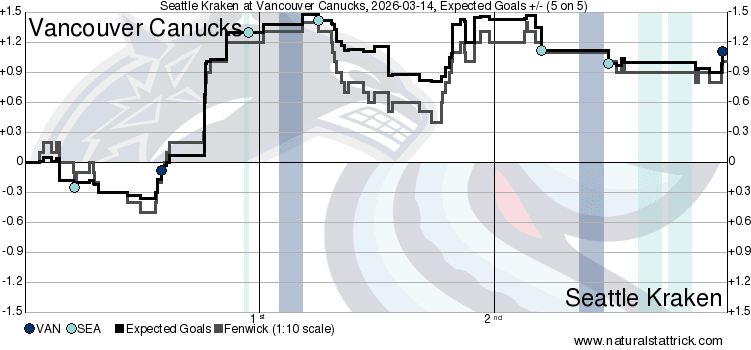
Game Flow
Aside from giving up the first goal of the game, the Canucks were able to surge hard after evening things back up in the first. The sheer statistical advantage they had at 5v5 was impressive, as while the CF% was only at 56.52, the xGF% was a staggering 77.99 in the Canucks’s favour. This was coming with a 1.81-0.55 xGF lead, Vancouver holding an 8-2 high-danger chance edge in the frame alone. Being down 2-1, with the other goal coming on the power play, didn’t seem all that bad when considering all of the stats. The second was similar, a little more tempered but with the Canucks still having a sizeable 5-2 lead in high-danger chances and 53.06 xGF% share.
However, as the Kraken added to their lead in the third, the Canucks simply just ran out of gas and didn’t look up to dragging themselves back up into the fight. They would finish the final frame with a 38.89 CF% share and only manage a 33.58 xGF% as well, unable to move the needle back in their favour when all was said and done. The goal at the end did make the scoreboard look a little better, but Vancouver finished this contest on a whimper when everything was considered.
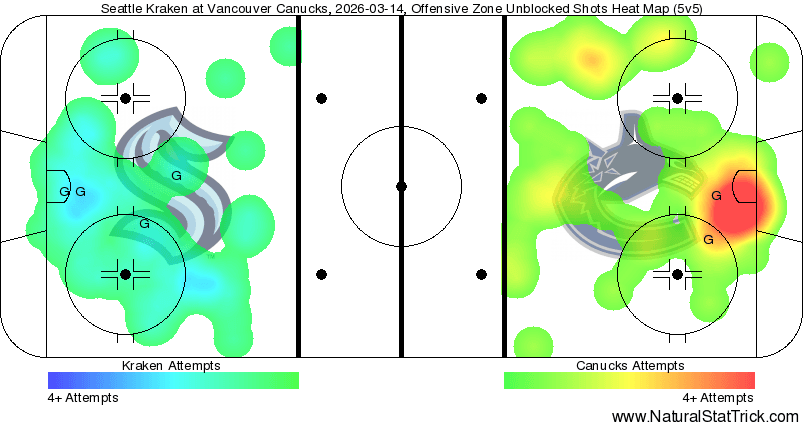
Heat Map
This looks like a winning heat map at first glance. Vancouver had a narrow 25-23 lead in overall scoring chances at 5v5 play, but had a hefty 15-7 lead in high-danger chances, as reflected by the very visible hotspot in tight against the Kraken. However, this is where the distribution is also important to consider, as the Canucks got 13/15 of their high-danger chances in the first and second periods but were unable to capitalize on most of them. It’s better to get these looks than not, and it’s something that this group has struggled with all season – so it’s definitely better than nothing. But with Seattle steadily taking a stranglehold on the game, there just wasn’t that elevation or pushback the Canucks had against the Predators.
Individual Advanced Stats
Corsi Champ: Tom Willander led all Canucks with a 65.63 CF%,
paired up with Marcus Pettersson once more and tasked with playing against the best the Seattle Kraken had to offer. While he was on ice for two goals against, Willander’s numbers were quite strong across the board. A 1.37 xGF was good enough for sixth-best on the team, while a 69.85 xGF% was the fifth-best mark amongst all skaters. Willander held a 10-4 split in overall scoring chances and a 5-1 edge in high-danger chances, which honestly was quite impressive given the quality of his opposition.
Corsi Chump: Elias Pettersson (D) was not having a great game before being forced to exit with an injury. Bringing up the rear of the team with a 26.67 CF%, the young Swede was on ice for a 1-6 hole in scoring chances against the bottom of the Kraken lineup. There is some solace in the fact that he still finished with a 56.64 xGF%, which was just a hair under team average, and the scoring chances stood at a 1-1 split during his TOI. Hopefully the injury isn’t too bad for D-Petey, as the depth behind him probably wouldn’t turn in much better results.
xGF: Leading the team in xGF% was…
Evander Kane? That’s right, the veteran winger managed to record a 77.69 xGF% to pace the team, his 1.84 raw xGF second only to linemate Drew O’Connor’s 2.08. Kane managed to be on ice for a massive 12-7 lead in scoring chances, translating that to an 11-2 high-danger chance advantage. If you’re keeping track, that’s 11/15 high-danger chances overall for the Canucks that Kane was on the ice for. He found the back of the net from this, which was more than well deserved – now, if only Elias Pettersson (C) can also start translating this statistical advantage into production.
GSAx: It was not Nikita Tolopilo’s finest outing, suffice it to say. Facing a 2.83 xGF, the netminder gave up two high-danger goals, two middle-danger goals, and one low-danger goal for a -2.17 GSAx on the night. That’s a pretty big deficit, especially considering that the Canucks did manage to score two goals by the end of the contest. That statistical advantage they had through the first two periods of the game probably would’ve actually built more momentum for Vancouver if Tolopilo was a little steadier throughout the game. Unfortunately, he wasn’t, and it ended up costing the Canucks a result in all likelihood.
As a team
CF% – 47.90% HDCF% – 70.83% xGF% – 55.81%
Again, for the Canucks to piece together the statistical advantage they got, and to start strong in two games in a row, might be considered a win in and of itself. This year has been rough, and this team has so often failed to launch, so just getting statistical pressure is a nice change of pace. Obviously, it’s clear that this group falls well short compared to pretty much every team across the league, and once things got rough in this one, there just wasn’t juice to find the comeback. At the very least, the top three pick continues to be solidified by this result, and perhaps some more
high-end talent inbound to look forward to after the draft this year.
Vancouver enjoys a couple of days off before the Florida Panthers roll into town on Tuesday.
Stats provided by naturalstattrick.com
Sponsored by bet365