
CanucksArmy has no direct affiliation to the Vancouver Canucks, Canucks Sports & Entertainment, NHL, or NHLPA
Hindsight Report: When was the best time to have traded each key Canuck asset?
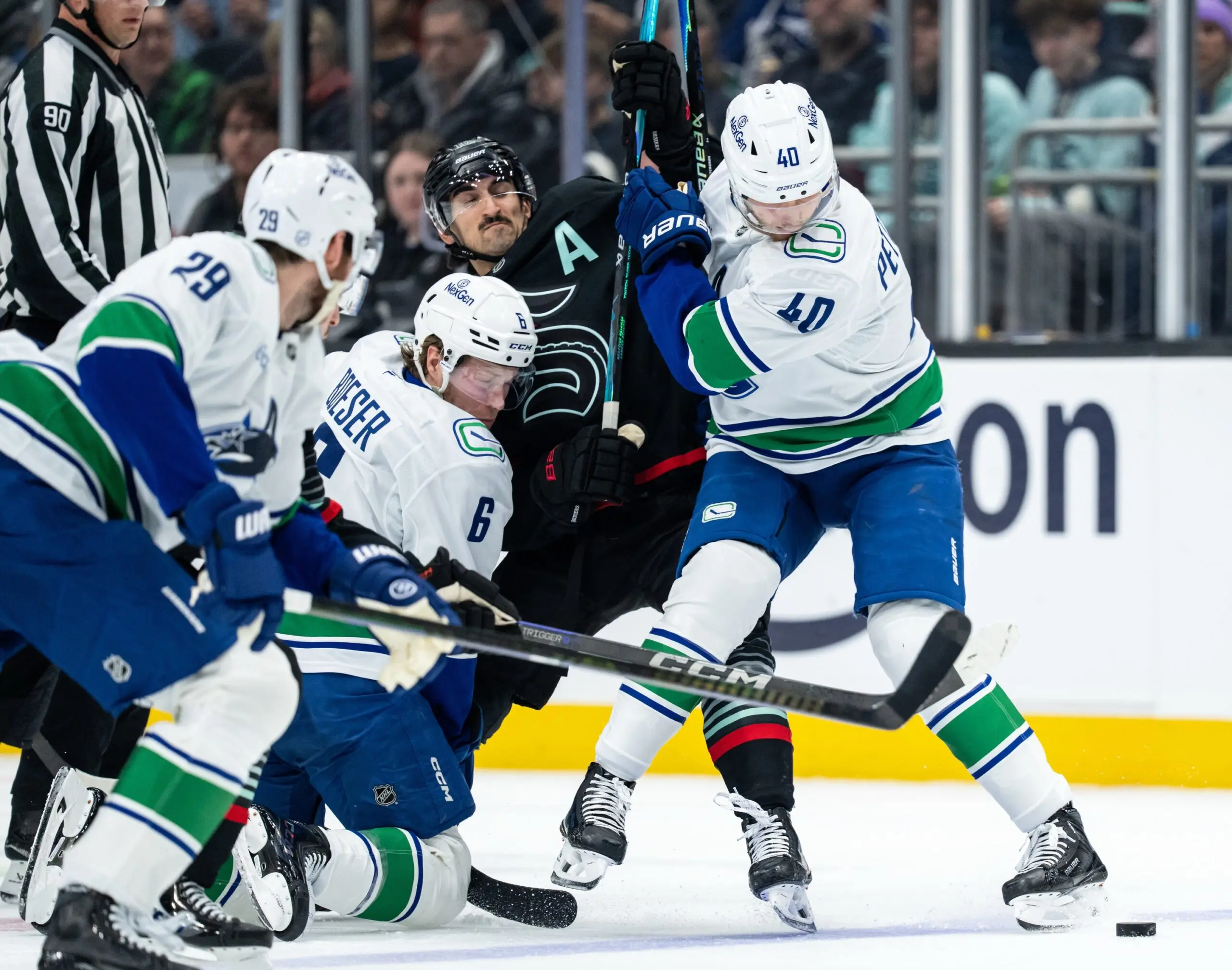
Photo credit: © Stephen Brashear-Imagn Images

Mar 14, 2026, 17:00 EDTUpdated: Mar 23, 2026, 15:44 EDT


We have to start this one off with a conversation about what we mean when we say “hindsight.”
For our purposes, we mean it in the sense of the phrase “hindsight is 20/20,” meaning we acknowledge a distinct advantage in writing from a future perspective about events in the past. Which means we are not writing this article as any sort of “I told you so” aimed at the management of the Vancouver Canucks. Instead, this is more of an “if we could go back in time, we’d change these things” sort of article.
In other words, it’s not about assigning blame, but more about wondering what could have been.
With that out of the way, the premise is simple enough. We’re going to focus on those Canucks assets who were part of the organization as of the start of this 2025-26 campaign – so there’ll be no mention of JT Miller or Bo Horvat or anyone else traded in years past. From there, we’re looking back to try to pinpoint when would have been the best time to cash in on that asset’s maximum trade value. This will include those Canucks who have already been traded and those still with the team. It goes without saying that this is purely subjective, and that debate is invited.
Also, we couldn’t decide on an order to list them in, so we defaulted to alphabetical.
Brock Boeser
Should Have Been Traded: July 2024
Actual Trade: N/A
We start out this thought experiment with one of our simplest hypotheses. Boeser should have been traded at some point before his current extension. That much is certain.
Pinpointing a more specific date is a little tougher. It might be easy enough to say that it’s Trade Deadline 2025, with Boeser as a pending UFA on the block, but we were told that the offers were not good at that time. Assuming that the team was never going to be willing to trade Boeser in the midst of his 40-goal 2023-24 campaign, with the Canucks holding down a division lead, so we’ll say the ideal date came a few months later, in the 2024 offseason. Any team trading for Boeser after July 1, 2024, would have been able to talk extension with him, and they’d be offering value in line with what has turned out to be Boeser’s career-best year by a long shot. It’d be a better-than-decent influx of future assets, and the avoidance of a contract that has quickly become regrettable.
Thatcher Demko
Should Have Been Traded: January 2025
Actual Trade: N/A
We continue our list of players who signed extensions last summer, and the theme is going to be “they should have been traded instead of signing those extensions.” That theme hits home hardest with Demko.
His near-constant injuries make it tough to find the ideal window within which to trade him. Demko’s best work came during that same 2023-24 season as Boeser’s did, but the chances of trading him within that season were nonexistent, with the team on the way to the playoffs and no heir apparent at that time. Then, by the time the offseason rolled around, Demko was once again injured, having bowed out of said playoffs to make way for Arturs Silovs.
We’ll instead skip ahead to partway through the 2024-25 campaign that followed. Demko did not return to it until December, but then he stayed relatively healthy all the way through to February and put up some great games and great numbers as he did. By the 2025 Trade Deadline, he was injured again, but if the team could have managed to find a buyer for him somewhere in between, that would have been their best bet.
If the team got anything back for Demko at that point, it would have been worth avoiding his current contract-anchor situation.
Conor Garland
Should Have Been Traded: The 2025 Trade Deadline
Actual Trade: March 5, 2026 (to Columbus for a 2028 second and 2026 third)
We swear the list will get a little more varied after this. But this is our third regrettable Summer 2025 extension in a row, and the answer, once again, will be that Garland should have been traded before signing that contract.
Garland’s answer is the most straightforward, at least. He was playing great, and consistently great, right up until his extension was signed and the 2025-26 season began. So, it makes the most sense to flip him at or around the 2025 Trade Deadline, with that extension still unsigned and Garland on the way to another 50-point season. There undoubtedly would have been sizeable offers for two playoff runs with Garland with no commitment beyond that, and those offers almost certainly would have reached beyond the second and the third that Garland eventually returned.
Quinn Hughes
Should Have Been Traded: December 12, 2025
Actual Trade: December 12, 2025 (to Minnesota for Zeev Buium, Marco Rossi, Liam Öhgren, and a 2026 first)
For a trade of this size and magnitude, most in the Canucks’ orbit have little in the way of regrets. It has now become apparent that Hughes was going to be traded at some point. And now that it’s happened, it’s hard to imagine any point at which any better offer would have been made.
It’s clear enough that Wild GM Bill Guerin stepped up his offer to stand head-and-shoulders above the other bidders, and when that happened, the Canucks pulled the trigger. With no knowledge of any better offers at any point, and with the likelihood of Hughes’ value dropping the closer he got to July 1 and the ability to negotiate an extension, we have to conclude that the Canucks effectively did maximize their return for Hughes by trading him at the right time for the right offer. It was, after all, one of the largest returns garnered in any NHL trade in recent memory.
Evander Kane
Should Have Been Traded: November 2025
Actual Trade: N/A
The short answer here is “the first time another team made an offer for him,” if that did actually ever come to pass. Kane is infamously still a Canuck post-deadline, the result of literally no offers being made for his services on or near Trade Deadline Day. But there were whispers of teams being interested earlier in the year, and if so, that would have been the time to pull the trigger.
If we had to guess when that might have been, we’d say it came about two months into the season, in late November 2025. At that point, Kane was still receiving a boatload of even-strength ice-time from Adam Foote and had a decent run of 14 points in his first 26 games. Even better, some of Kane’s more frustrating attributes weren’t as visible at that point.
If the Canucks were even offered a fifth-round pick back in November, or at any other date, for Kane, they should have taken it.
Kevin Lankinen
Should Have Been Traded: February 20, 2025
Actual Trade: N/A
Another extension signed in 2025, another one we’d like to avoid, though this one came a little bit earlier than the summer. The fact of the matter is that Lankinen performed his career-best work filling in for Demko last season, and that performance earned him what now looks like a somewhat ridiculous five-year, $4.5 million AAV extension. If the Canucks could go back and un-sign that contract, they would. That would allow them to cash in on whatever value he had during that run, avoid his extension, and probably keep Arturs Silovs in-house for at least another season, if not longer.
That trade could not have come at the 2025 Trade Deadline, as Lankinen had already signed his extension by that point. Instead, we’ll say he should have been traded the day before his extension, which puts us at exactly February 20, 2025. This will be our most specific answer, by far.
Tyler Myers
Should Have Been Traded: During the 2025 offseason
Actual Trade: March 4, 2026 (to Dallas for a 2027 second and a 2029 fourth)
This one might be the trickiest. In the end, the value the Canucks received back for Myers was fine, and there’s not too much reason for regret. But it’s also true that Myers had a great season last year, and that his performance took a tumble in 2025-26.
That means that the Canucks were probably best to sell Myers a little earlier, as in this past 2025 offseason. He still had two years of his $3 million AAV extension in place at that point and still had an NMC, but may have been willing to move with the Canucks on the decline and a whole summer to think about it. And if teams were trading for the 2024-25 version of Myers, they probably would end up paying more than a second and a fourth, at least by some degree.
This move really requires the power of hindsight, however, because it requires knowledge that Tom Willander’s transition to the NHL would be smooth, and that Myers would become superfluous sooner than later. Otherwise, there was no real chance of the Canucks trading Myers this past summer.
Elias Pettersson
Should Have Been Traded: February 2024
Actual Trade: N/A
This one may be controversial, but it’s also a surprisingly easy call. We know that throughout early 2024, the Canucks were in a bit of a game of chicken with Pettersson. Contract negotiations were ongoing, but so were trade negotiations, with word being that if Pettersson didn’t give the Canucks the extension they wanted, he’d be shipped out of town. At the time, the heaviest rumours suggested that the Carolina Hurricanes were in on him and were offering a package that centred around Martin Necas.
In the end, the Canucks signed Pettersson to an eight-year, $11.6 million extension on March 2, 2024, and his performance has only continued to decline from there. Necas, meanwhile, has 162 points in 140 games over the past three seasons.
If they could go back in time, the Canucks would simply take the Hurricanes up on their offer and never look back. A straight-up Necas-for-Pettersson swap would look great in the rear-view, and that’s to say nothing of the bonus assets that Carolina was rumoured to be including.
Marcus Pettersson
Should Have Been Traded: Immediately, or never traded for
Actual Trade: N/A
Apologies if this one sounds a bit harsh, but it’s true. The Canucks took the then-conditional first-round pick they got from the New York Rangers and turned it into Marcus Pettersson and Drew O’Connor. That pick ended up at 12th overall, which is already too much to pay for such a return. The Canucks doubled down by extending Pettersson a few days later, and although he had a fine end to the 2024-25 campaign, his 2025-26 has been dismal.
Looking back, it would have been best to either flip Pettersson immediately, if that were possible, or to instead simply not trade for him. Keep that conditional first and make a selection at 12th overall, trade a lower pick for O’Connor, and pick up some cheaper veteran LD somewhere along the way, and the Canucks are sitting in a much better position, and feel a lot better about the whole Miller departure, too.
Kiefer Sherwood
Should Have Been Traded: January 19, 2026
Actual Trade: January 19, 2026 (to San Jose for a 2026 second, a 2027 second, and Cole Clayton)
We know that the Canucks were asking for a first-round pick, or more, for Sherwood. We can also reasonably assume that such a return was never offered because, if it had been, the Canucks probably would have jumped on it.
Instead, they jumped on two seconds in the next two drafts, and that feels like a fine result. Given the other returns between January and the deadline, Sherwood went for about as much as he was ever going to get. Given Sherwood’s injuries and slowing down, there was every chance the Canucks would have gotten a lower return had they waited until closer to the deadline.
If there’s any solace to the 2025-26 season, it’s that the Canucks probably managed to trade their two top tradeable assets, in Sherwood and Hughes, at the right time to maximize their return values. There are plenty of regrets to be found in this article, but not with these two players, at least.
PRESENTED BY PACIFIC TOYOTA DEALERS

Need performance without compromise? Check out the Toyota Prius Plug-In Hybrid. Enjoy up to 72 km of electric range on battery alone. Heading farther for an away game? It seamlessly switches to gas for a combined 962 km range. It’s a total power play on the road with a sleek design and sophisticated, tech-loaded interior. Plus, you can recharge easily at home or utilize over 2,000 public charging stations in BC. Experience range, style, and versatility. Visit your local Pacific Toyota dealer during Red Tag Days for limited-time offers.


Breaking News
- Canucks’ Jack Thompson clears NHL waivers, will report to AHL Abbotsford
- JPat’s Monday Mailbag: Canucks chemistry lessons, a hot dog feast and press box bingo
- The Statsies: Canucks overwhelmed at 5v5 in Hughes’ return after a strong first period
- The Stanchies: Boo birds rain on Hughes in return to Vancouver; Canucks lose 4-2 to Wild
- Instant Reaction: Canucks start strong but fall 4-2 to Wild in Hughes’ return to Vancouver

Vancouver CanucksTeam Cap Summary

Cap Summary
2026-27
2027-28
Projected Cap Hit
$87,295,050
$71,329,167
Projected Cap Space
$16,704,950
$42,170,833
Current Cap Space
$19,290,240
$42,170,833
Active Players
23/23
13/23
Draft Picks
Round
'27
'28
1
1
1
2
2
2
3
1
1