
CanucksArmy has no direct affiliation to the Vancouver Canucks, Canucks Sports & Entertainment, NHL, or NHLPA
Who do the Canucks want in their top-six in 2026-27?
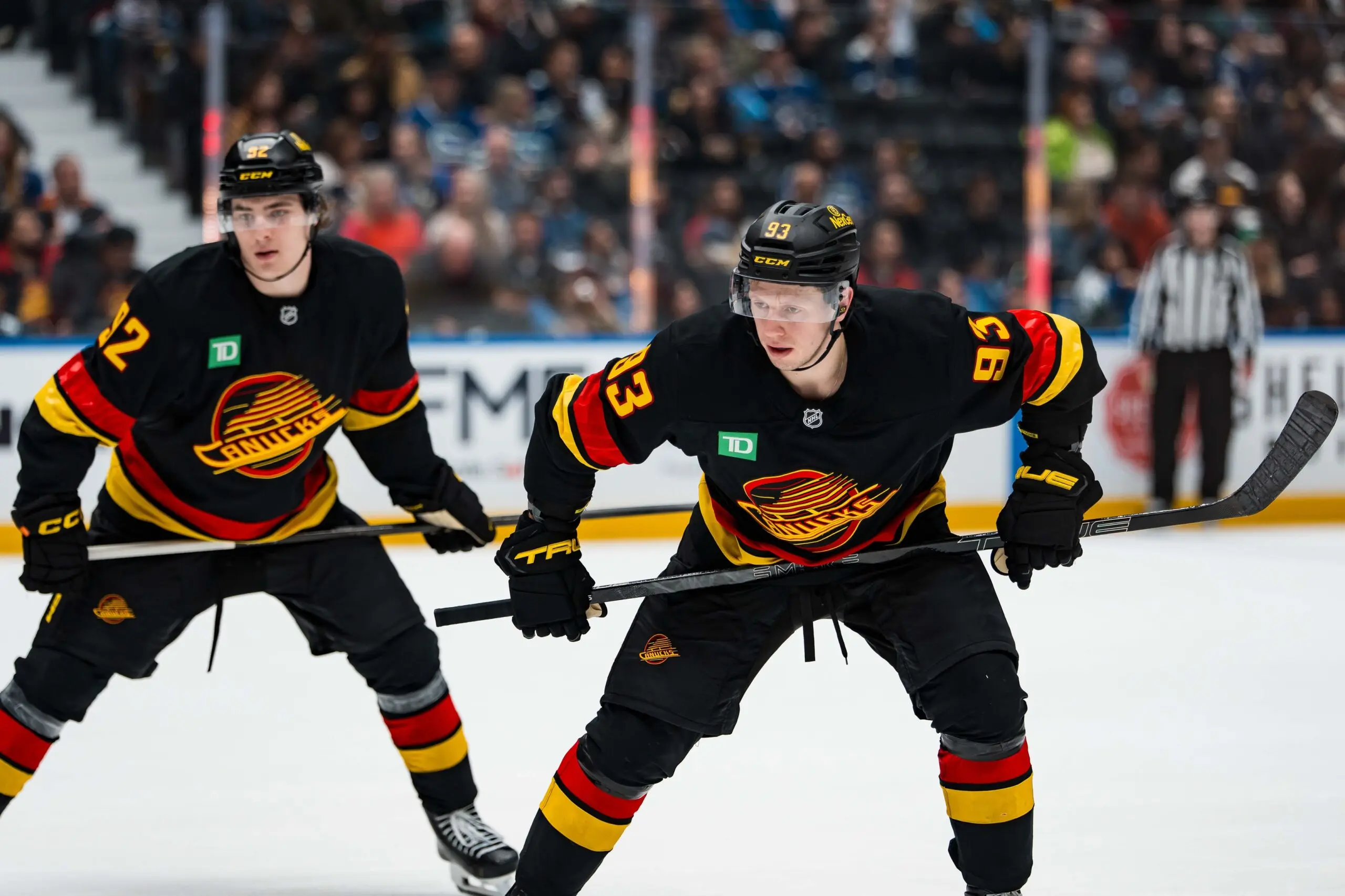
Photo credit: © Bob Frid-Imagn Images

Jun 3, 2026, 14:00 EDTUpdated: Jun 3, 2026, 13:56 EDT


In our ongoing quest to predict the first moves of the Vancouver Canucks’ newest managerial team, we’ve had our sights set primarily on the long-term. This is a team on route to a rebuild, after all, and that means that the far-flung future is far more important than the present day.
But the 2026-27 season will arrive in a few months, all the same. And before it arrives, the trio of GM Ryan Johnson and co-POHOs Henrik and Daniel Sedin are surely going to start making some decisions. Moves made to address the team’s most immediate needs won’t necessarily be the most important ones in the long run, but that doesn’t make them unimportant overall.
To attempt to guess at what some of these early transactions might be, we thought it was probably time to start thinking about the 2026-27 roster, more specifically, at the Canucks’ prospective top-six forwards. And more specifically than that, what the Canucks really need out of it next year.
It’s no longer a simple question of arranging the most effective collection of six forwards on the roster. The Canucks now have goals outside of scoring goals. This is a rebuilding team, and the first job of a rebuilding team is to develop its current stable of young talent.
There are certain veteran players who probably will play in the Canucks’ top-six next year if they’re not traded in the interim. We’re talking Elias Pettersson, Brock Boeser, and Jake DeBrusk.
But those aren’t necessarily the players that the Canucks want or need to play in the top-six. They’re more like the defaults. The players that the Canucks want to play in their top-six are those with at least a little upside left in their development. The kind of players who will get better with more minutes and opportunities. The players who, by getting played more now, might contribute more down the road, once the rebuild has progressed toward contention.
The most definitive name on this list is Liam Öhgren. He played better after being traded to the Canucks than he ever did with the Minnesota Wild, but still managed only 18 points in 51 games. At age 22, Öhgren has plenty of developmental time remaining, but only so much time available to really take that next step into a true scoring role. Finding out whether or not he can do so, and giving him ample opportunity to find out, are major priorities for the 2026-27 season. Öhgren needs a top-six role.
Another name in a similar boat is Jonathan Lekkerimäki. It’s become fairly obvious that he’s of the ‘top-six or bust’ variety of prospects, but some still see him as a future 30-goal scorer in the NHL. It may not feel like it, but Lekkerimäki is from the exact same 2022 draft class as Öhgren. Entering his fourth pro season and the fifth season after being drafted, Lekkerimäki isn’t quite running out of road. But every day that passes without him establishing himself in the Canucks’ top-six means it’s all the more likely that it never happens, and that he is ultimately surpassed by younger talent.
But for the time being, Lekkerimäki’s potential – and its potential impact on the long-term success of the Canucks – cannot be ignored, and they’ve got to take their best shot at realizing it. Lekkerimäki needs to at least have a path to the top-six open and available to him at Training Camp 2026, so that he has the opportunity to claim it and then run with it.
Marco Rossi has a little less to prove than Öhgren and Lekkerimäki. He’s a couple of years older, has a larger history of NHL production, and is already almost inked in to the Canucks’ top-six for next year. It might, however, be tempting to bump Rossi down the depth chart if someone like Braeden Cootes or perhaps a new centre draftee really makes some noise at Training Camp.
We’ve commented that Rossi’s place in the rebuild is tricky to determine. But whatever the long-term future for him with the Canucks might be, there’s a lot of benefit in continuing to play him in a top-six role for the time being.
If Rossi takes a few more developmental steps forward, well then, maybe he’s a player worth keeping in the fold as a true high-quality 2C. To take those steps forward, he’ll need to be in the top six consistently.
But even if he’s mostly topped out at this point, playing Rossi more and seeing his production rise, even a little, would increase his trade value. And if Rossi’s not part of the long-term picture in Vancouver, he’s next-most valuable to them as a trade chip. Either way, the Canucks benefit from having Rossi in the top six for now.
The next name we’ll throw onto this list will be a bit more controversial, but it’s Linus Karlsson. At 26 going on 27, Karlsson isn’t old, but he’s a lot older than any of the three we’ve mentioned so far, and that brings his long-term role in the rebuild into question. But even if Karlsson isn’t going to stick around until the next decade, the Canucks would benefit from seeing where his skill level truly tops out. He made the climb all the way from the AHL to being the Canucks’ top five-on-five producer last year.
The Canucks also just signed Karlsson to a two-year, $2.25 million AAV contract extension. If they’re able to have Karlsson in their top-six while producing consistently over those two years, then he suddenly becomes another one of their most valuable trade chips.
And aside from potential transactions, Karlsson has also proven some value in raising others’ game. He clicked fairly well with Pettersson last year, and could have some more direct value in aiding the development of some of these other players we’d like to see placed in the top-six. Whether it’s reaching his own potential or helping others reach it, Karlsson makes sense in the Canucks’ top-six, at least part of the time.
Some truly young names deserve mention here, too. If Cootes has another strong Training Camp and forces himself onto the opening night roster again, the Canucks would certainly want some of his NHL minutes to come in the top six. There’s just no point in limiting his minutes to bottom-six deployment when top-line in the AHL is a perfectly cromulent alternative option.
The same goes for any forward the Canucks might draft at third overall. If it’s Ivar Stenberg, he probably goes straight to the NHL next year, and straight into the top-six. If it’s Caleb Malhotra, unless he makes the team out of camp, he’ll be playing in the NCAA as a Boston University commit.
That’s probably the set, though some other names deserve some consideration. After his World Championship success, does the organization want to give a couple of last looks at a top-six Aatu Räty? Maybe not, but we’d bet that the rebuild-conscious new front office wants that more than they want someone like Teddy Blueger or David Kampf getting those minutes next year.
Does the team want to give Drew O’Connor a more consistent top-six job as a pending UFA, so as to juice his value a little more before the 2027 Trade Deadline? That feels fairly likely.
The implication of all this should be fairly obvious. Given the names we’ve listed, plus those default veterans at the start of the article, there are simply too many players at play here. And that probably equates to a bit of space needing to be made via trade in this offseason, before 2026-27 kicks off.
Most would place money on DeBrusk being one of those departures, and his being traded would open up a lot of minutes in the top-six – and the power play, on top of that. Clearing Nils Höglander out of the picture and out of the way, giving him a fresh start somewhere else, also seems like prudent business.
In any case, the focus will have to shift and is clearly already in the process of doing so. The purpose of the Canucks’ top-six forward arrangement for the 2026-27 season has a lot less to do with putting together the best 2026-27 top-six, and a lot more to do with putting together the top-six that is still going to matter in five years’ time. Development comes to the forefront, and that could leave some older players off to the side, in the bottom six or elsewhere entirely.
Sponsored by bet365


Recent articles from Stephan Roget
Breaking News
- What’s behind ex-Canuck Conor Garland’s struggles in Columbus?
- NHL Notebook: Senators fans ruthless and creative in Brady Tkachuk’s return to Ottawa
- Scenes from morning skate: Signs point to Öhgren as a possible scratch for Canucks vs. Red Wings
- 3 ways the Canucks can get more out of their power play
- WDYTT: How do you want to see the Canucks handle their goaltending moving forward?

Vancouver CanucksTeam Cap Summary

Cap Summary
2026-27
2027-28
Projected Cap Hit
$87,295,050
$71,329,167
Projected Cap Space
$16,704,950
$42,170,833
Current Cap Space
$18,841,630
$42,170,833
Active Players
23/23
13/23
Draft Picks
Round
'27
'28
1
1
1
2
2
2
3
1
1