
CanucksArmy has no direct affiliation to the Vancouver Canucks, Canucks Sports & Entertainment, NHL, or NHLPA
Canucks’ Garland return mostly a case of difficult timing and playing it safe
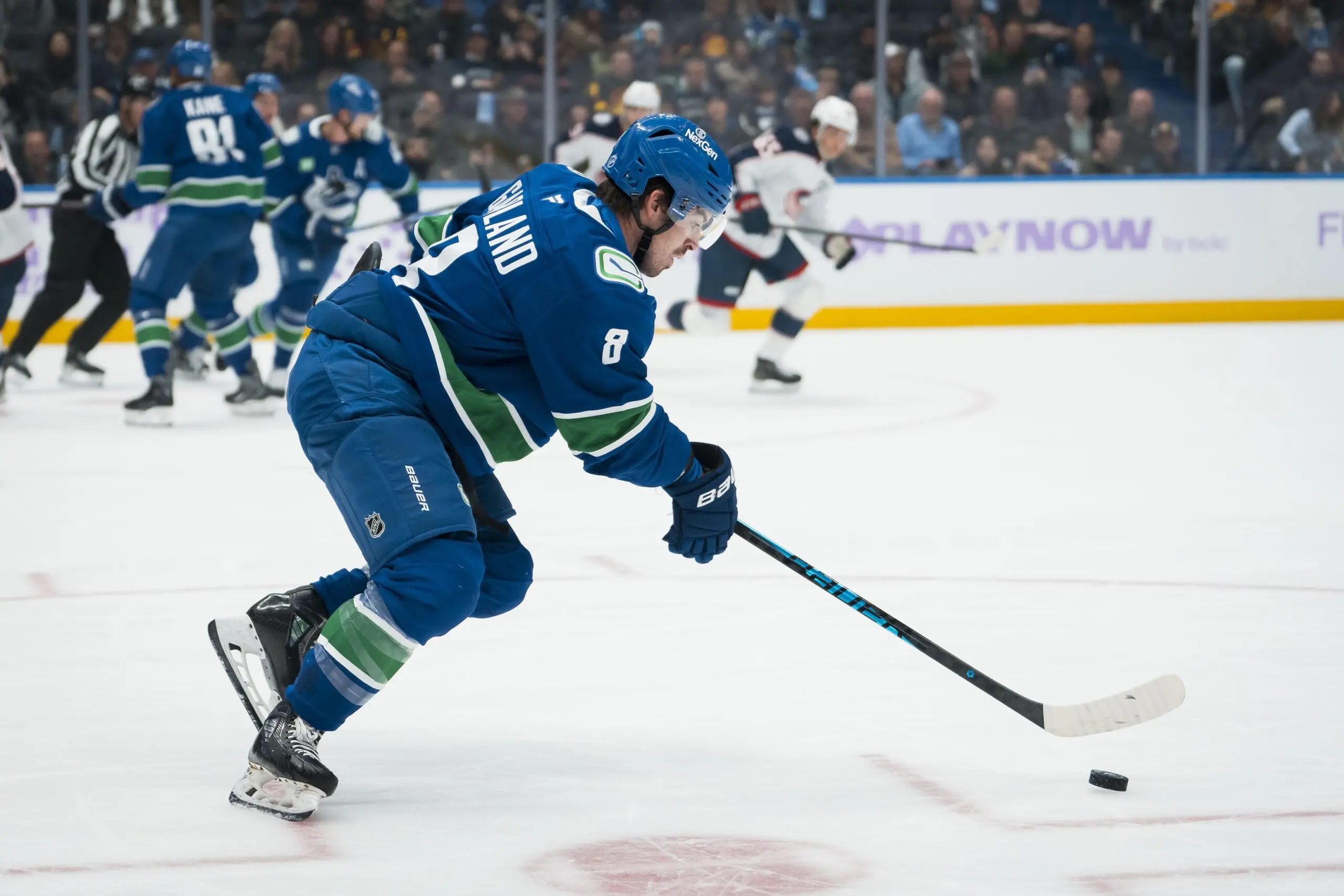
Photo credit: © Bob Frid-Imagn Images

Mar 6, 2026, 12:40 EST


After weeks of speculation about the likelihood of a trade and the potential for a return on that trade, Conor Garland has finally been dealt by the Vancouver Canucks to the Columbus Blue Jackets.
In the end, the return was a 2028 second-round pick and a 2026 third. And it’s no real surprise that the initial reactions to this deal have been mixed. For some, seeing the Canucks do something, anything, to move the rebuild in the correct direction is worth celebrating. But for others, this level of return for Garland can’t help but feel a tad disappointing.
The truth of the matter is that Vancouver fans know best that, in a vacuum, Garland should be worth more than just a second and a third. That’s probably true if we’re just talking about his production, where, prior to this season, Garland averaged close to 50 points a year with great consistency. But then, Garland has also been loaded with more intangible qualities, including an unparalleled on-ice effort, a typically high degree of defensive responsibility, and a habit of dragging his team into the fight.
Based on everything Garland had shown as a Canuck prior to this 2025-26 campaign, a second and a third does sound like a let-down. Given the uncertain nature of draft picks, it feels like the odds of Garland making a positive difference for his new team come out higher than the chances of the picks making a notable impact in Vancouver.
But the key phrase in all this was “in a vacuum.” Nothing really happens in a vacuum, and Garland’s trade happened within the grander context of the Canucks’ 2025-26 season, and within the specific context of the 2026 NHL Trade Deadline.
In the end, what it really came down to was a case of difficult timing.
It’s well known that Garland’s contract was set to change as of July 1, 2026. With his previous deal ending and his new extension beginning on that date, Garland is due a slight increase in annual cap hit, from $4.95 million to an even $6 million. More importantly, however, Garland was about to go from having no trade protection whatsoever to having a full no-movement clause until 2029.
The real context here is that Garland was about to start a new contract that had the potential to be a lot harder to move on from. At the same time, Garland is in the midst of the worst season of his career to date, with just 26 points in 50 games and just one goal post-November.
Those two pieces of reality were heading toward one another at a rapid pace, and in making this move, the Canucks have essentially chosen to make the safe play, “getting out” of the Garland contract while they were still sure they could. Especially if Garland was set to continue his lacklustre production through the rest of 2025-26, which was probably fairly likely if he remained in Vancouver.
There was risk involved in keeping Garland beyond this deadline, and avoiding that risk has value, even if Garland rebounds significantly from here in his new home in Columbus – which does seem likely.
One of the best ways to understand how the timing affected this deal is to compare it to the trade that preceded it, which sent Tyler Myers (with 50% retention) to the Dallas Stars in exchange for a 2027 second-round and a 2029 fourth-round pick.
Both Garland and Myers had some inherent value as hockey players. But if we’re being honest about who has made more impact in their time as Canucks, and who is likely to make more impact from here on out? It’s Garland, and probably by a considerable margin. Myers has some things going for him in terms of the market, including his scarce position as an RD and the big difference in salary, but Garland has outright been the Canucks’ best forward at times during his stint in Vancouver. If we go back to the vacuum, Garland should really have returned a lot more than Myers.
And yet, he didn’t. In the end, the difference in their return was the difference of a single mid-round, a third to a fourth.
Back outside of the vacuum, however, we’re looking at two very different cases of timing and an almost opposite context.
The Canucks did not need to trade Myers right now. He had a year remaining on a very reasonable $3 million AAV contract. The thinking had to be that Myers would retain most, if not all, of his trade value all the way through to next year’s 2027 deadline. It’s not as if RDs were about to suddenly become more abundant or anything like that.
Myers’ own trade protection was also about to change. This season, he has a full NMC, but as of July 1, that changed into just a 12-team modified no-trade clause. If anything, it was going to be easier for the Canucks to shop Myers around beyond this point. The direct result of that being that the Canucks had the option to just hang on to Myers if their asking price for him was not met at this time, and the direct result of that was that they got pretty close to maximum value back for him.
Garland’s tradeability was headed in the other direction, and that made it harder for the Canucks to get max value back. This deadline was far more of a deadline for moving Garland than it was for moving Myers, and that can’t help but show up in the return. The Canucks didn’t have to trade Garland here, either, with the draft and post-NMC still being options. But with decent deadline offers on the table, there was every chance that now was the best timing, and that it was only going to get harder to move him from here on out.
Chances are all but certain that the Canucks’ initial ask for Garland was higher. From what we heard, it started out over and above a first-round pick, and whittled down from there to the second and a third it eventually reached.
By late Thursday, the Canucks got to the point where they decided it was time to get what they could for Garland, rather than take on the risk of having a harder time moving him later. Whether that winds up being the right choice in the long run will have a lot to do with how Garland rebounds from here on out, how those draft picks end up, and what the Canucks are able to do with this $6 million in cap space they’ve gained.
But it won’t take that long to know that the Canucks have got out of the Garland extension before it began, and that’s the bit of timing that seemed to matter most in the end. Time will tell if this was the best move the Canucks could have made, but it was almost certainly the safest.
Sponsored by bet365


Breaking News
- Canucks: D Elias Pettersson’s impressive start is more than just passing the eye test
- What’s behind Marco Rossi’s seven-game scoring drought for the Canucks?
- Canucks Game Day: Looking to close out lengthy road trip with a win vs. Lightning
- Vancouver Canucks practice in Tampa Bay; Abbotsford signs defenceman to PTO
- Why did Canucks fans rate Aatu Räty higher than the rest of the league?

Vancouver CanucksTeam Cap Summary

Cap Summary
2026-27
2027-28
Projected Cap Hit
$87,295,050
$71,329,167
Projected Cap Space
$16,704,950
$42,170,833
Current Cap Space
$18,309,380
$42,170,833
Active Players
23/23
13/23
Draft Picks
Round
'27
'28
1
1
1
2
2
2
3
1
1