
CanucksArmy has no direct affiliation to the Vancouver Canucks, Canucks Sports & Entertainment, NHL, or NHLPA
How possible is it the Canucks don’t trade Myers, and is there any benefit to waiting it out?
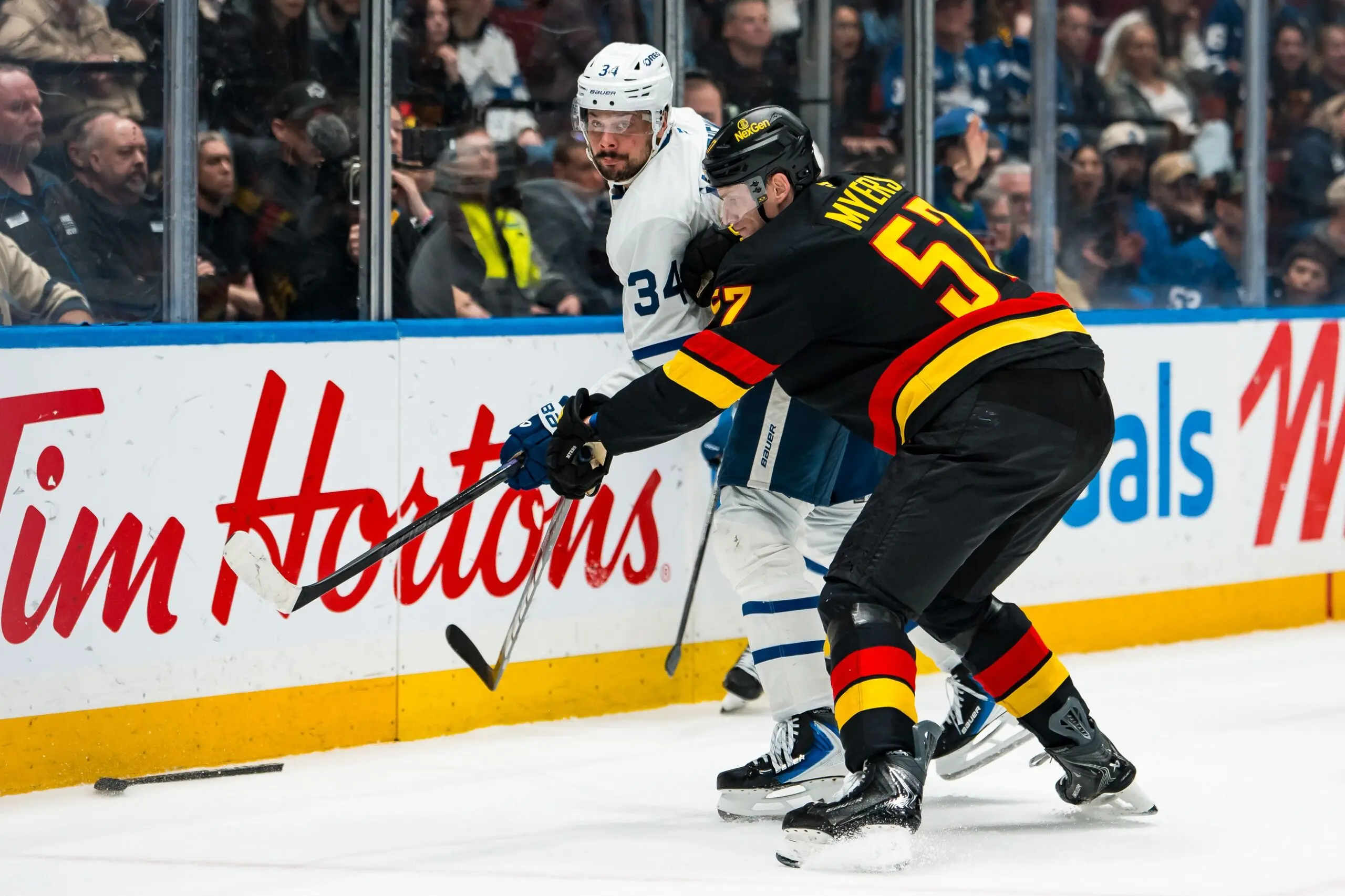
Photo credit: © Bob Frid-Imagn Images

Mar 2, 2026, 12:18 ESTUpdated: Mar 2, 2026, 12:20 EST


What happens when the inevitable becomes the uninevitable? Or is that just the “evitable”?
Usually, when a player is scratched for “roster management” purposes in the NHL, the writing is on the wall, and the writing says “Pack your bags, and soon!”
And yet, Tyler Myers has been scratched by the Vancouver Canucks for roster management purposes since Wednesday. As of this Sunday writing, he’s dressed for final-looking warmup skates, and then sat out for consecutive matchups against the Winnipeg Jets and the Seattle Kraken.
At this point, we’ve heard enough reports to cobble together a cohesive series of events. We believe that the Canucks received a legitimate offer from the Detroit Red Wings for Myers, one serious enough that they approached Myers about waiving his full no-movement clause. Myers and his family needed some time to think about such a drastic move, and thus the process of “roster management” began.
Somewhere along the line, Myers appears to have decided that Detroit is not for him. Some say this was a result of another team – namely, the Dallas Stars – entering into negotiations, and that Myers would prefer that destination. Others say that the Stars have yet to make a formal offer, and that this is more a case of Myers rejecting the Red Wings outright.
Which, if true, opens up the distinct possibility that no trade happens between now and the Friday deadline, and that at some point here Myers will somewhat awkwardly be un-scratched for roster management purposes and then be inserted back into the lineup for those regular ol’ hockey-related purposes again.
Such instances are rare, but they do happen. So, how likely is that outcome for the Canucks?
Much has been made of Myers’ changing clauses. As of now, he has that full-NMC, meaning he cannot be traded, waived, or re-assigned without his express say-so. But as of July 1, that clause turns into a modified no-trade clause, and a fairly minimal one at that, with an ability to block up to 12 destinations.
That means that Myers loses a lot of say in where he goes as of July 1. Theoretically, that means that if the Canucks were to wait until this offseason to trade Myers, they should have more available suitors.
But is that really the case? It is well-known that Myers has some family concerns that will weigh heavily on his family’s decision to move. We know that proximity to the highest-quality healthcare is vital to them. For that reason alone, there are some NHL destinations that just won’t work out for the Myerses, and probably more than 12 of them.
After seven years with the franchise, are the Canucks really going to use the opportunity of a changing clause to send Myers anywhere he truly does not want to go? We think not, and nor should they, from a moral perspective. So, the changing clause really doesn’t open up the market as much as one might think it does, and the list of realistic suitors will probably be roughly the same come this summer.
Of course, the offseason can bring change to various teams’ plans, and that could bring more interest in Myers. But with his $3 million cap hit and a preponderance of cap space available around the league, there honestly aren’t that many teams that can’t afford Myers in the present moment. That said, if anyone is going to interested in adding Myers to their 2026-27 rosters this offseason, it stands to reason that they’re also interested in adding him for their 2026 playoff run. Getting a player for two runs is always more valuable than getting them for one, and by that token, Myers should be at least slightly more valuable now than he will be this summer to those same teams.
If retention were to enter the picture, it wouldn’t really matter when it is applied. The Canucks have two slots available now, and anyone else they might use one on is a pending UFA. That means that were the Canucks to retain on Myers, he’d likely enter 2026-27 as their only retained piece, leaving two slots for alternate use.
To get back to the question posed by the headline, we can approach it from two opposite perspectives. There does not seem to be much added benefit to waiting until the offseason – or later, like at the 2027 Trade Deadline – to trade Myers. Even with his clause changing, the Canucks are likely to trade Myers somewhere he wants to go, regardless. So, waiting doesn’t really open up the door to all that many more suitors, or to much more of a bidding war.
But at the same time, waiting for a trade doesn’t really run much risk of the value dropping much, if at all. We are ultimately talking about a return in the range of a second round pick, or an equivalent prospect, and some spare change.
It’s true that teams would probably value Myers more if they acquired him now and could use him for two playoff runs, as opposed to grabbing him this summer. But how much more, and would that value show up much in a trade return? On that, we’re skeptical. If anything, waiting to trade Myers until this summer might cost the Canucks an extra small sweetener. That’s certainly not any reason to rush a decision, either on their part or on Myers.
There is also the chance, however small, that the offer actually increases come the summer. Maybe after free agency has passed, and one of the teams interested in his has missed out on some choice UFAs, they’re willing to up their offer. That may be unlikely, but it’s also possible.
In the end, the return for Myers won’t change much from right now to the offseason and right through to next year. And so, the real answer as to when Myers is likeliest to be traded is still when he and his family think it’s best.
In other words, don’t be surprised, or dismayed, if this Trade Deadline comes to pass and Myers is still Vancouver property. This is not a transaction that needs to happen right away. There’s not much benefit to waiting it out, but there’s not much risk, either.
Sponsored by bet365


Breaking News
- What’s behind Marco Rossi’s seven-game scoring drought for the Canucks?
- Canucks Game Day: Looking to close out lengthy road trip with a win vs. Lightning
- Vancouver Canucks practice in Tampa Bay; Abbotsford signs defenceman to PTO
- Why did Canucks fans rate Aatu Räty higher than the rest of the league?
- What the Canucks are getting in new trade acquisitions Jacob Quillan and Brandon Buhr

Vancouver CanucksTeam Cap Summary

Cap Summary
2026-27
2027-28
Projected Cap Hit
$87,295,050
$71,329,167
Projected Cap Space
$16,704,950
$42,170,833
Current Cap Space
$18,309,380
$42,170,833
Active Players
23/23
13/23
Draft Picks
Round
'27
'28
1
1
1
2
2
2
3
1
1