
CanucksArmy has no direct affiliation to the Vancouver Canucks, Canucks Sports & Entertainment, NHL, or NHLPA
How does Thatcher Demko fit into the Canucks’ rebuild?
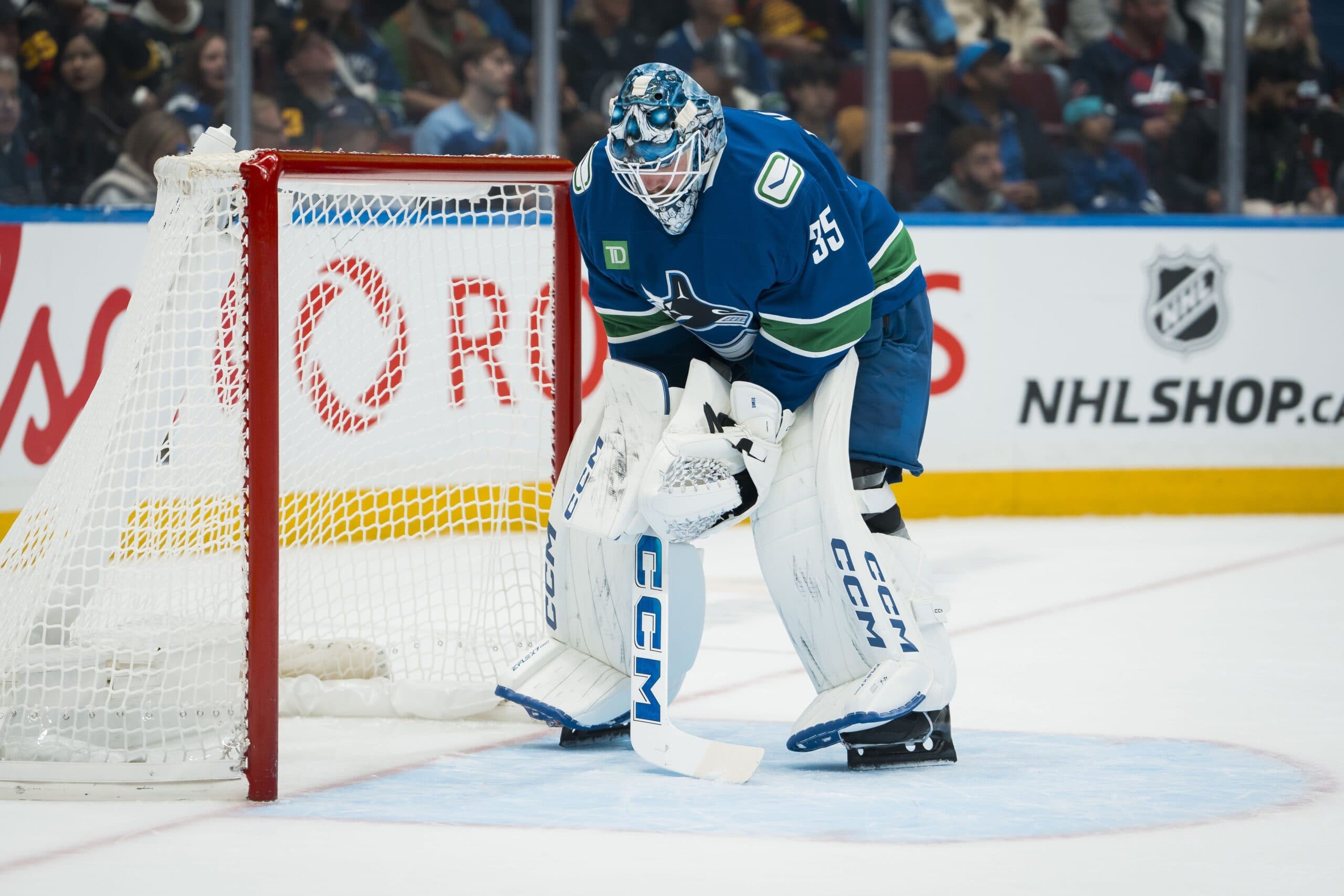
Photo credit: Bob Frid-Imagn Images

By Elijah Ford
May 27, 2026, 17:19 EDT


The Vancouver Canucks are in the early stage of their self-described rebuild. The team’s urgency to instill youth has left the roster with just six players over the age of 27 under contract for next season.
New Canucks General Manager Ryan Johnson was asked about potentially trading some of his veteran players to align with the rest of the roster, to which he calmly responded: “Nothing is off the table.” That answer prompted further questions about players such as Filip Hronek, Elias Pettersson, Brock Boeser, and Thatcher Demko, and what their future with the team may look like as they enter this rebuild.
A recent article by The Athletic’s Thomas Drance and Dom Luszczyszyn introduced a model that highlights the gap between the Canucks in their current state and a true Stanley Cup contender:
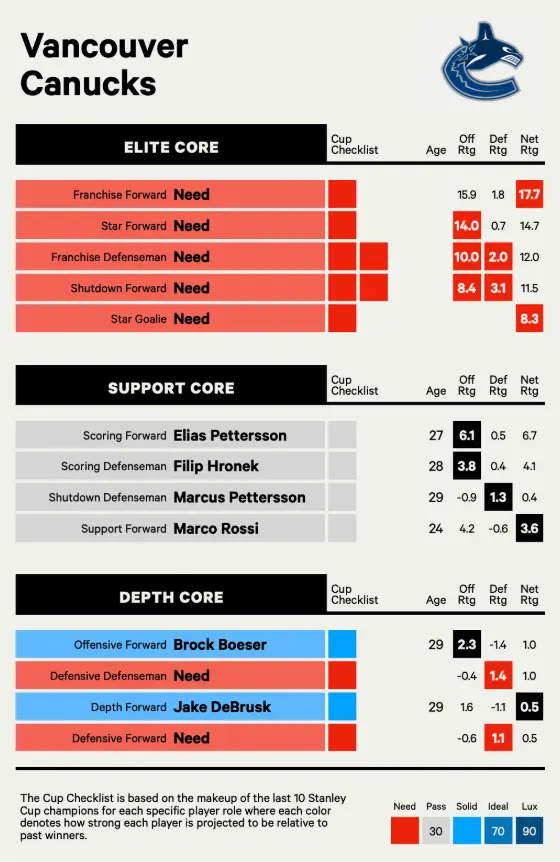
One of the model’s identified “needs” is a star goalie, even though 2024 Vezina Trophy finalist Thatcher Demko is under contract in Vancouver. It’s rare for a team to begin a rebuild with a Vezina-calibre goaltender. With so few elite options available, teams typically commit significant resources to maximizing that player’s window.
Demko, however, is not a typical case. Over the past four seasons, he has appeared in just 126 of a possible 328 games. “Extensive” hardly captures his injury history. He underwent hip surgeries in college, suffered a rare popliteus muscle injury in 2024, and is currently rehabbing from what he described as major hip surgery.
Even in ideal conditions, elite goaltending is volatile. Vezina-calibre names like Sergei Bobrovsky, Connor Hellebuyck, and Igor Shesterkin have all experienced downturns while fully healthy.
Combine that positional unpredictability with Demko’s availability concerns, and he becomes a difficult long-term foundation piece. Now in his 30s, he’s entering the back half of his prime, a timeline that doesn’t align with a rebuild expected to take three to five years. By the time the Canucks are ready to contend, Demko will likely be in his mid-to-late 30s.
Expediting the rebuild to match his window would be a mistake. History shows that building around an aging, injury-prone goaltender is not a recipe for success. Carey Price offers a clear example. After winning both the Vezina and Hart trophies in 2015, his body began to break down almost immediately. He missed most of the 2015-16 season and continued to battle injuries in the years that followed.
The Canadiens faced a familiar dilemma: an elite goalie capable of stealing games, but one whose health could no longer be trusted. They chose to retool around Price in an attempt to capitalize on his closing window. Outside of a surprising run to the 2020 Stanley Cup final, it didn’t work. Montreal failed to advance past the first round in every other post-MVP season, and eventually fell to the bottom of the standings by the time Price was gone.
The parallel is difficult to ignore.
Demko and the Canucks are operating on separate timelines. As an aging netminder, Demko likely wants to win as soon as possible. The Canucks, however, are not positioned to support that urgency under this new management regime. That leaves the organization with limited options — none of them clean.
An option that would benefit both parties is to arrange a trade to send the netminder to a contender in need of a high-end goaltender. However, that is much easier said than done, considering all the questions and concerns around Demko.
The San Diego, California native is entering a three-year extension worth $8.5 million annually, placing him among the league’s highest-paid goalies. Contenders rarely have that kind of cap space available, and even fewer are willing to commit major assets in exchange for a goaltender with significant injury risk.
Recent team-building trends only reinforce that hesitation. Successful teams have increasingly relied on affordable tandems rather than a single, expensive workhorse. Unless an unlikely trade partner emerges, the Canucks are left choosing between two imperfect paths: ride with Demko, or hedge against him with supplemental goaltending.
They’ve already explored the latter.
With Demko missing 59 games in 2024-25, Kevin Lankinen emerged as a bright spot. Signed for under $1 million, he provided stability with a 2.62 goals against average and a .902 save percentage across his 49 starts. That performance earned him a five-year extension at $4.5 million annually — a deal widely viewed as insurance against Demko’s health. At the time, it made sense. The Canucks were still trying to compete. Now, in a full rebuild, the calculus has changed; veteran stability in goal is no longer a priority.
A more logical approach is to pivot toward youth and identify and develop the next long-term solution, using Demko as a mentor when available.
The organization has options. Nikita Tolopilo showed flashes at times last season after Demko went down with an injury. A few years later, Aleksei Medvedev and Ty Young headline a group of young goaltenders with legitimate upside that could make an impact, as well as Aku Koskenvuo.
Moving Lankinen and creating NHL opportunities for that group would accelerate the evaluation process. The short-term growing pains would be manageable — and potentially even beneficial — for a team not focused on immediate results.
The alternative of leaning on Demko as a workhorse is both unnecessary and risky. Given his injury history, asking for 50-plus starts invites further setbacks. There’s also a strategic concern. At his best, Demko is good enough to keep the Canucks competitive — but not good enough, on his own, to make them contenders. And that’s a position where the Canucks have found themselves in over the last few years in the mushy middle — not good enough to make the playoffs, but not bad enough to secure a high-end draft pick.
There is no clean solution here. The situation is defined by uncertainty, and by the reality that injuries can derail even the most carefully constructed plans. Whatever path the Canucks choose, one thing should remain constant: a commitment to handling Demko’s future with respect. He has earned that much.
Sponsored by bet365


Breaking News
- Instant Reaction: Brady Tkachuk scores late hat trick in Canucks’ overtime loss to Florida
- Canucks trade Aatu Räty to Maple Leafs for forwards Jacob Quillan and Brandon Buhr
- What’s behind the early struggles from Canucks’ Zeev Buium and Filip Hronek?
- Canucks’ Räty clears NHL waivers, will report to AHL Abbotsford
- Blackfish: Romani opens strong, Cootes continues to impress and Malhotra shows his offensive potential

Vancouver CanucksTeam Cap Summary

Cap Summary
2026-27
2027-28
Projected Cap Hit
$87,295,050
$71,329,167
Projected Cap Space
$16,704,950
$42,170,833
Current Cap Space
$18,206,519
$42,170,833
Active Players
23/23
13/23
Draft Picks
Round
'27
'28
1
1
1
2
2
2
3
1
1