
CanucksArmy has no direct affiliation to the Vancouver Canucks, Canucks Sports & Entertainment, NHL, or NHLPA
Canucks: What NHL history tells us about Elias Pettersson’s decline
Photo credit: © Bob Frid-Imagn Images

By Elijah Ford
Jul 30, 2026, 17:00 EDTUpdated: Jul 30, 2026, 15:40 EDT


After only his rookie season, few doubted Elias Pettersson would become a longtime NHL superstar. Wayne Gretzky said after Pettersson’s first year in the NHL that his raw hockey IQ and playmaking ability reminded him of himself and Sidney Crosby. In Pettersson’s first six NHL seasons, he won the Calder Trophy, made four NHL All-Star teams and looked like the unquestioned No. 1 centreman in Vancouver for years to come.
Then, in 2024, almost inexplicably, his point totals began to decline. Before the All-Star break that year, Pettersson was averaging 1.31 points per game, putting him on pace for a 107-point season. After that mark, he averaged just 0.75 points per game, the equivalent of a 61-point season.
Since then, Pettersson hasn’t been able to return to being one of the NHL’s preeminent scorers. Over his past two seasons, his points-per-game rate has dropped to 0.70, with long, lifeless stretches of play that have left Canucks fans scratching their heads. Many have wondered whether there is any precedent in NHL history for a player experiencing such a steep decline in his seventh and eighth seasons, typically the years when elite players are expected to be entering their absolute prime.
Some have pointed to Nathan MacKinnon as a comparable career arc. After winning the Calder Trophy in his rookie season, MacKinnon struggled over the next three years with the Colorado Avalanche, failing to reach the 55-point mark in any of them. The hair in the soup for this comparison, however, is that sophomore slumps and early-career struggles are relatively common. MacKinnon’s may have been more pronounced than most, but he did not have nearly the extended NHL résumé that Pettersson had before his decline.
In fact, only 100 players in NHL history have averaged at least a point per game through their first six seasons, and Pettersson is one of them. Because Pettersson’s decline has felt so unusual, we wanted to determine just how rare it actually is. We compared every player on that list and measured the drop in production between his first six NHL seasons and the following two. The results illustrated just how dramatic Pettersson’s decline has been.
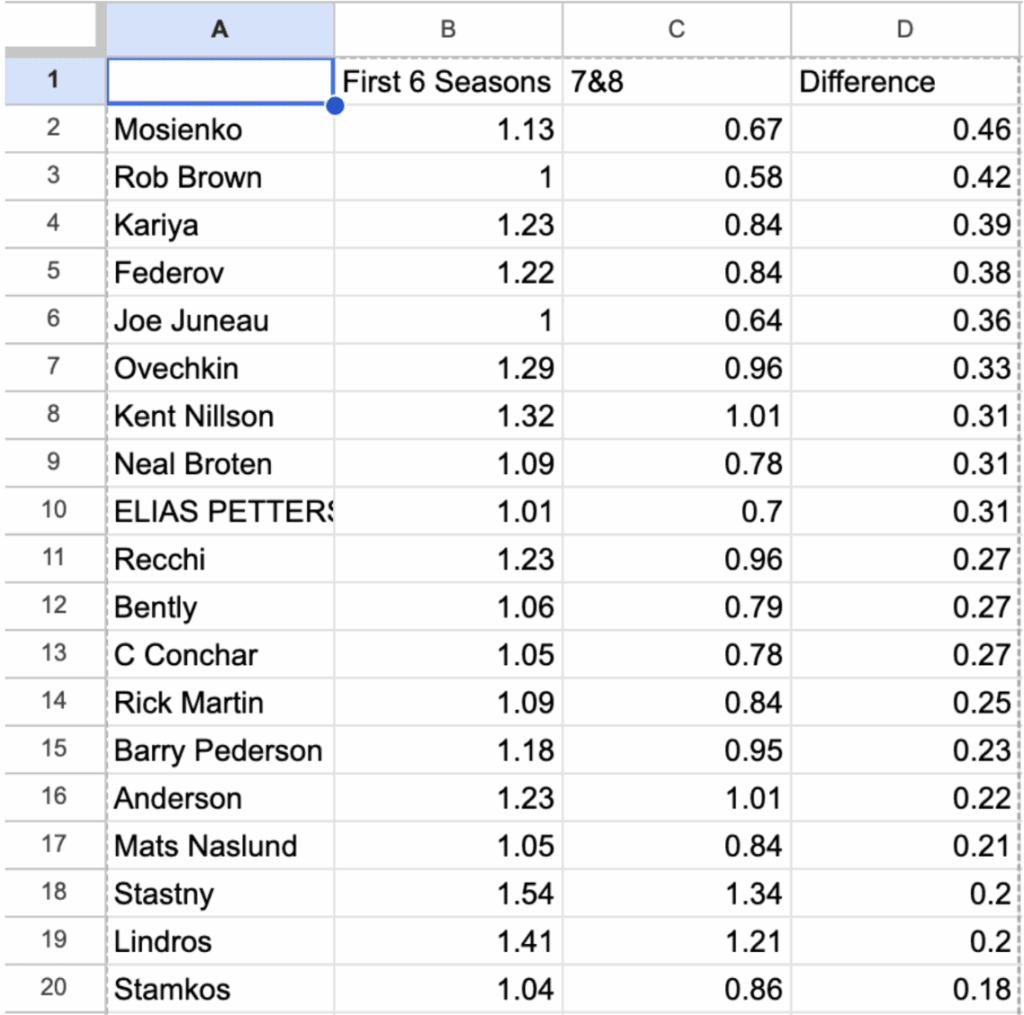
Pettersson is tied for the seventh-largest drop-off in NHL history between a player’s first six seasons and the subsequent two. It is certainly not a list anyone wants to be on, but the names above him provide important context.
Two of the six players ahead of Pettersson saw their careers derailed by major injuries (Mosienko: broken leg; Kariya: concussions). Although some still wonder whether Pettersson’s knee tendinitis, which first surfaced in early 2024, continues to linger, he has not suffered an injury anywhere near the severity of those examples. Pettersson missed only eight games last season, making it difficult to attribute his decline primarily to injury.
Another two players on the list, Rob Brown and Joé Juneau, benefited from unique circumstances early in their careers. Brown enjoyed much of his offensive success while playing alongside Mario Lemieux and, outside of one productive season with the Hartford Whalers, never again approached those numbers. Juneau, meanwhile, peaked during his 25-year-old rookie season while playing with Adam Oates and benefiting from Ray Bourque on the back end. Few would argue that Pettersson wasn’t driving play himself during his best seasons, as his playmaking consistently elevated the production of the wingers around him.
That leaves two players whose declines most closely resemble what we’ve seen from Pettersson: Alex Ovechkin and Sergei Fedorov. Both are all-time legends who rank among the greatest players in NHL history. So why did they experience such significant declines in the middle of their primes? In both cases, the answer lies largely in the coaching philosophies and systems that surrounded them.
In Fedorov’s case, under Scotty Bowman, the Detroit Red Wings gradually evolved from a young, free-flowing team led by the Russian Five into a structured, four-line, shutdown-style club during the dead-puck era. Ovechkin, meanwhile, transitioned from Bruce Boudreau’s offence-first approach to Dale Hunter’s far more defensive-minded system.
Coincidentally, the most productive season of Pettersson’s career came in 2022-23, when Boudreau began the year behind Vancouver’s bench. Midway through that season, Boudreau was replaced by Rick Tocchet, whose conservative, dump-and-chase, defence-first system represented a significant philosophical shift.
In Tocchet’s box-and-one defensive-zone system, the centreman carries tremendous responsibility to support the play and protect the middle of the ice. That requires constantly balancing opportunities to jump into the rush and create offence while ensuring defensive responsibilities are not neglected. It is reasonable to believe Tocchet emphasized the defensive side of the position more than Pettersson’s previous coaches had. His dump-and-chase system also limited Pettersson’s opportunities to create offence off the rush.
Some might point out that Pettersson continued producing at an elite level early in Tocchet’s first full season in 2023-24. The difference was that much of that production was fuelled by unsustainably high shooting percentages. His three most common five-on-five linemates before the All-Star break — Brock Boeser (22.4%), Nils Höglander (22.6%) and Ilya Mikheyev (10.9%) — combined to shoot 18.6%, well above the NHL average of 11.9% that season. Once those percentages inevitably regressed, Pettersson’s point totals followed.
The following season was when Pettersson’s struggles truly became apparent. Tocchet’s conservative system, combined with a rapidly deteriorating roster and instability surrounding the team, contributed to the lowest offensive production of his career to that point. The next season, Tocchet’s defensive-focused assistant, Adam Foote, was promoted to head coach. Foote’s ineffective structure, coupled with a team that increasingly shifted toward rebuilding late in the season, created an environment in which few players thrived, particularly one already struggling offensively.
Is coaching entirely to blame for Pettersson’s decline? Absolutely not. As mentioned, the quality of his teammates, off-ice circumstances, and his own inability to consistently drive play have all contributed to one of the most unusual declines in recent NHL history. At the same time, it is noteworthy that the two all-time greats whose career arcs most closely resemble Pettersson’s were also heavily influenced by changes in coaching philosophy and the personnel around them.
Canucks fans hope new head coach Manny Malhotra and a refreshed young roster can reignite the offensive spark that has largely been absent from Pettersson’s game for nearly three years. Perhaps Malhotra could have a similar effect to what Barry Trotz had on Ovechkin, whose arrival helped spark a return to consistent 50-goal form following his own two-year slump. It is equally possible, however, that Pettersson follows a path more similar to Fedorov, who evolved into one of the NHL’s premier two-way centres while averaging roughly 65 points per season during a low-scoring era.
Pettersson’s decline has been steep, but not unprecedented. The next few seasons will determine whether his career is ultimately viewed more like those of Ovechkin and Fedorov — all-time legends who adapted their games to changing circumstances — or players such as Joé Juneau, Kent Nilsson and Neal Broten, who were never able to recapture the offensive heights of their early careers. Pettersson has reached a major crossroads, and it will be fascinating to see which path he follows.
Sponsored by bet365


Breaking News
- 10 statistics that stand out from the first 10 Canucks games
- Could the Vancouver Canucks and Ottawa Senators hook up on an in-season forward trade?
- The Statsies: Canucks dominated at 5v5 in 4-2 loss to Lightning
- The Stanchies: Prime Lankinen returns, Canucks still go winless on road trip with 4-2 loss to Lightning
- Instant Reaction: Canucks give up four unanswered goals in 4-2 loss to Lightning

Vancouver CanucksTeam Cap Summary

Cap Summary
2026-27
2027-28
Projected Cap Hit
$87,295,050
$71,329,167
Projected Cap Space
$16,704,950
$42,170,833
Current Cap Space
$18,518,630
$42,170,833
Active Players
23/23
13/23
Draft Picks
Round
'27
'28
1
1
1
2
2
2
3
1
1