
CanucksArmy has no direct affiliation to the Vancouver Canucks, Canucks Sports & Entertainment, NHL, or NHLPA
What will carrying three goalies on their roster actually mean for the Canucks?
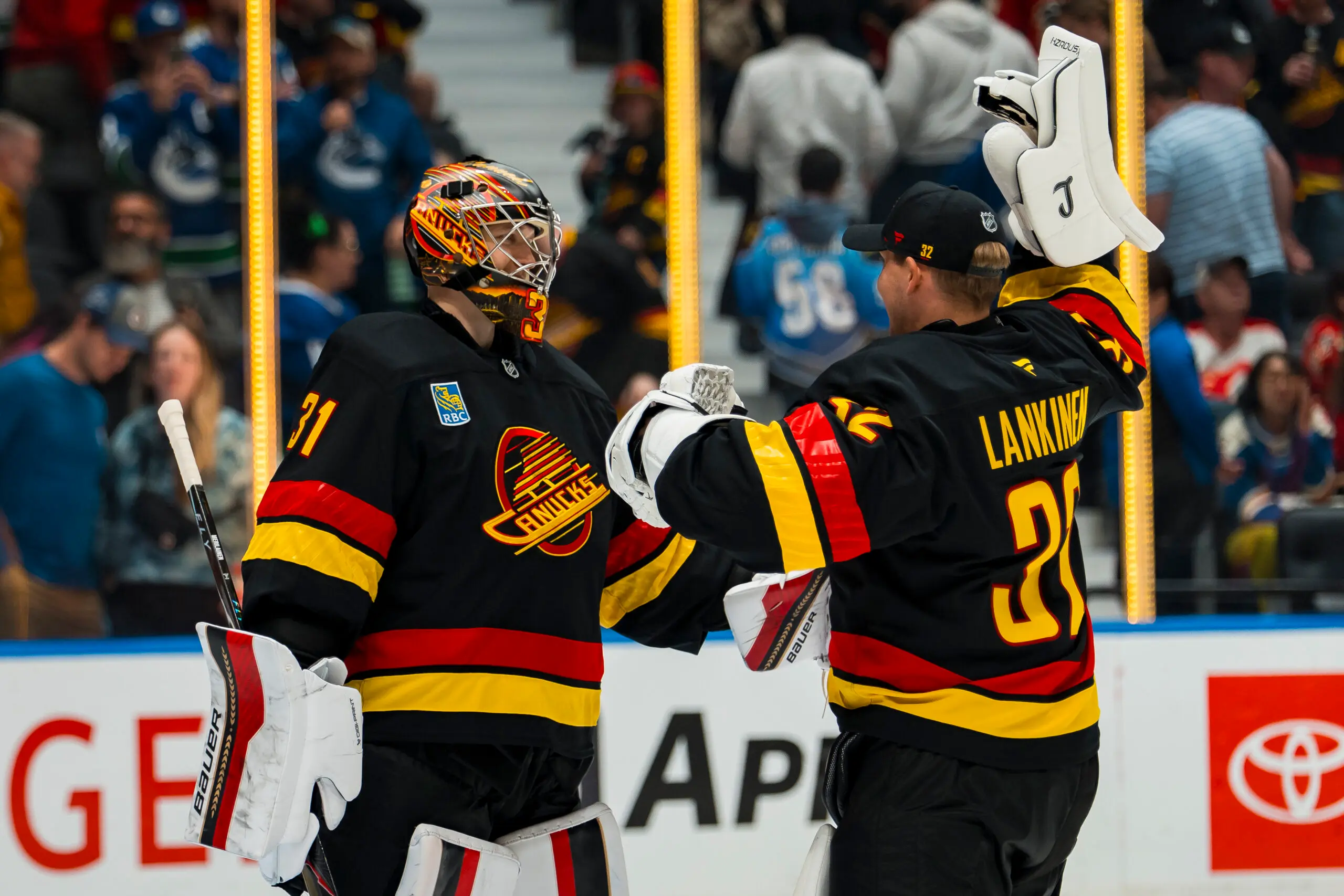
Photo credit: Bob Frid-Imagn Images

By Elijah Ford
Nov 5, 2026, 08:00 ESTUpdated: Nov 4, 2026, 22:42 EST


When the Vancouver Canucks claimed Leevi Meriläinen off waivers from the Ottawa Senators just before the season began, the expectation was that the young Finnish goaltender would provide upside and insurance behind Kevin Lankinen. A few weeks into the season, that decision is shaping up to be a home run.
Meriläinen has taken full advantage of his opportunity, emerging as Vancouver’s most reliable goaltender while Lankinen has struggled mightily. But the eventual return of Thatcher Demko later this year presents an interesting predicament for the Canucks’ front office.
Lankinen has a full no-movement clause in his contract this season, meaning he cannot be sent to the minors or traded without his permission. Meanwhile, Meriläinen would have to clear waivers to be assigned to Abbotsford, something that could be difficult to accomplish given his current performance and potential. That leaves Vancouver facing the possibility of being forced to carry three goaltenders on its NHL roster for the rest of the season.
Although the situation isn’t necessarily unprecedented around the league, it presents some unique challenges for a Canucks organization still in the early stages of its rebuild. So what would carrying three NHL goaltenders actually mean for Vancouver? There are three areas worth examining: the salary cap, roster construction, and, perhaps most importantly, playing time.
1. The salary cap dynamics
The good news for Vancouver is that carrying three goaltenders isn’t going to create an immediate salary-cap problem.
Being at the start of a rebuild means the Canucks aren’t particularly pinched for cap space at the moment. According to PuckPedia, Vancouver currently has approximately $19.3 million in cap space, with its three goaltenders accounting for a combined $14.1 million in cap commitments.
Importantly, Demko’s $8.5 million cap hit is already included in that figure, despite his current placement on injured reserve. His eventual return won’t suddenly add another $8.5 million to Vancouver’s books. The more interesting financial implications come next season.
Meriläinen is currently playing on a relatively inexpensive one-year, $1.1 million contract that expires after this season, making him a restricted free agent in July. If he continues performing at his current level, it’s reasonable to expect a significant pay increase for the Finnish goaltender.
For the sake of discussion, let’s assume Meriläinen receives a three-year contract worth approximately $4 million annually. That would leave Vancouver with roughly $17 million committed to three goaltenders through the final season of Demko’s current contract in 2028-29. Although the NHL’s projected salary-cap increases could make that number more manageable, committing that much money and resources to one position isn’t necessarily ideal for a rebuilding team that still has several roster holes to address.
If the Canucks eventually decide that carrying three goaltenders isn’t a viable long-term solution, they’ll have a few different options. Lankinen is probably the most logical candidate to move.
At 31, the Finnish goaltender is the oldest of Vancouver’s three options and has struggled considerably to start the season. But with his $4.5 million cap hit running through the 2029-30 season and his no-movement clause, his contract could be difficult to move. However, an opportunity is coming up.
Lankinen’s full no-movement clause only covers the first two seasons of his contract. Beginning in the 2027-28 season, that protection changes to a 15-team no-trade clause. That would give Vancouver more flexibility to explore the trade market. Retaining a portion of his salary could also make him a more attractive option for potential trade partners.
Demko presents a different situation entirely. When healthy, he has demonstrated that he can be one of the NHL’s best goaltenders. His injury history, however, has become increasingly difficult to ignore. The 30-year-old is signed through 2028-29, with an $8.5 million cap hit and a full no-movement clause throughout the contract.
While Demko would likely be a more appealing trade asset than Lankinen based on his track record, his injury concerns and contractual protection make that scenario difficult to envision. Ultimately, Demko’s future is largely in his own hands. If he wants to remain in Vancouver, the organization will have to find a way to make the financial situation work.
2. Roster space — who gets moved?
While the salary cap isn’t an immediate concern, Vancouver’s active roster presents a much more pressing problem. NHL teams are allowed a maximum of 23 players on their active roster. The Canucks have carried 13 forwards, eight defencemen, and two goaltenders this season, putting them at that limit.
Once Demko is healthy enough to return, Vancouver will have to clear a roster spot to accommodate him. There are a few different ways the front office could approach that decision.
Victor Mancini
The easiest option from a waiver perspective would be sending Victor Mancini to Abbotsford. The young defenceman is currently waiver-exempt, with approximately 14 NHL games remaining before he becomes eligible. That means Vancouver could assign him to the AHL without risking another team claiming him.
Mancini’s season in Vancouver hasn’t exactly gone smoothly, and a stint in Abbotsford could provide an opportunity to rebuild some confidence while receiving more meaningful minutes. It would also allow him to help an Abbotsford team that has been playing some excellent hockey. However, there is another consideration.
Ryan Johnson has previously emphasized an anti-yo-yo approach when it comes to developing young players. Constantly moving prospects between the NHL and AHL can make it difficult for them to establish consistency. If the organization believes Mancini is better served remaining with the NHL group, it may look elsewhere for a roster solution.
Guillaume Brisebois
The other obvious candidate is Guillaume Brisebois. The 29-year-old defenceman has just 32 career NHL games to his name and is currently waiver-eligible. Vancouver could attempt to send him through waivers and assign him to Abbotsford. Given his limited NHL experience and place on the organizational depth chart, there’s a reasonable chance he could clear.
That would allow the Canucks to keep Mancini with the NHL group while maintaining defensive depth in the organization. Of course, there is always a risk that another team claims Brisebois, something the front office would have to weigh before making the move. Vancouver could also consider moving a forward rather than a defenceman, depending on how Malhotra wants to structure his lineup. Regardless, carrying three goaltenders means somebody is eventually going to lose their spot on the active roster.
3. Playing time — how does Malhotra balance three goaltenders?
Perhaps the most fascinating part of this situation is how Malhotra will distribute playing time once all three goaltenders are available. Meriläinen has already established himself as Vancouver’s preferred option currently, and the numbers help explain why.
According to MoneyPuck’s goals-saved-above-expected metric, Lankinen ranks last among qualified goaltenders at minus-15. Meriläinen is above average in the same metric, sitting at 0.6 despite playing behind the same defence. Malhotra has been particularly impressed with the young goaltender’s ability to handle the increased responsibility.
When asked why Meriläinen had been given four straight starts before their game against the Toronto Maple Leafs, Malhotra bluntly answered: “He gives us an opportunity to win every night.” That makes the eventual return of Demko an even more interesting development.
Although Demko is the most experienced and accomplished goaltender of the three, Vancouver will have to be incredibly careful with how it manages his workload. He’s coming off major hip surgery and has missed significant time over the past two seasons because of recurring lower-body injuries. The organization has already made it clear that it doesn’t intend to rush his return, with Henrik Sedin previously indicating that the team’s goal is to have Demko back around Christmas.
Even once he is cleared to play, it’s unlikely Vancouver immediately hands him a traditional starting workload. The Canucks will need to give him time to regain his conditioning and establish that he can handle the demands of an NHL season. There’s also the development aspect to consider.
Meriläinen is just 24 and has shown he deserves an increased NHL workload. With Vancouver focused on the long-term future, giving him consistent opportunities at the NHL level could be incredibly valuable. That leaves Lankinen in a particularly uncomfortable position.
After signing a five-year contract worth $22.5 million in February 2025, the expectation was that he would provide Vancouver with some stability in the crease while Demko dealt with his injury problems. Instead, he’s now being outplayed by a younger, cheaper goaltender and could eventually find himself third on the depth chart.
Keeping three goaltenders means somebody is going to have to sacrifice playing time. If Meriläinen continues earning the majority of starts and Demko gradually works his way back into the lineup, Lankinen could be left with very few opportunities to play.
That creates a difficult situation for both the coaching staff and the player. How does Malhotra keep three goaltenders prepared to play when only two can dress on any given night? And how long can Vancouver realistically maintain that arrangement before something has to give?
Rather than establishing a predetermined percentage split, Vancouver would likely benefit from keeping the rotation relatively fluid:
Meriläinen should continue receiving a significant portion of the starts, particularly while he’s playing well.
Demko should gradually work his way into the rotation as his health and conditioning allow, with his workload increasing only when the organization is confident he can handle it. Until that happens, he should only suit up in games he’s going to start. At this point in his career, with all of his injuries, there’s next to no value in having him serve as the backup on non-starting nights.
Lankinen could provide additional insurance and receive occasional starts, but his role would become increasingly difficult to justify if his performance doesn’t improve.
Having three NHL-calibre goaltenders available does provide some benefits, particularly when it comes to injury protection and workload management. However, those benefits only go so far. Eventually, the Canucks will have to make a decision about which goaltenders they want to build around.
Conclusion
Ultimately, carrying three goaltenders isn’t going to cripple the Canucks financially, particularly with the amount of cap space they currently have available. The bigger challenges will be finding room on the active roster and ensuring that all three goaltenders are receiving enough playing time to remain effective.
For now, keeping all three might be the most practical solution. Meriläinen has earned an extended opportunity, Demko needs time to recover, and moving Lankinen isn’t particularly straightforward given his contractual protection.
But as Vancouver continues through its rebuild, the organization will eventually have to determine which goaltenders fit into its long-term plans. One thing is becoming increasingly clear: Meriläinen’s emergence has made an already complicated situation even more interesting.
Sponsored by bet365


Breaking News
- What will carrying three goalies on their roster actually mean for the Canucks?
- Agent confirms ex-Canuck Evander Kane will be signing in KHL
- Ex-Canucks Mason Raymond and Jeremy Colliton part of WHL expansion ownership group
- Blackfish: Malhotra & Novotný play hero, Romani continues his goal scoring streak, and more
- A look at the Canucks’ five fights vs. Anaheim with insights from Sasson, Malhotra, and more

Vancouver CanucksTeam Cap Summary

Cap Summary
2026-27
2027-28
Projected Cap Hit
$87,993,412
$71,329,167
Projected Cap Space
$16,006,588
$42,170,833
Current Cap Space
$19,653,659
$42,170,833
Active Players
23/23
13/23
Draft Picks
Round
'27
'28
1
1
1
2
2
2
3
1
1