
CanucksArmy has no direct affiliation to the Vancouver Canucks, Canucks Sports & Entertainment, NHL, or NHLPA
What a $127.5 million NHL salary cap could mean for the Canucks in 2028-29
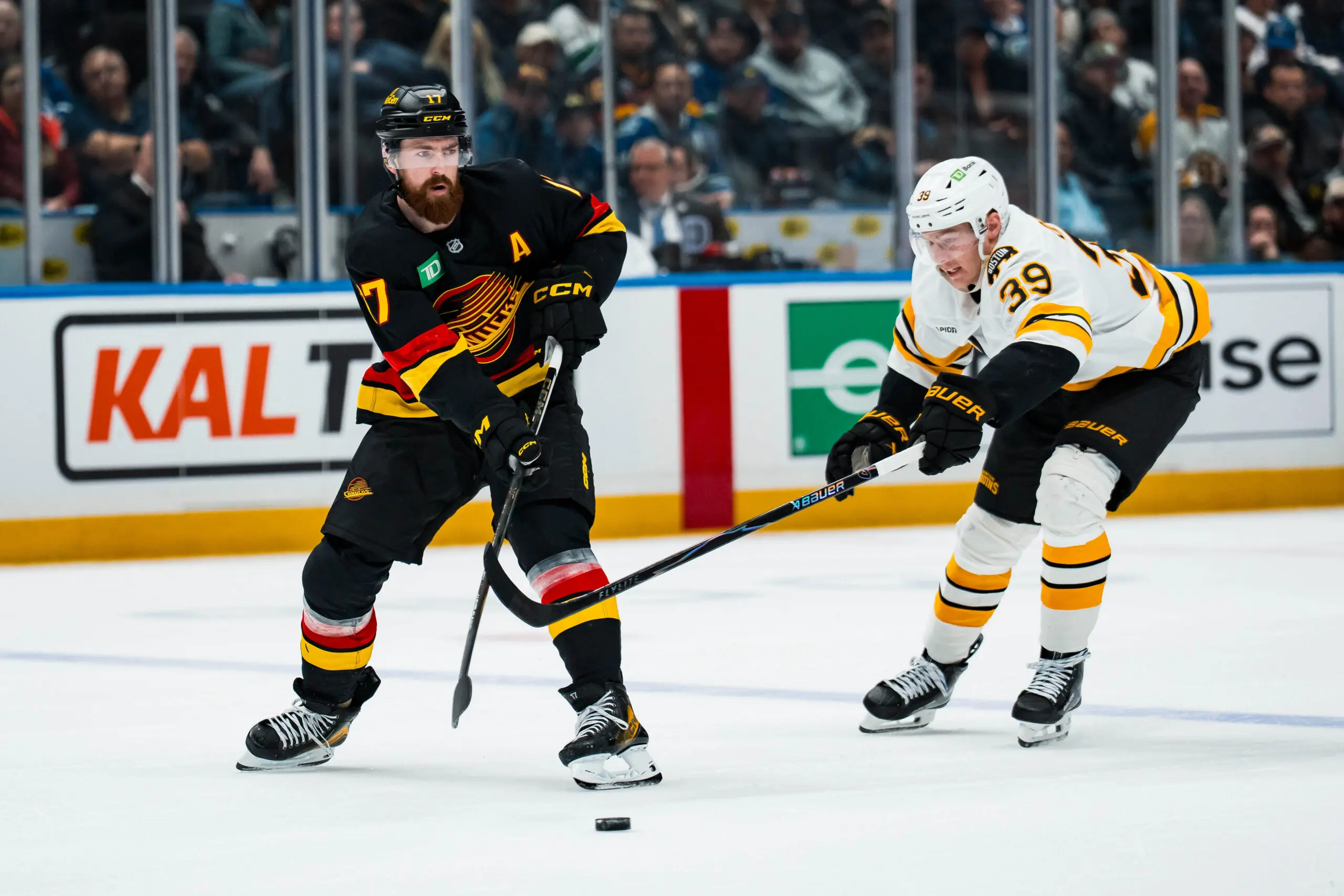
Photo credit: Bob Frid IMAGN IMAGES via Reuters Connect

Oct 7, 2026, 13:30 EDTUpdated: Oct 7, 2026, 13:31 EDT


Prior to the start of the current 2026-27 season, Sportsnet’s Elliotte Friedman reported that the NHL salary cap will rise to $127.5 million starting in the 2028-29 season.
The NHL salary cap is already at record highs, as the league and the NHLPA are in year two of a three-season agreement that has seen the upper limit rise to $95.5 million in 2025-26, $104 million this season, $113.5 million next season, and, as Friedman wrote, if the 2028-29 guesstimate holds, it would also be the largest season-to-season jump of the NHL salary cap era, at $14 million.
Naturally, one of our first thoughts was what such a jump would represent for the Vancouver Canucks. Let’s dive in.
Canucks’ long-term commitments
First, a reminder of the Canucks’ contract commitments still on the books in 2028-29, courtesy of Puck Pedia.
Forwards
Elias Pettersson: $11.6 million, 4 years remaining (including in 28-29)
Brock Boeser: $7.25 million, 4 years remaining
Jake DeBrusk: $5.50 million, 3 years remaining
Brock Boeser: $7.25 million, 4 years remaining
Jake DeBrusk: $5.50 million, 3 years remaining
Defencemen
Filip Hronek: $7.25 million, 4 years remaining
Zeev Buium: $9.38 million, 7 years remaining
Zeev Buium: $9.38 million, 7 years remaining
Goaltenders
Kevin Lankinen: $4.5 million, 1 year remaining
Between now and the start of 2028-29, the Canucks will almost certainly sign restricted free agents Tom Willander and Elias Junior Pettersson. Up front, they’ve got Jonathan Lekkerimäki, Liam Öhgren, and Aatu Räty, all of whom will be RFAs at the end of this upcoming season. The Canucks will also have to decide on Marco Rossi, who will need a new contract for the 2028-29 season. But for today’s purposes, we’ll focus on the Canucks’ long-term commitments and how they fit into the NHL’s rising salary cap. In particular, what percentage of the cap these commitments will take up in 2028-29 at a $127.5 million upper limit.
Cap percentage of each of the Canucks’ commitments
Elias Pettersson
Percentage of salary cap in year one of contract (2024-25): 13.18%
Percentage of salary cap this season: 11.15%
Percentage of salary cap in 2028-29 (at $127.5 million): 9.09%
Percentage of salary cap this season: 11.15%
Percentage of salary cap in 2028-29 (at $127.5 million): 9.09%
We begin with Elias Pettersson for a couple of reasons. The first is that Pettersson’s contract has been heavily discussed, particularly because his play has declined since the start of the contract. A $127.5 million salary cap means that Pettersson’s contract becomes much less of a talking point in the market, as taking up 9.09% of the total cap is about what you can expect a second-line centre to make. And if Pettersson can build off of what he’s shown through his first four games of the 2026-27 season? The contract will become even more desirable for the Canucks.
Which leads us to the second point: Pettersson’s contract, even if he hovers around a 60-70 point centre with solid two-way ability, could become one teams look to trade for as soon as this season. July 1st free agency is becoming more and more watered down, and buying teams have made it clear that they’ll pony up to get a player they feel can help their team win. If Pettersson’s contract stops being a hurdle (and even becomes a positive in the conversation around him), trade interest could easily renew and give the rebuilding Canucks something to think about in the coming seasons.
Brock Boeser
Percentage of salary cap in year one of contract (2025-26): 7.59%
Percentage of salary this season: 6.97%
Percentage of salary cap in 2028-29: 5.68%
Percentage of salary this season: 6.97%
Percentage of salary cap in 2028-29: 5.68%
It’s obviously a similar story for Boeser, but as a winger (who is also two years older than Pettersson), his trade value would be lower than Pettersson’s. The need to trade Pettersson (and Filip Hronek, who we’ll talk about later) really stems from two things. First, the Canucks getting an offer they can’t refuse, and second, them identifying that with Caleb Malhotra, Braeden Cootes, and other young players still not even drafted, forming their next nucleus, they must weigh the pros of keeping current players into their 30s vs. trading them for pieces that better fit their competitive timeline.
When the Canucks do that exercise with Boeser, it would be hard to imagine they’d get an offer they flat-out can’t refuse. So what his cap hit in a rising salary cap world really means for the Canucks is probably that they get to see Boeser finish his career as a Canuck with minimal impact on their broader picture during their contending years, when Boeser’s cap hit will take up the percentage that we’ll likely see middle-six wingers being paid anyway.
Jake DeBrusk
Percentage of salary cap in year one of contract (2024-25): 6.25%
Percentage of salary this season: 5.29%
Percentage of salary cap in 2028-29: 4.31%
Percentage of salary this season: 5.29%
Percentage of salary cap in 2028-29: 4.31%
The chances of Jake DeBrusk still being a Canuck by 2028-29 feel a bit slim at this current juncture, so we won’t spend too much time on him. His contract’s cap hit wasn’t much of a hindrance when it was originally signed, and will only look better as time goes on. Any acquiring team knows that, as do the Canucks.
Filip Hronek
Percentage of salary cap in year one of contract (2024-25): 8.24%
Percentage of salary this season: 6.97%
Percentage of salary cap in 2028-29: 5.68%
Percentage of salary this season: 6.97%
Percentage of salary cap in 2028-29: 5.68%
Now we get to the real doozy. What could a salary cap of $127.5 million mean for the Canucks? Well, it means that, in Filip Hronek, they might have one of the absolute best value contracts in the league by the time 2028-29 turns around.
I’ve made it clear in previous writings that while I can understand the Canucks’ thought process for wanting to keep Hronek around the young defencemen for this year and maybe even next, the club would likely be wise to deal Hronek before or during the 2028 offseason in a trade for assets that better fit their competitive timeline. Hronek will be heading into his age 31 season, and while there is little doubt that he’ll still be an effective defenceman at that time, the value of the pieces the Canucks manage to get in return for him outweighs the value he’d bring to the still-hopefully-rebuilding Canucks.
That is, of course, with the expectation that Hronek’s trade value would still be sky-high and that the Canucks find a trade they can view through the lens of “does this trade help us get closer to building a team that can consistently compete for Stanley Cups?” and find the answer to be a resounding yes. Finding such a trade should get a whole lot easier with Hronek taking up just 5.68% of the total salary cap in 2028-29.
Zeev Buium
Percentage of salary cap in year one of contract (2027-28): 8.26%
Percentage of salary this season: Still on ELC
Percentage of salary cap in 2028-29: 7.35%
Percentage of salary this season: Still on ELC
Percentage of salary cap in 2028-29: 7.35%
Lastly, we get to Zeev Buium, the Canucks’ most recent long-term contract commitment.
The Canucks, particularly general manager Ryan Johnson, were upfront about the club’s thought process when signing Buium, who turns 21 in December, to such a big contract.
“Yeah, it was something that we really batted around a lot and wondered, okay, what really is our threshold at the end of the day to make an investment like this in a player with 70-some games that is very early in his development?” Johnson said shortly after the deal was signed. “If you had asked me five years ago if I would ever have considered something like this, my answer would have been immediately no. But I didn’t want to get caught up in some archaic thinking of this, I wanted to get aggressive enough to know where the landscape is going. If we could sit and really have a conversation about Zeev the player, but also the person, and we could get to a number that maybe we felt that is maybe admittedly overpaying right now, but being a really good deal down the road, we were aggressive in exploring this as much as we could to see if we could get something done.”
The Canucks might have a steal on their hands with Buium by the 2028-29 season, and they might really come out ahead if the NHL salary cap continues to skyrocket. Of course, a lot of this depends on whether Buium hits as a true top pairing defenceman. We simply don’t know if that will be the case yet, and we also have no real idea when we will definitively know the answer.
READ NEXT: Breaking down how the Canucks have had so much success on the counterattack
Sponsored by bet365


Breaking News
- Canucks Game Day: Can new lines help snap the losing streak in Anaheim?
- What positive steps forward is the Canucks’ rebuild making this season?
- Leevi Meriläinen adjusting well to starting duties for Canucks, but he wants to win
- 3 Canucks Stars of the Week: Jonathan Lekkerimäki a bright spot amid losing streak
- Abbotsford Weekly: Hats fly for newcomer Jacob Quillan as Canucks sweep Wranglers

Vancouver CanucksTeam Cap Summary

Cap Summary
2026-27
2027-28
Projected Cap Hit
$87,295,050
$71,329,167
Projected Cap Space
$16,704,950
$42,170,833
Current Cap Space
$19,405,750
$42,170,833
Active Players
23/23
13/23
Draft Picks
Round
'27
'28
1
1
1
2
2
2
3
1
1