


Arshdeep Bains with a buzzer beater!

CanucksArmy has no direct affiliation to the Vancouver Canucks, Canucks Sports & Entertainment, NHL, or NHLPA
Breaking down how the Canucks have had so much success on the counterattack
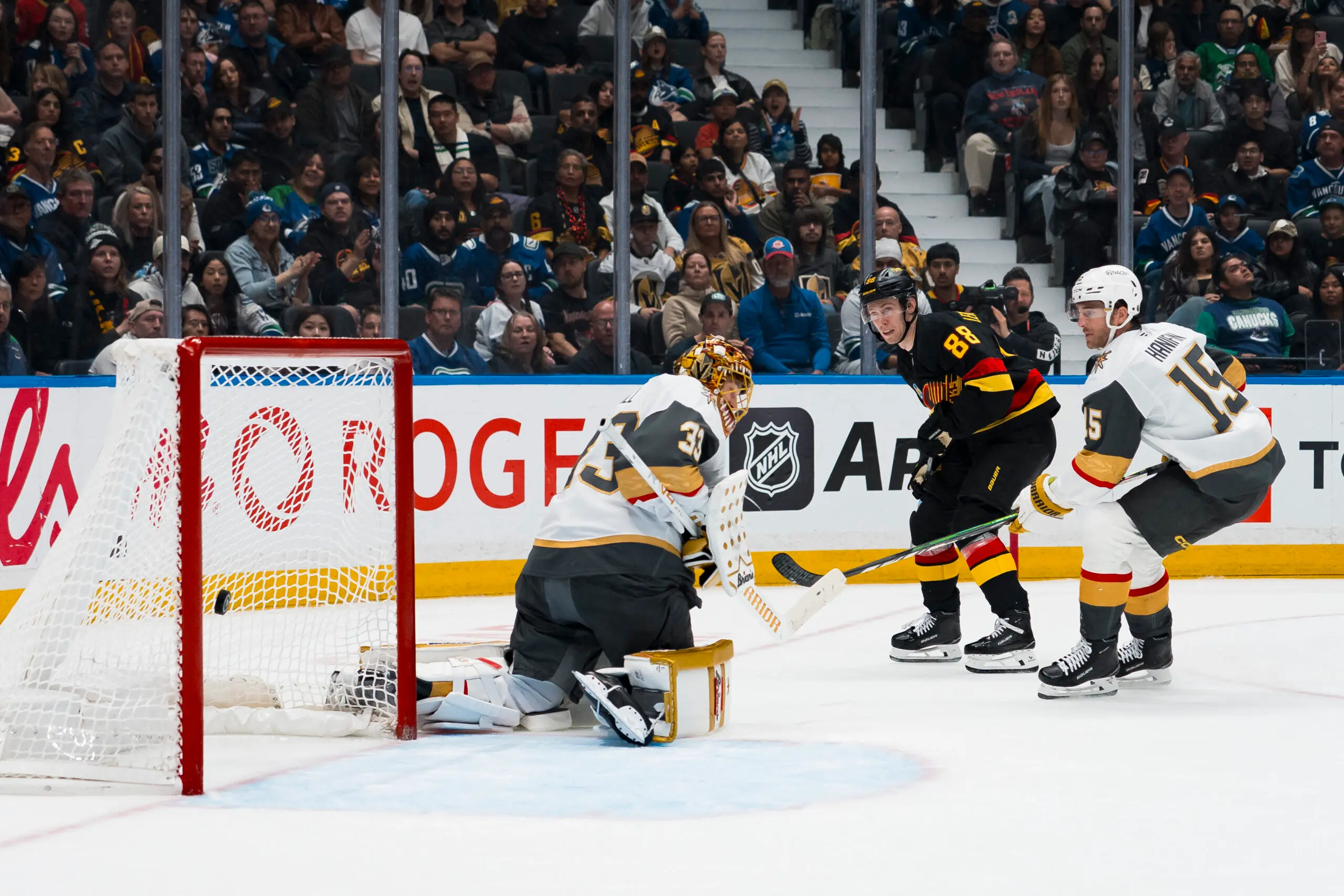
Photo credit: Bob Frid-Imagn Images

Oct 7, 2026, 10:00 EDTUpdated: Oct 7, 2026, 02:16 EDT
Not many fan bases have enjoyed their first week of the NHL regular season more than the Vancouver Canucks. With the Canucks finally entering a rebuild, new yet familiar faces in management, and a sense of direction for the future, fans are no longer worried about winning today; they know effort and development now will lead to success tomorrow.
With 19 goals in just four games, much of the enjoyment in Vancouver has come from the team scoring at will. It’s rare for a team this early in a rebuild to have the skill to score 4.75 goals per game. Whether it’s a shooting bender or a fresh environment that has allowed players to play up to their potential is yet to be seen, but one thing is certain: the Canucks have been an extremely exciting team on the counterattack so far.
In this article, we will break down the Canucks’ counterattack goals and explain what we believe head coach Manny Malhotra is trying to implement.
First, we’ll lay out the parameters used to break down the Canucks’ goals. A counterattack goal can start from the Offensive Zone, Neutral Zone, or Defensive Zone (Labelled as OZ, NZ, & DZ). A counterattack could result from a direct turnover (poor pass) or pressure off the forecheck. An OZ counter (forecheck) goal must be scored within six seconds, while an NZ or DZ counter must be scored within eight seconds of a change in possession. Additionally, any goal scored on a second or third shot in the sequence must be via rebound, as any goal on a pass following the first shot is considered part of the cycle.
Offensive Zone Counters
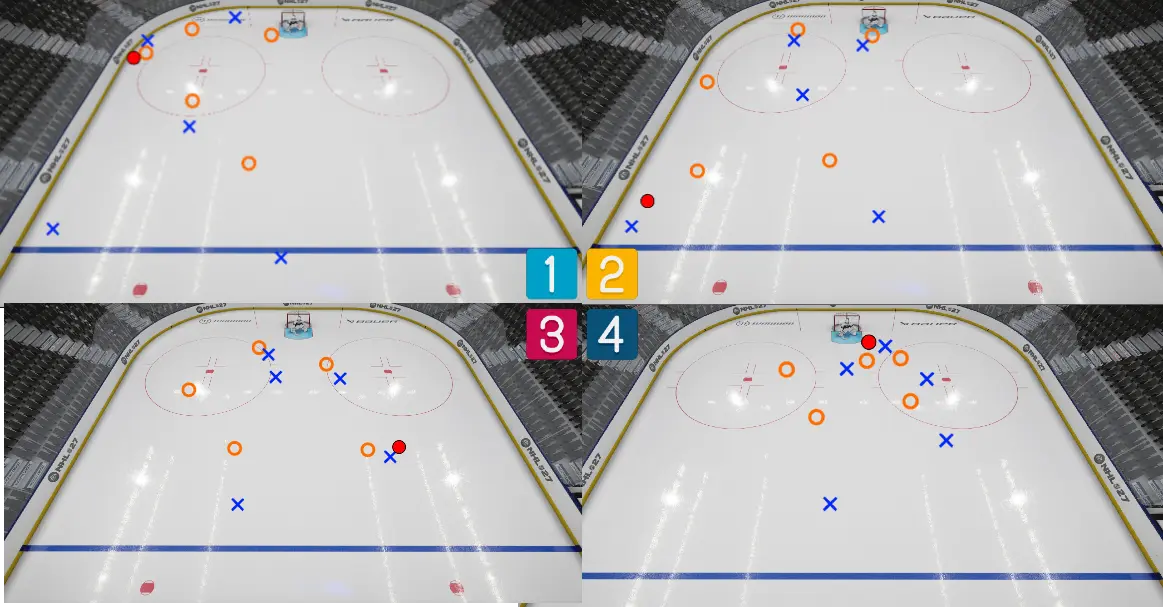
In game two against the Edmonton Oilers, the Canucks scored all four of their current 5-on-5 forechecking goals. In Manny Malhotra’s system, the Canucks’ OZ counter typically starts with a recovery along the wall, followed by a low-to-high pass to the strong-side defenceman, then a pass to the player on the far flank. The idea is that stacking the forecheck to one side of the ice forces opponents to provide close support on the breakout. If the Canucks recover and quickly move the puck to the far side, the puck receiver should have plenty of space to shoot or put it in the low slot.
First Option: On Arshdeep Bains’ 6-2 goal, the Canucks make a D-to-D pass, and Filip Hronek’s mobility lets him walk into the high slot between the faceoff dots. When this happens, their priority shifts to finishing rather than extending the cycle. This lets the entire triangle shift across the middle, stacking the screen in front of Devon Levi while also providing a low-slot option. By outnumbering their opponents low on one side of the ice, they can also create a small pocket of space to deposit the rebound, as Bains separates himself from the net-front defenceman and gets lost behind the strong-side defenceman.
Low-To-High OZ Counter, Between The Dots
Marco Rossi's shoulder makes it 8-5!
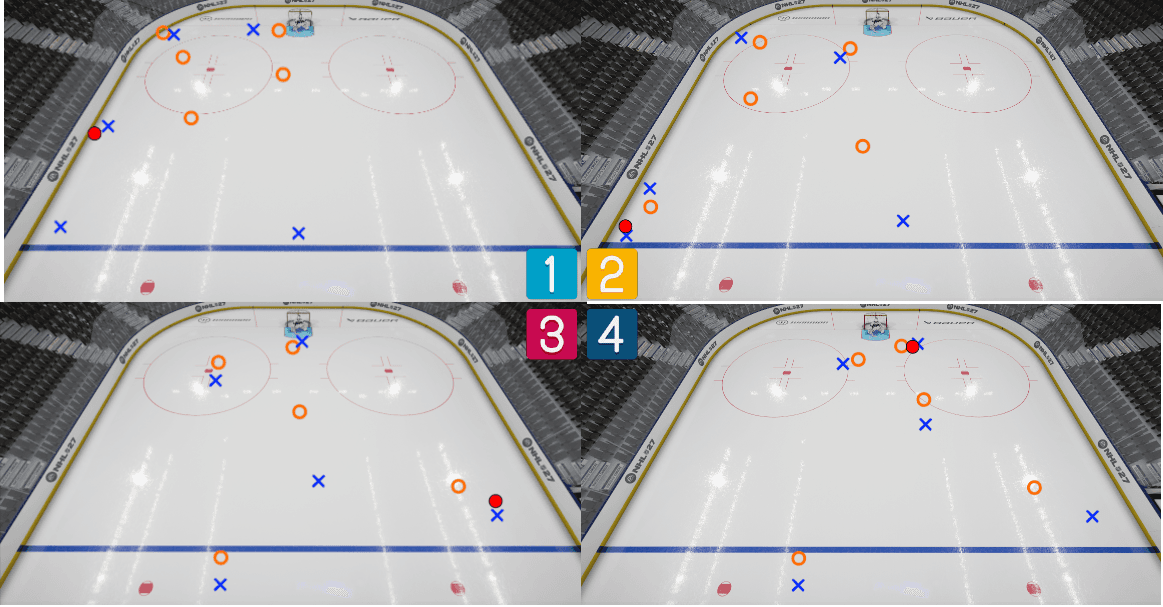
Second Option: Sometimes, however, the D-to-D pass might be used out of necessity to relieve pressure, putting the far-side defenceman in a tighter spot and unable to create. In that case, the focus shifts to getting the puck low, either to extend the cycle or to force the goalie to cover it. During these plays, the Canucks switch to a more traditional 2-1-2 OZ system, which focuses on retrievals and perimeter support. If a forward is near the net, they’ll make sure they’re the closest forward to any rebounds or pucks sent low along the perimeter. This switch gives the Canucks more time to reset and restart the cycle once the forwards overload to the strong side.
In Rossi’s case, it’s an example of what happens when the defenceman tries to put a shot on through the single screen. In this case, the puck bounces across and off of Rossi’s shoulder before going in the net, but traditionally the idea is for the puck to make its way low, and if sent towards the net, for the two men low to crash to the top of the crease with the third forward as a high option in case a puck squeaks loose. In these cases, however, teams will usually prioritize puck possession.
Canucks OZ Counter, Possession Based
The average time elapsed between a successful forecheck and a goal was 4.8 seconds for the Canucks.
Neutral & Defensive Zone Counters
EP40 ROCKS ZAYNE PAREKH! DREW O’CONNOR GOES THE ITHER WAY AND SCORES 🚨
On counterattacks from the NZ and DZ, the Canucks will react based on the manpower situation heading up ice. So far, the Canucks (outside of Linus Karlsson) have focused on shooting on 2-on-1s.
Over the past 10 years, as research into game theory has increased, it has become clear that while passing on a 2-on-1 is the higher-danger play, the majority of passes on a 2-on-1 actually occur before the faceoff circles, causing the defenceman to make an adjustment to their gap and also forcing the goalie to recentre themselves. Once a team gets past the circles on a 2-on-1, the higher-danger pass becomes harder to execute as they get closer to the net.
From a purely analytical point of view, if a player can assume a pass completion rate of 40% or higher, they should pass every time to maximize offensive output. The Canucks may have one player who could reach that mark (Elias Pettersson), but the rest of the team simply aren’t skilled enough to avoid shooting on a 2-on-1 once they get to the circles. The philosophy is simple: get between the dots and make your read early, and rip it where it’s open.
MAX SASSON SILENCES THE EDMONTON CROWD 🤫
In a 2-on-2 or 3-on-3, the play is entirely read-based, except for a couple of non-negotiables: one player must take off up ice to spread the opponent’s defence, and two forwards must be on the strong side of the puck to provide close support through the neutral zone. The goal is to create gaps large enough to break through the neutral zone, while creating a 2-on-1 against one defenceman to enter the zone.
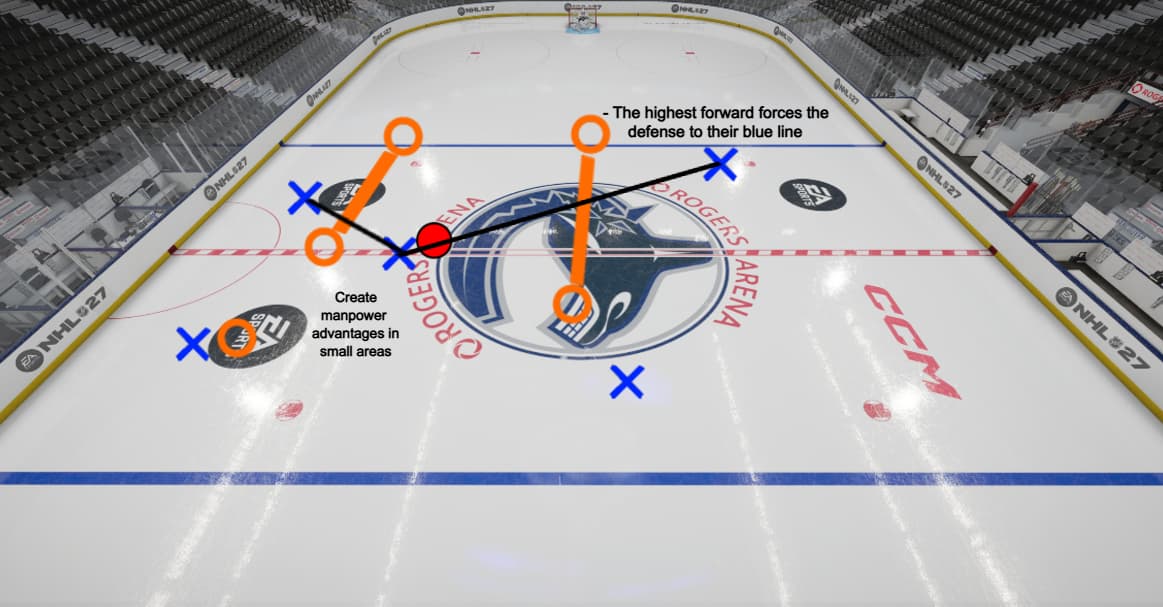
On Max Sasson’s goal against Edmonton, Karlsson does a great job turning the 3-on-3 into a 2-on-2 up ice. With Sasson and Drew O’Connor overloaded on the left, and Vasily Podkolzin in front of Sasson, he can make a quick pass to O’Connor before attacking the Oilers forward, get behind him just in time, take O’Connor’s return feed, and bury it. If the Canucks’ opponents press up at the blue line too much, or if they catch their opponent’s on a quick pass, they will try to put pucks behind the defence to advance the play and create either an odd-man rush or a scoring opportunity.
Boeser off the post to make it 6-2 Oilers.
But if the puck is put to the far side, like it was for Brock Boeser, the read is based on a variety of factors. In Boeser’s case, he uses the defenceman as a screen and his elite shot to put the puck past Levi. In other cases, the player may try to reload the puck up high if there’s a defenceman with him. They may try to attack the middle or go 1-on-1 with a defenceman.
The average time elapsed between an NZ or DZ counter attempt and a goal was 5.5 and 6.0 seconds, respectively.
Stats/Trends
Of the Canucks’ 19 goals, 14 were scored on the counterattack.
- Five OZ counters
- Two NZ counters
- Six DZ counters
- One quick strike/broken play
Typically, team goals are in the 45% rush, 55% cycle range. Elite offensive teams can score 50-55% of their goals off the rush. The Canucks currently have two 5v5 cycle goals and six off the rush, for a 5v5 rush-goal percentage of 75%. If the Canucks fail to generate offence from their cycle, they will suffer serious offensive regression. But for the meantime, the counterattack is giving Canucks fans an extremely fun brand of hockey to watch in 2026-27 thus far.
Sponsored by bet365


Breaking News
- The Statsies: Canucks overwhelmed at 5v5 in Hughes’ return after a strong first period
- The Stanchies: Boo birds rain on Hughes in return to Vancouver; Canucks lose 4-2 to Wild
- Instant Reaction: Canucks start strong but fall 4-2 to Wild in Hughes’ return to Vancouver
- Canucks: What happened the last time a controversial former captain returned to Vancouver?
- Scenes from morning skate: Canucks looking to snap winless skid and spoil Quinn Hughes’ homecoming

Vancouver CanucksTeam Cap Summary

Cap Summary
2026-27
2027-28
Projected Cap Hit
$87,295,050
$71,329,167
Projected Cap Space
$16,704,950
$42,170,833
Current Cap Space
$19,290,240
$42,170,833
Active Players
23/23
13/23
Draft Picks
Round
'27
'28
1
1
1
2
2
2
3
1
1