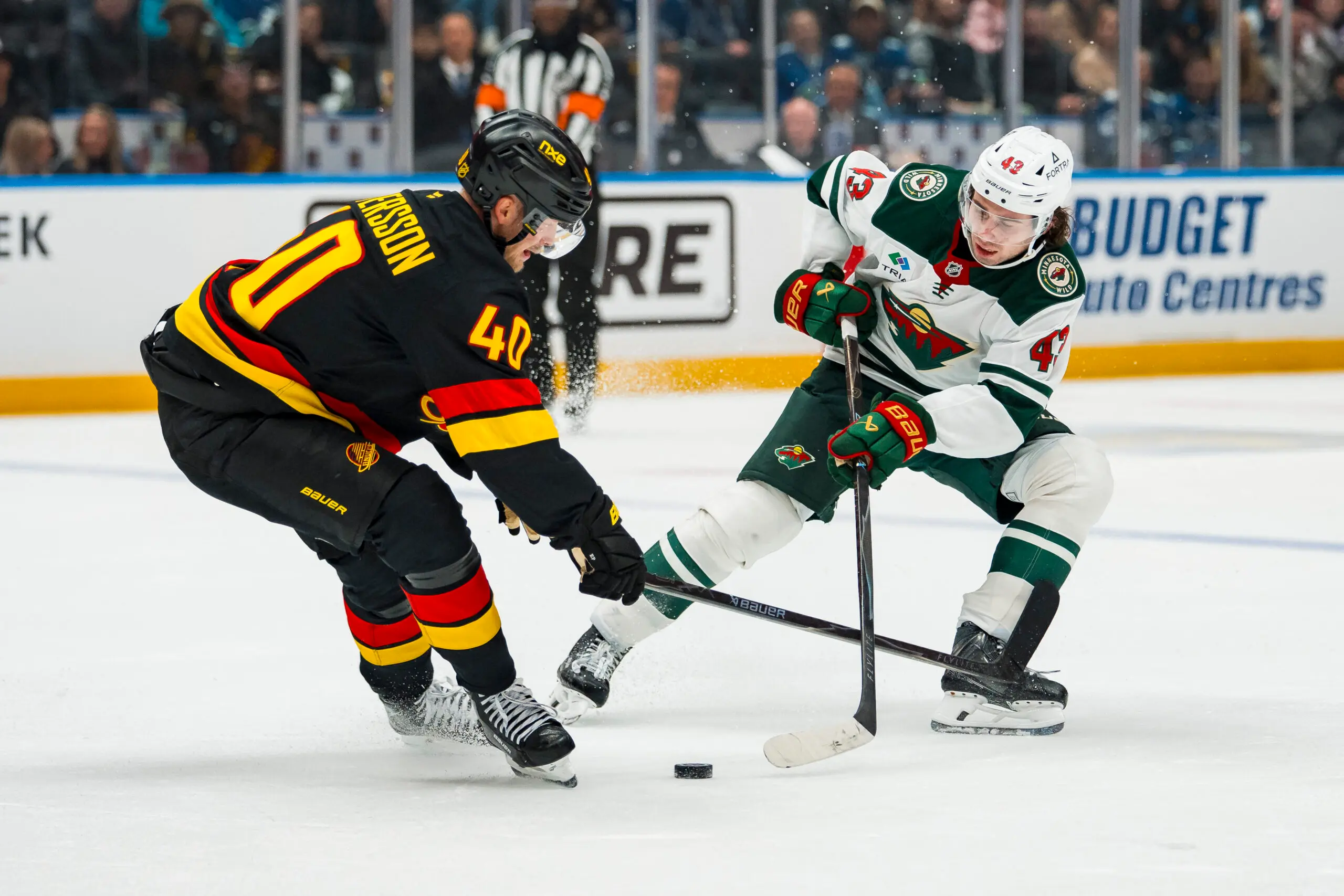
“It’s not the size of the dog in the fight; it’s the size of the fight in the dog.” This idiom has stood the test of time, emphasizing that hard work, determination, courage, and perseverance matter far more than size or strength.
Listed at 6’2”,
Elias Pettersson is not a short player, but at 176 lbs, he ranks 714
th out of the 745 players who have played one game this season in terms of weight. Throughout his career, a common criticism of Pettersson has been his inability to stay on his skates and how easily he gets pushed around.
Pettersson doesn’t have the size, that’s for sure. Nonetheless, what Pettersson has shown this season is that he has fight in him, and he is doing his part to lead the
Vancouver Canucks into the fight on a nightly basis.
But how can one determine “fight”?
Historically, intangibles have been hard to track. Hits, blocked shots, fights, and even faceoff wins have been used to determine whether someone is “a player you can win with”.
The issue is that these stats often reflect a team’s overall ability. If a player is constantly stuck in the defensive zone, they’re likely to have more blocked shots. If a player never has possession of the puck, they’re likely to throw more hits. These stats show a player’s willingness to sacrifice their body, but they don’t show a direct correlation between that sacrifice and positive results on the ice.
At best, they show a correlation between sacrifice and preventing negative results, like in the case of blocked shots. At worst, they don’t correlate at all.
Enter the analytics era, and the NHL has seen a massive explosion of people and companies dedicated to tracking parts of the game that historically haven’t been tracked. One of those companies, SportLogIQ, has been at the forefront of hockey analytics, and many NHL teams use their models.
In an analytics-centred world, it’s easy to categorize microstats as purely offensive or defensive. Yet, some microstats also track a player’s intangibles much better than what has historically been used. One of those stats is “Puck Battles Won”. This stat counts every time a player physically engages or actively competes with an opponent for a loose or contested puck and successfully comes away with possession for their team.
The NHL forward leader in puck battles won? Elias Pettersson.
On the surface, it seems preposterous that a player as tall and light as Petey could win more 50/50 puck battles than anyone else in the league. When you think of forwards that should be elite at winning puck battles, names that come to mind are Aleksander Barkov,
Bo Horvat, Jordan Staal, etc.
So how does Pettersson win these puck battles? It’s his intelligence. Specifically, his intelligence within head coach Manny Malhotra’s system.
Let’s look at some examples of how Pettersson uses his hockey IQ to win puck battles and generate offence. First, we’ll start with the Canucks most recent game against the
Anaheim Ducks.
In what was one of Pettersson’s best periods of the season, a two-point effort that saw the Canucks pull within one goal before ultimately coming short, Pettersson’s best shift came after those points.
First, Pettersson starts in the defensive end. With Jake DeBrusk and Ducks forward Judd Caulfield engaged along the wall, Pettersson does a good job keeping himself between Caulfield and Leo Carlsson.
Initially, Pettersson tries to pull the puck back, but as DeBrusk pushes the puck up the wall, Pettersson keeps his distance, making sure he doesn’t dive completely into the pile forming just inside the Canucks’ blue line. Instead, he stays behind Caulfield, taking away his stick as he tries to wedge the puck up the wall. As the pile disperses and the puck comes free, Pettersson reestablishes his positioning between Caulfield and Carlsson. By spreading his legs and turning his body, he uses his left foot to cut off Carlsson from pulling the puck inside and uses his stick to take away Caulfield’s.
With the puck loose, DeBrusk retrieves and carries it before chipping it below the Ducks’ goal line. As the second forechecker, Pettersson is funnelled to the wall by defenceman Tristian Luneau, but pushes him into the pile and engages. Between three Ducks players, Pettersson leans on Luneau before sealing off the wall by putting his right foot between the defenceman’s legs.
As the puck squirts behind Luneau, Pettersson then disengages and positions himself between the puck and both Luneau and Carlsson, allowing DeBrusk to push the puck to
Brock Boeser. Boeser then carries it up the wall, and the Canucks begin to attack. They register three shots on goal, including two high-quality chances from both Boeser and Pettersson.
Within 45 seconds, Pettersson helps move the puck 150 feet up the ice and nearly ties it up against the Ducks’ top line. Showcasing his two-way chops, Pettersson’s spatial awareness allows him to multitask, taking on multiple opponents at once to free the puck up for a teammate.
In Malhotra’s system, where the forwards overload heavily to one side of the ice, there is always support around the puck. This allows Pettersson’s linemates to quickly pounce on any opportunities he creates.
We can see this on another play, this time against the New York Rangers.
After winning the draw, Pettersson deflects a puck on net before rushing to the corner of the Rangers’ zone to retrieve the rebound. With Adam Fox on his back, Pettersson cuts against Fox’s momentum before running into JT Miller. Like against the Ducks, Pettersson positions himself between two opponents, using his stick to keep Fox from engaging with the puck while also preventing Miller from chipping it to Fox or Alexis Lafreniere.
When Pettersson seals the wall, he utilizes the same technique he used against Luneau, putting one of his legs in between the legs of his opponent, preventing him from turning and forcing the puck into
Jonathan Lekkerimäki, who pinches Miller on his other side as he tries to reverse the puck low to defenceman Vladislav Gavrikov. Lekkerimäki dislodges the puck before finding DeBrusk in the slot, who quickly deposits a shot to tie the game for the Canucks.
Pettersson’s initial puck battle was the faceoff. It wasn’t a clean win, but by getting under Miller, he won the ensuing scrum, swept the puck back, and beat him to the net before picking up the rebound and taking on two Rangers before playing structurally sound, intelligent hockey.
Does Pettersson pick up an assist on either of these plays? No, he doesn’t. However, without him, these sequences do not happen. The Canucks have had a rough go of it this season, especially along the wall, where teams constantly beat the Canucks to pucks, pull them into the middle, and create manpower advantages in the slot and around the net.
These little plays have helped Pettersson regain his confidence and rebound production-wise. With 18 points in 17 games, Pettersson looks to be reestablishing himself as an elite top-line two-way forward. Will the points keep coming? Perhaps, but if Pettersson keeps playing like this, he’ll give himself the best chance to produce like the superstar Canucks fans have come to expect.
Sponsored by bet365