


417 points as a Golden Knight for Mark Stone 🤩

CanucksArmy has no direct affiliation to the Vancouver Canucks, Canucks Sports & Entertainment, NHL, or NHLPA
Why short-term pain is necessary for long-term gains for Canucks penalty kill
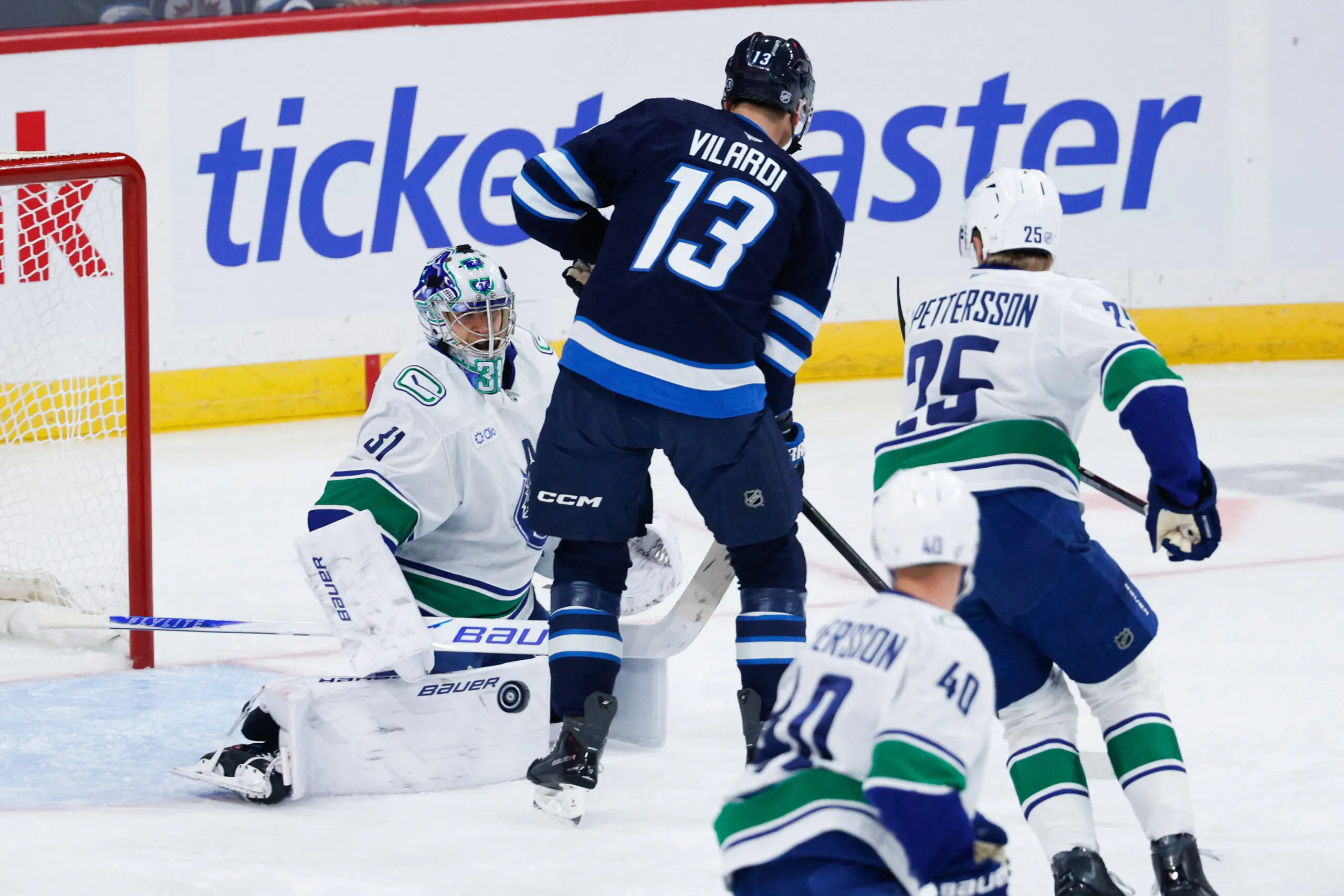
Photo credit: Terrence Lee-Imagn Images

Nov 19, 2026, 16:31 EST
The Vancouver Canucks are hot right now. On the back of a two-game winning streak against the Stanley Cup Finalist Vegas Golden Knights and the young, fun Utah Mammoth, the Canucks and their fans have been given a well-deserved break after a stretch in which they won only once in 18 games.
However, despite the club’s results, what continues to stand out is how porous the Canucks’ penalty kill remains. Ranking second-to-last in the NHL at 63.2% (only ahead of the Seattle Kraken at 62.7%), the Canucks haven’t held a team to zero goals on the power play since Halloween night against the wilting Toronto Maple Leafs.
In November, the Canucks have surrendered 10 goals on 22 penalty-killing opportunities. And without any help on the way, two questions emerge: one, why aren’t the Canucks using different players on the PK? And two, what structure are the Canucks trying to install?
During November, the Canucks penalty killing units have been the following: Elias Pettersson and Brock Boeser with Elias Pettersson (defenceman) and Filip Hronek as the first unit, with Filip Chytil and Drew O’Connor with Jamie Oleksiak and recent waiver pickup Cameron Crotty on the second unit. Max Sasson and Linus Karlsson are the third forward pair but get minimal ice time.
At first glance, players like Boeser and Chytil don’t look like your prototypical penalty killers. Judging by the deployment, the Canucks are prioritizing a mix of offensive IQ and pace from their forwards on the penalty kill over the size and speed that head coach Manny Malhotra has leaned on since the beginning of the season.
The thought process could be that by putting out players with high offensive IQ’s, those players would best be able to predict what their opponents are looking for and would be the best positioned to recognize when a team is put in a disadvantageous position, such as when the puck is trapped along the wall or off an errant pass.
When watching the Canucks penalty kill in action, they’re extremely aggressive, relentlessly pursuing the puck carrier and attempting to force puck movement.
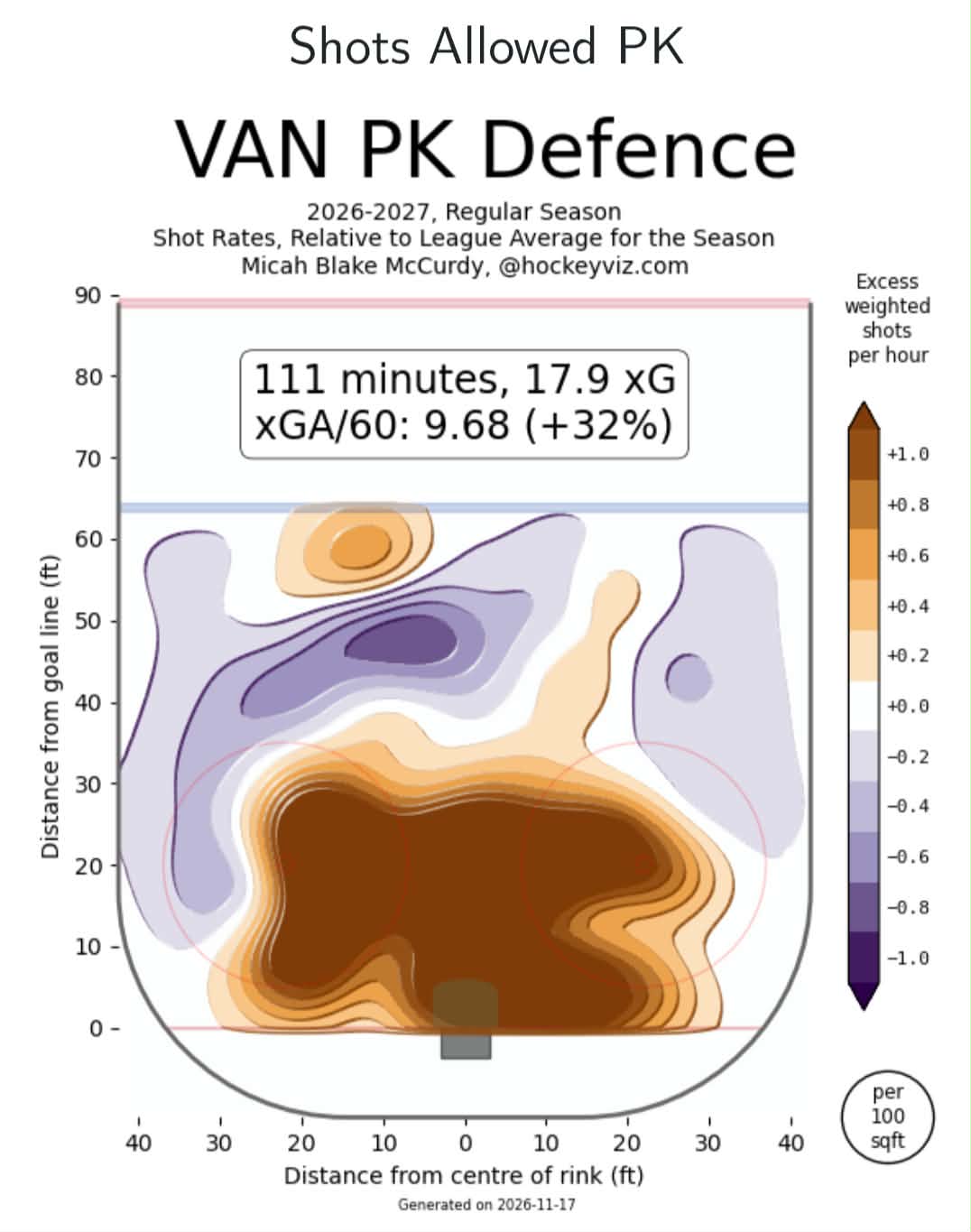
The club would much rather force a team to make a series of perfect passes around the penalty killers to find a high-danger chance than defend while flat-footed.
However, the Canucks penalty kill hasn’t been successful in this endeavour. Currently, the Canucks rank second-last in scoring chances against (156) and fourth-last in high-danger scoring chances against (66).
While those numbers suggest the Canucks PK might be a bit unlucky, adding medium-danger scoring chances against (MDSCA) makes a bit more sense. The club leads the league with 90 MDSCA allowed this season, 11 more than the next closest team.
When you add medium- and high-danger chances together, the Canucks have surrendered 156, second-last behind the San Jose Sharks at 162.
So why haven’t the Canucks adjusted?
Looking at the NHL’s most successful penalty-killing teams, the New York Rangers, Nashville Predators, and Dallas Stars rank in the top three, all above 88%.
The common theme among those teams? High pressure above the circles, with off-puck players rotating into different positions based on their individual reads. The goal is to force opponents to move the puck low before collapsing into the slot, then move it cleanly into packed areas.
The Canucks, however, have been failing to make these reads.
On this play against the Vegas Golden Knights, the Canucks are in their “survival” structure: a collapsing diamond that they only used on extended possessions. When teams are tired, they’re more likely to develop tunnel vision, and defenceman Elias Pettersson showcases it here when he collapses on Tomas Hertl in the bumper instead of boxing out Mark Stone.
Filip Hronek’s stick is positioned in the passing lane, and Brock Boeser has collapsed to both take away Hertl’s stick on his forehand and to block any passes up to the point on his backhand. Pettersson (C) is taking away a cross-ice pass while preparing to take away the backdoor if the puck drops low.
Pettersson (D) is stuck defending empty space and is caught puck-watching. As Jack Eichel inches down the half wall, the moment he finds a direct passing lane to Stone, he takes it, sending the pass and watching as Stone has ample time to move the puck to his forehand before slipping it behind Nikita Tolopilo.
By puck-watching instead of scanning the ice, Pettersson (D) can’t make an effective read based on his teammates’ positioning, and it burns the Canucks.

🚨 Cutter X 2 🚨 Another power play goal! That one looked oddly familiar... We lead 4-2! #FlyTogether
The Canucks went zero-for-three on the penalty kill on November 3rd against the Anaheim Ducks, and on this particular kill we see a similar issue, this time with Victor Mancini.
As the Ducks work the puck around the ice, the Canucks penalty kill rotates to have both defencemen on the strong side, with Jacob Quillian and Brock Boeser on the far sides.
As the closest penalty killer to the puck, Mancini couldn’t scan the ice around him. That, combined with being much higher up on the ice than he usually is as a defenceman, causes him to panic when Cutter Gauthier makes a pass to Beckett Sennecke at the bottom of the circle.
Mancini turns and rushes Sennecke at the goal line, watching the puck the entire time and not noticing that Pettersson (D) had rotated into Mancini’s original spot. When Mancini charges him, Sennecke slips a pass past him to Gauthier, and with Mancini and Pettersson (D) packed tightly, they create a screen Kevin Lankinen can’t see through as Gauthier rips a shot into the top corner.
After the goal, Pettersson (D) gives Mancini a prolonged stare before slamming his stick on the ice, clearly frustrated by the breakdown.
While these goals represent some of the Canucks’ biggest breakdowns, you can watch any power play goal against them this season and see similar (though less egregious) breakdowns. The Canucks aren’t used to making such quick reads and playing hybrid systems that require one or two players to play in a man structure while the others play zone defence or cover passing lanes.
So, again, why haven’t the Canucks adjusted?
From the coaching staff’s perspective, they likely believe that as the season progresses, these reads will become subconscious for the players, which should lead to increased success.
Also, the club lacks true talent. That’s why they’re 32nd in the league, but it makes sense that a team as young as the Canucks needs to learn to play fast.
It’s much easier to slow things down than to speed things up. By playing an ultra-aggressive system, the club and its young players will be best positioned to slow things down when the time calls for it, giving them the most flexibility possible if they decide to switch to a more passive, tight-knit structure.
In the preseason, we saw some successful penalty killing from recent draftees like Braeden Cootes and Yaroslav Bryzgalov, even when they were outmatched roster-wise. This suggests that as the Canucks continue to draft high-IQ players in the entry draft, their special teams will improve as their draftees earn roster spots, with the current group of young players able to teach the new guys as they enter the league.
Is the penalty kill an issue currently? Yes, but the Canucks are laying the foundation for potential future success.
Sponsored by bet365


Breaking News
- Why short-term pain is necessary for long-term gains for Canucks penalty kill
- Scenes from morning skate: Meriläinen looking to lead Canucks to third straight win vs. Kraken
- Canucks vs. Red Wings: A sharp contrast in off-ice decision-making
- Canucks prospect Connor Davis listed on Steven Ellis’s top-5 late-round steals from 2026 NHL Draft
- Why the Canucks should consider starting Kevin Lankinen Sunday against the Blackhawks

Vancouver CanucksTeam Cap Summary

Cap Summary
2026-27
2027-28
Projected Cap Hit
$87,211,195
$70,329,167
Projected Cap Space
$16,788,805
$43,170,833
Current Cap Space
$22,618,251
$43,170,833
Active Players
22/23
12/23
Draft Picks
Round
'27
'28
1
1
1
2
2
2
3
1
1