
CanucksArmy has no direct affiliation to the Vancouver Canucks, Canucks Sports & Entertainment, NHL, or NHLPA
Canucks: Why size and speed matter so much at centre in Manny Malhotra’s system
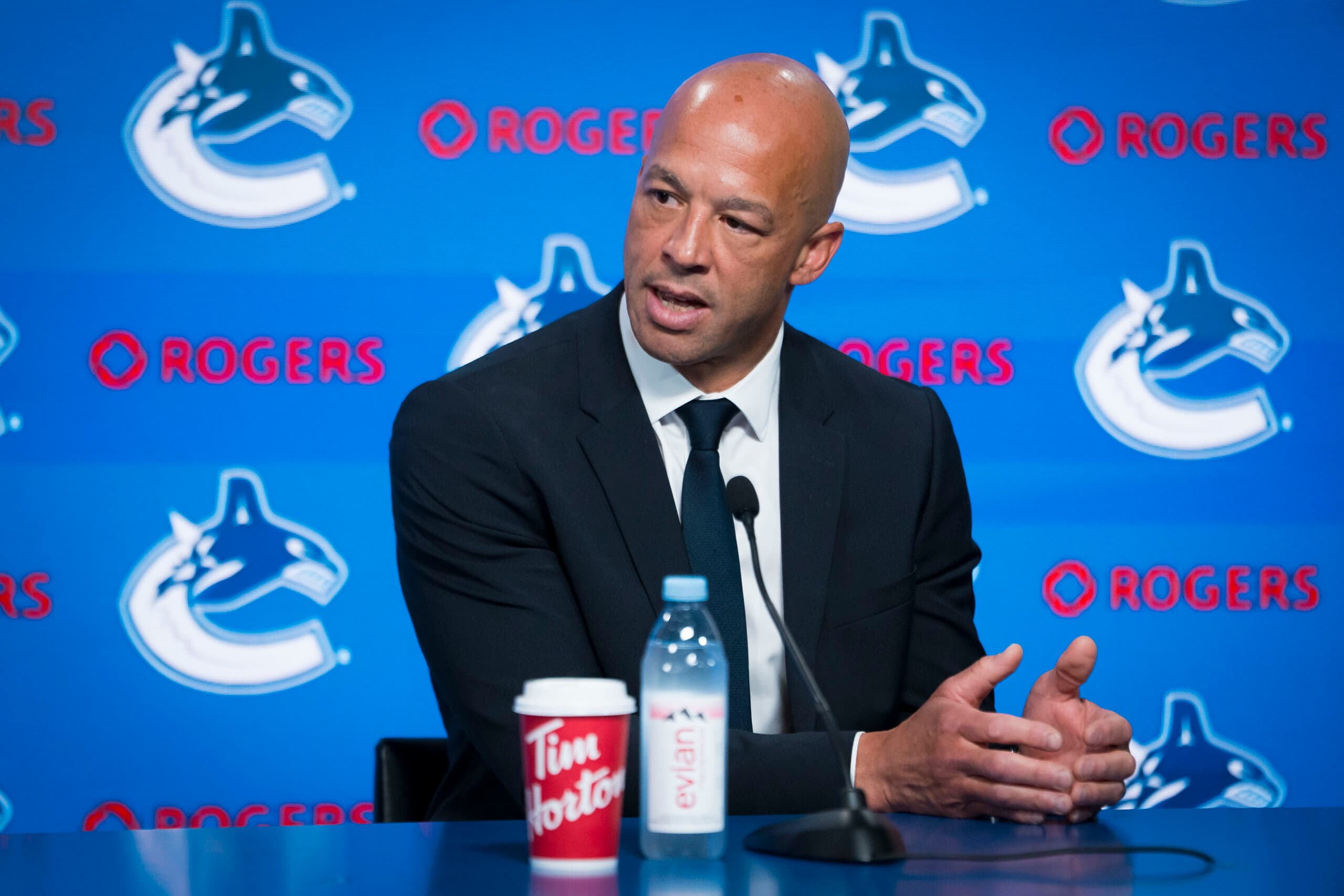
Photo credit: © Bob Frid-Imagn Images

By Elijah Ford
Oct 6, 2026, 16:53 EDT


Manny Malhotra has made one thing increasingly clear with his deployment of the Vancouver Canucks’ centres: size and speed matter.
Through the early part of the season, Elias Pettersson has unsurprisingly taken the most 5-on-5 shifts down the middle, playing 36:50 at centre, according to Natural Stat Trick. But right behind him is Paul Cotter at 34:22, with Max Sasson at 31:28. Marco Rossi, meanwhile, has spent 23:17 at centre at 5-on-5. That distribution is notable because it reflects something Malhotra said himself about Cotter’s move to the middle.
“His size and speed at the centre position becomes a major asset, and his ability to play a physical game and get those matchups that were looking for definitely helps out the lineup,” Malhotra said pregame on Sunday against the Vegas Golden Knights.
The size and speed part is important. Those are traits any NHL coach would want in a player, but they take on even greater importance at centre in Malhotra’s system because of just how much responsibility the position carries defensively. The centre can switch responsibilities with the wingers from time to time when the play dictates it, but there remains a strong emphasis on that role protecting the middle of the ice.
In Malhotra’s defensive-zone structure, the basic concept is a “box and one.” The defencemen and wingers form a box shape to keep opponents to the outside, while the centre acts as a rover in the middle. That makes the centreman the fulcrum of most defensive sequences.
The first responsibility of the centre is supporting his defenceman along the wall by pinching if necessary and taking away the middle of the ice. That is where size becomes particularly useful. A bigger centre can eliminate more passing lanes simply through his reach. He can also make it more difficult for opponents to attack through the middle without having to completely abandon his position. But the centre cannot just sit in the middle.
When a winger or defenceman pins an opponent along the boards, the centre needs to swarm the puck and provide support. If a teammate gets beaten along the wall, he may have to quickly take over the assignment. That requires mobility.
The puck can also move from one side of the ice to the other in an instant. A centre might start in the strong-side high slot before having to race toward the weak-side half wall to support a play. That is a difficult defensive task. The centre has to cover significant ground without opening up the middle of the ice in the process. It helps explain why Malhotra is so interested in players who can combine length with skating ability. It also helps explain why Cotter has become such an intriguing option down the middle.
At 6-foot-2, Cotter has the physical dimensions to take up space in the middle of the ice, while his good skating ability allows him to recover when he needs to leave that position. His physical play is another benefit. A centre who can get underneath an opponent along the boards and turn a loose puck into possession gives the Canucks another way to end a defensive-zone sequence. That is particularly valuable in a system that asks its players to swarm the puck rather than simply sit back and wait for an opponent to make a mistake.
The benefits of having a mobile centre do not stop in the defensive zone. Speed at centre can also make Vancouver’s breakout more efficient. The quicker a centre can get into a support position, the sooner he can skate onto a chip up the boards, receive a short pass through the middle or chase down a puck flipped into the neutral zone. In other words, the same skating ability that allows a centre to recover defensively can help Vancouver transition out of its own end. That makes Cotter’s 34:22 at centre particularly significant.
He is already getting almost as much 5-on-5 work in the middle as Pettersson, despite having spent much of his career as a winger. It would be easy to look at that deployment simply as Malhotra rewarding a player who has played well. But the coach’s comments suggest there is something more specific going on. Malhotra sees Cotter’s physical tools as an advantage in part because they are being used at centre. That could become increasingly important as the season progresses.
Filip Chytil, for example, should be a natural candidate for significant centre minutes when he returns from injury. He combines size with the skating ability to cover large areas of the ice, giving Malhotra another player who fits the physical profile he appears to prefer at the position. His return may also create room for Rossi to shift to the wing more regularly.
Rossi has played 23:17 at centre at 5-on-5, the lowest total among Vancouver’s four primary options. He is a skilled offensive player and can certainly play the position, but he is also significantly smaller than Cotter and does not provide the same type of skating or physical presence.
That does not make Rossi a poor fit for Malhotra’s system. It simply means that some of the things that make Rossi useful offensively may be easier to maximize on the wing, where he is not responsible for covering as much ground in the defensive zone. Sasson presents another interesting wrinkle.
At 31:28, he has received almost as much 5-on-5 centre time as Cotter. On the surface, that is somewhat surprising given that Sasson may ultimately profile better offensively as a winger. But on top of his elite skating, Sasson has one advantage that is difficult to quantify from a lineup card: familiarity.
He already understands Malhotra’s system from his time in Abbotsford, and that understanding matters at centre because the position requires constant reads. The player has to know when to protect the middle, when to support a battle and when to leave his position to help a teammate. Sasson already has experience making those reads within Malhotra’s structure.
Then there is Pettersson, who represents the biggest exception to the size-and-speed preference. Pettersson has decent size, but he is not one of Vancouver’s most explosive skaters. Yet, moving him to the wing would create another set of challenges for a player who has spent his entire career playing centre and is still working his way back to his best level. More importantly, Pettersson has other traits that allow him to succeed in the middle.
He has shown a willingness to get involved along the boards and in the corners, and his ability to compete for pucks down low can help compensate for some of the skating limitations he has compared with a player like Cotter. That may ultimately be the biggest takeaway from Malhotra’s deployment.
Size and speed are not requirements for playing centre in this system. They are tools that make the position easier to execute. The centre has to protect the middle, support teammates along the boards, recover when assignments break down, move laterally with the puck and then immediately become part of the breakout. That is a lot of ice to cover and a lot of decisions to make.
Cotter’s 34:22 at centre suggests Malhotra believes his size and speed can help him handle those demands. Chytil could become another natural fit when he returns. Sasson’s understanding of the system has earned him an opportunity down the middle, while Rossi’s skill set may ultimately be better utilized on the wing. And Pettersson shows that the formula can be adjustable depending on circumstances.
Malhotra may value size and speed at centre, but what he really appears to value is the ability to cover space, win battles, and keep the middle of the ice protected. For a position that essentially serves as the engine of his defensive system, that makes sense moving forward.
Sponsored by bet365


Breaking News
- What positive steps forward is the Canucks’ rebuild making this season?
- Leevi Meriläinen adjusting well to starting duties for Canucks, but he wants to win
- 3 Canucks Stars of the Week: Jonathan Lekkerimäki a bright spot amid losing streak
- Abbotsford Weekly: Hats fly for newcomer Jacob Quillan as Canucks sweep Wranglers
- Scenes from practice: Malhotra hauls out line blender in attempt to help Canucks snap 10-game losing skid

Vancouver CanucksTeam Cap Summary

Cap Summary
2026-27
2027-28
Projected Cap Hit
$87,295,050
$71,329,167
Projected Cap Space
$16,704,950
$42,170,833
Current Cap Space
$19,405,750
$42,170,833
Active Players
23/23
13/23
Draft Picks
Round
'27
'28
1
1
1
2
2
2
3
1
1