


😱 Goal of the year from Connor Bedard 😱 This isn't up for discussion. @CHLHockey | @TheWHL | @BarDown | @HeyBarber

CanucksArmy has no direct affiliation to the Vancouver Canucks, Canucks Sports & Entertainment, NHL, or NHLPA
What the Canucks can learn from the Blackhawks tumultuous rebuild

Photo credit: © Bob Frid-Imagn Images

Nov 13, 2026, 09:00 ESTUpdated: Nov 12, 2026, 22:13 EST
It is often said that the easiest part of a rebuild is the teardown: trading veteran players to contenders for draft and prospect capital, losing a bunch of games, getting a couple of top-five picks, and bada-bing, bada-boom, you have yourself a future Stanley Cup Contender, right?
Well, not so fast.
Tearing the team down and drafting all these young junior superstars is fun, but what happens when a team tries to rebuild and get back to playoff contention? In Chicago, the Blackhawks have had a weird 2026. Finishing second-to-last in the NHL last season, the club decided that with Connor Bedard’s ELC expiring and what they felt was a solid team nucleus, it was time to accelerate the rebuild.
On the surface, it’s understandable. In 2023, the Blackhawks were handed the ticket of a lifetime when they landed junior phenom Connor Bedard with the first overall pick, winning the lottery with the third-best odds at 11.5%.
Over the next two seasons, the Blackhawks landed the second- and third-overall selections, respectively, drafting defenceman Artyom Levshunov and forward Anton Frondell. Adding those two players to a prospect pool that has seen them draft 11 first-rounders gave GM Kyle Davidson the confidence to move the 2026 fourth- and 45th-overall picks, as well as defenceman Louis Crevier, to the Buffalo Sabres for Bowen Byram & Jordan Greenway.
In free agency, the club doubled down on its desire to contend for a playoff spot, signing franchise legend Patrick Kane to a two-year, $8M AAV and the Canucks’ number one free-agent target, veteran defenceman Ian Cole, to a one-year, $4M contract.
Fast-forward to the 2026-27 regular season, and the Blackhawks are once again in the cellar of the NHL standings. With nine points in 19 games, the club ranks second-last in the league, only ahead of the Vancouver Canucks by two points (VAN has played in 20 games).
So, what were the Blackhawks’ biggest mistakes?
Prospect Theory

Developed in 1979 by Daniel Kahneman and Amos Tversky, “Prospect Theory” is a behavioural economic and psychological model that describes how people make decisions under risk and uncertainty.
Key points about Prospect Theory
1 – Reference Points: People and organizations do not look at the totality of their assets but rather at them in relation to what they used to have.
2 – Loss Aversion: The pain of losing is about twice as severe as winning an item of the same value.
3 – Predicting Gains and Losses: People and organizations tend to be more risk-averse when dealing with gains, and risk-seeking when dealing with losses. And lastly;
4 – Probability Weighing: People and organizations overweigh small probabilities and underweigh moderate and high probabilities.
With Prospect Theory in mind, dissecting the Blackhawks’ decision-making over the course of their rebuild becomes much easier, and it shows how easy it is for a team to go from having one of the brightest futures in the league to one clouded in uncertainty.
Reference Points & Evaluating Risk
The Byram trade may have been the Blackhawks’ latest attempt to accelerate their rebuild, but it’s not the first. In 2017-18, the Blackhawks missed the playoffs for the first time in nine seasons.
With ESPN’s Corey Pronman ranking their prospect pool the 27th best in the league, four of the club’s six core players aged 32 or older, and after being eliminated in the first round in back-to-back seasons, it was clear the club needed to prioritize adding young talent to its system.
Over the next three seasons, the club drafted Adam Boqvist, Kirby Dach, and Lukas Reichel with its first-round selections, while also hitting on mid- and late-round picks, including Wyatt Kaiser, Louis Crevier, and Alex Vlasic.
In 2021, fresh off missing the playoffs after winning the qualifying round the year prior, the Blackhawks looked at their top two scorers, Patrick Kane and Alex DeBrincat, and decided those two players would be able to carry the club into the future, while their recent draftees would eventually fill in the gaps and take over the team over the course of a couple of seasons.
Now owning the 12th-best prospect pool, the Blackhawks decided that if a superstar piece became available, they could sacrifice a prospect and pick to supplement their current core. So, on July 23rd, the club moved Boqvist, the 2021 12th overall pick, and both their 2022 first- and second-round picks for defenceman Seth Jones.
Seen as a bona fide top-pair defenceman, Seth Jones was 26 and had already played nine NHL seasons, racking up multiple 40-point campaigns and peaking at 57 points in 2018.
A 6’4”, 213-pound right-handed defenceman who could play 25 minutes a game was never going to be cheap, but the Blackhawks sorely miscalculated Jones’ actual impact as a number one defender.
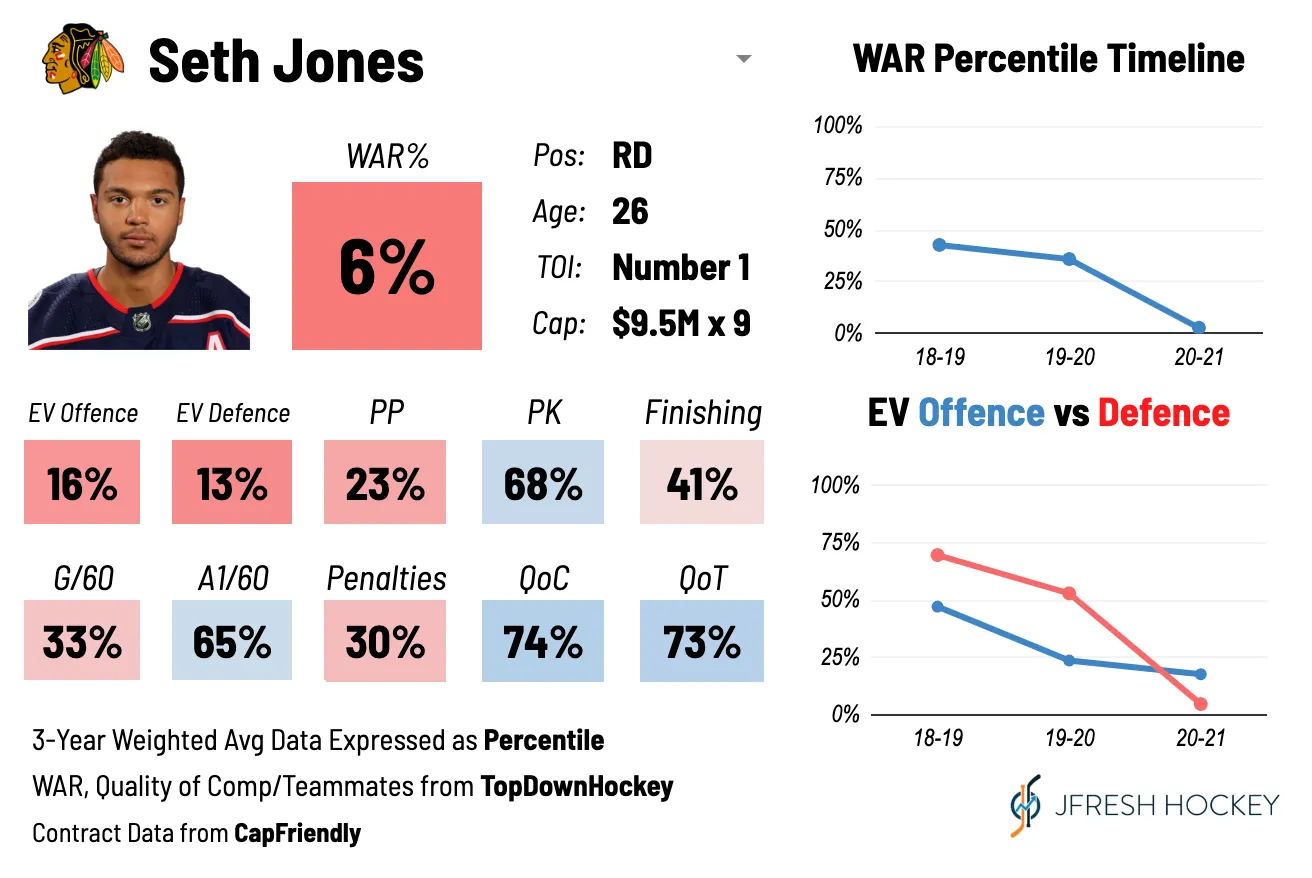
In a similar fashion, the Blackhawks repeated this mistake this past offseason by trading for Byram. Despite high-end point totals and on-ice play that draws the attention of fans across the league, their impact, once isolated for their environment and deployment, is minimal at best and negative at worst.

In both cases, the Blackhawks looked at the top of their lineup, saw a high-end player or two, and decided that they needed help immediately instead of letting the plan run its course. In the process, they sacrificed draft picks and prospects for a win-now piece, expecting it to carry the club back to contention. Instead, it temporarily brought them into no-man’s land: too good to land a top-three pick, and too bad to be seen as a playoff team. It only delayed the inevitable pain.
Recently, trade rumours have been swirling around Matvei Michkov, and if the Canucks are interested, management should consider whether trading for the young Russian would yield similar results.
Loss Aversion & Probability Weighing
In a way, the Blackhawks are entering the middle stages of their own “Quinn Hughes arc” with Connor Bedard. In both the Canucks and Blackhawks cases, fresh off missing the playoffs, the franchise cornerstone signs a medium-term extension off their Entry Level Contract, potentially walking them to unrestricted free agency.
For both clubs, the goal of building a contender remained. But with the clock ticking down to their contract expirations and unrestricted free agency, a second objective emerged: retain them at all costs.
The issue, however, is that if a General Manager panics early in the process, or if the superstar shows frustration, these two goals end up conflicting. Again, we see this in the Byram trade, where the Blackhawks’ lack of high-quality NHL defencemen (and only two high-end D prospects, both right-handed) led them to seek outside help to bring the team closer to its contention window way too early in the building process.
One could argue that the Canucks made a similar mistake back in 2021, when they traded the ninth overall selection and more for Oliver Ekman-Larsson and Conor Garland. Where could the Canucks’ core of Pettersson, Miller, Horvat, and Hughes have gone if they’d drafted Guenther and didn’t have to contend with a massive buyout penalty?
However, the Byram trade may not have been seen as a necessary risk if the Blackhawks had capitalized on some of their top-10 selections.
In 2022, the Blackhawks drafted defenceman Kevin Korchinski seventh overall. Coming off a 65-point campaign with the Seattle Thunderbirds, the 6’3”, 198-pound defenceman was looked at by the Blackhawks as an all-situations player who could be a solid top-pair defenceman. His draft rankings, however, paint a picture of a team that not only reached on a player projected to be drafted anywhere in the mid- to late-first round, but traded two-time 40-goal scorer Alex DeBrincat to do so.
Now, in 2026, Korchinski has not only failed to live up to expectations but is stuck in the mushy middle: too much value and potential to put on waivers, but not good enough to stick in the lineup consistently, playing in only five games this season.
The Blackhawks banked on him hitting his ceiling without considering the median and lower-end outcomes, and without a solid contingency plan in place.
Alex Vlasic, the Blackhawks’ next-best left-handed defenceman, has become a solid NHL player. However, his defence-first style meant he was never going to become a top-pair defenceman who fit the archetype the Blackhawks were hoping to fill with Byram. By failing to develop Korchinski, the Blackhawks wasted their most valuable trade asset, forcing them to spend even more premium assets just to keep their franchise player happy and willing to stay in Chicago beyond his five-year contract.
In the Canucks’ case, they eventually had to trade Quinn Hughes. Now with Zeev Buium as the star piece of the return, they have to do their utmost to prevent him from becoming their Korchinski. But if Buium doesn’t hit his ceiling, the Blackhawks have presented a clear example of what not to do.
In a world where the Canucks draft another superstar and any of their current or future top prospects fail to hit their ceilings, the last thing they should do is spend premium assets to supplement them while they’re still under long-term control. Instead, the club needs to lick its wounds, re-evaluate its practices, and prevent any mistakes from snowballing.
The best rebuilding teams are the ones that don’t fall victim to Prospect Theory. Will RJ and the Sedins figure out those warning signs? Or fall victim the same way the Blackhawks did? We shall see, but they do not have to look far to see a perfect case study of what could happen if they don’t.
Sponsored by bet365


Breaking News
- What the Canucks can learn from the Blackhawks tumultuous rebuild
- Sedins show united front and appeal for patience while assessing Canucks’ disappointing start to season
- Scenes from Canucks practice: Cameron Crotty links up with new teammates in first Canucks practice
- Blackfish: Medvedev trade and debut, Novotný plays overtime hero, and more
- 5 mock trades the Canucks and Blackhawks could explore

Vancouver CanucksTeam Cap Summary

Cap Summary
2026-27
2027-28
Projected Cap Hit
$87,846,504
$70,329,167
Projected Cap Space
$16,153,496
$43,170,833
Current Cap Space
$20,891,855
$43,170,833
Active Players
23/23
12/23
Draft Picks
Round
'27
'28
1
1
1
2
2
2
3
1
1