
CanucksArmy has no direct affiliation to the Vancouver Canucks, Canucks Sports & Entertainment, NHL, or NHLPA
Where each of the Canucks’ three young defencemen has improved the most, and why offence isn’t everything
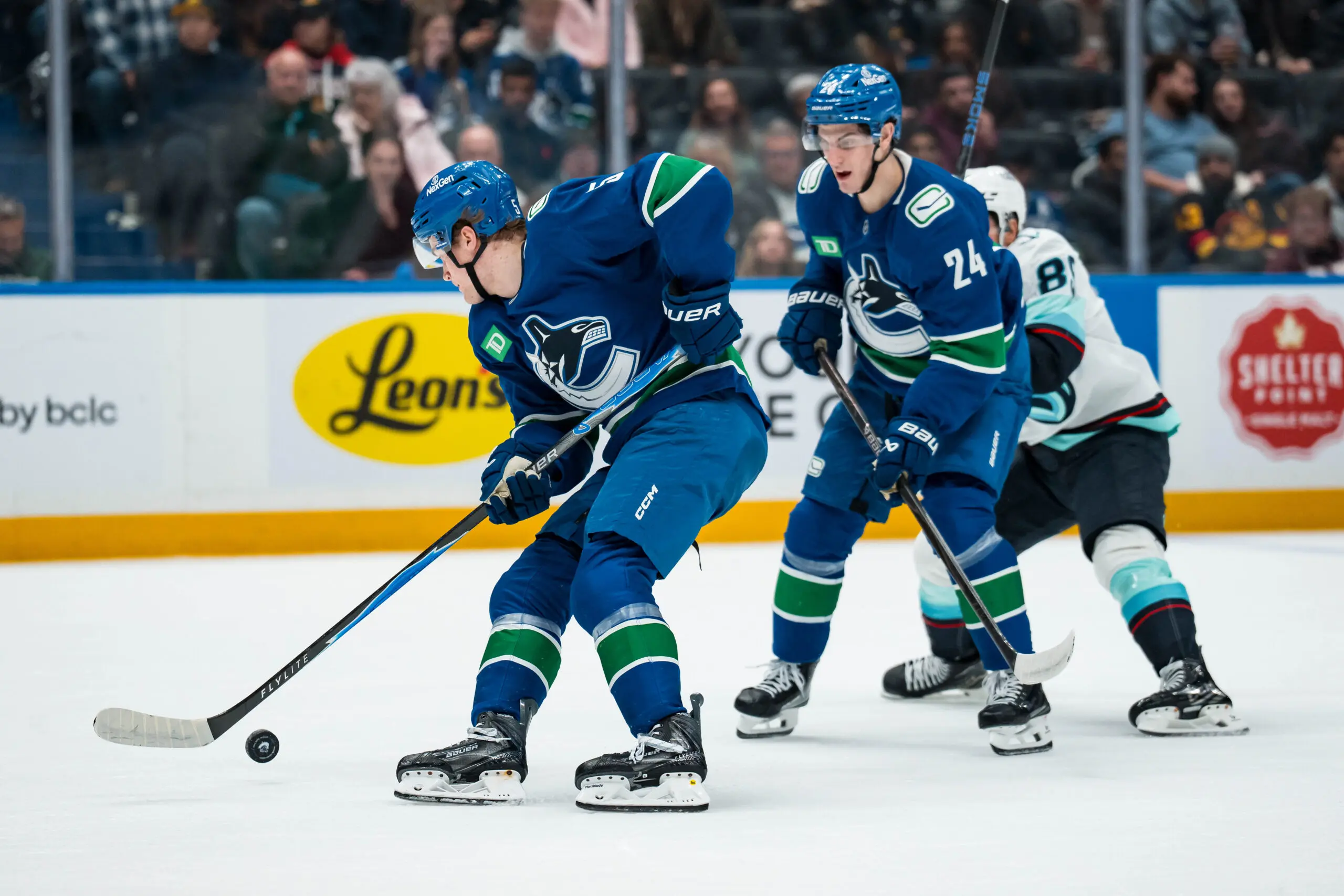
Photo credit: Bob Frid IMAGN IMAGES via Reuters Connect

Nov 28, 2026, 18:15 ESTUpdated: Nov 28, 2026, 18:19 EST


No one said progression was linear.
The Vancouver Canucks are more than 30% into their season, and the team results have been about as expected. A ton of losses, but with new head coach Manny Malhotra and general manager Ryan Johnson beginning to instill a fresh environment, the players have put in a ton of effort both on and off the ice.
While the improved play of veterans like Elias Pettersson and Brock Boeser has been encouraging, the club continues to focus on its young players, particularly its defencemen.
Zeev Buium, Tom Willander, and Elias Pettersson (D) have been under the microscope this season, and each has had their own peaks and valleys, which is common for young players. However, the importance of these three defencemen and how they could affect the future of the Canucks and their rebuild has put more pressure on them to develop quickly and provide tangible results.
With seven, four, and four points, respectively, the offensive results haven’t been great for the Canucks’ young blueliners, but that’s not necessarily a bad thing. Each defenceman has taken massive steps in other areas of their game, and it’s about time they’re given proper credit for their development.
Elias Pettersson
In his rookie season, Pettersson quickly established himself as a no-nonsense, physically imposing rookie who looked to have more defensive talent than previously believed, with some untapped offensive potential. With 51.06% Corsi for (CF%), 50.41% expected goals for (xGF%), and 52.73% high-danger scoring chance for (HDCF%), the 20-year-old (at the time) defenceman was not only surviving in the NHL, but thriving.
His sophomore season was a completely different story. Under former head coach Adam Foote’s “swarm” defensive zone structure, Pettersson looked lost. In 2024-25, he had found chemistry with both Tyler Myers and Filip Hronek, the Canucks’ right-handed defencemen in their top four, with 58.23 and 55.84 xGF%. In 2025-26, with those same linemates, he put up a dreadful 47.32 and 40.6 xGF%.
Those underlying metrics matched what people saw on the ice. A young defenceman made mistakes that ended up in the back of the net, shaking his confidence to the point where he became uncertain about executing the plays that made him such a promising prospect in the first place. He became hesitant to use his size and strength to wipe out opponents, and those small gaps grew into large ones that were picked apart to the point that he was sent down to the AHL.
This season, Pettersson has had some high peaks, including his early goal outburst, which saw him activate deep in the offensive zone and score a beautiful game-winner against the Calgary Flames. His valleys have been low, including times when his propensity for being physical, but not finishing the job, has led to goals against.
Nonetheless, his game has taken massive strides. His confidence is evident every night, especially when he pinches low to prevent the opponent from exiting the zone along the wall. He agitates opponents, isn’t afraid to get chippy, and stands up for his teammates, as shown by a post-whistle scrum against Toronto Maple Leafs rookie Gavin McKenna and by being jumped by both the Utah Mammoth and Vegas Golden Knights veterans late in Canuck victories against both teams.
Pettersson may not be an offensive dynamo, but there is untapped production, and he looks well on his way to becoming a solid #4 defenceman.
Zeev Buium
Going into this season, one of the Canucks’ biggest priorities was developing Zeev Buium. The youngest of the bunch, Buium has always had high expectations placed on him, and those expectations peaked when he became the centrepiece of the Quinn Hughes trade, followed by a contract extension that will make him the highest-paid defenceman in Canucks history starting in 2027-28.
With seven points, Buium’s production hasn’t been up to snuff for a defenceman who is slated to make $9.35M per year for the next eight seasons. His defensive game has also continued to be a work in progress, particularly around the crease, where he is frequently manhandled by forwards and is unable to use his mobility to kill chances before they formulate, which is how the aforementioned Hughes turned his defensive game from a weakness to an above-average trait.
But his development as a puck-moving defender who excels in transition has been a treat to watch, and it has gone under the radar outside of an article by West Coast Conversation co-host and The Athletic writer Harman Dayal.
Ranking 22nd and 23rd in controlled exits and entries, respectively, Buium has put himself into the company of defencemen like Erik Karlsson, Zach Werenski, and Owen Power in terms of his ability to transition the puck. More impressively, he has done this while turning the puck over 11.1% of the time, which is better than the NHL median of 12.3%.
Buium’s 5:03 of puck possession per game ranks 10th among NHL defencemen, and outside of Quinn Hughes’s astounding 7:11, Buium is within 44 seconds of every other name ahead of him.
Where Buium needs to improve is in his attacking. During three-on-three play, Buium attacks the net with purpose and is willing to take on opponents one-on-one to create chances. At five-on-five, however, Buium hasn’t been able to get pucks to the middle of the ice with his passing or his skating.
As the season has progressed, Buium has improved, but if he wants to go from a fantastic puck-moving defenceman to an elite offensive defenceman, he will need to improve his skating to generate more power on his first lateral step. Buium struggles to shake off attackers up top in the offensive zone, which prevents him from creating the separation he needs and finding lanes into the middle of the ice.
Tom Willander
If the Canucks held a fan survey about who they thought was the most improved Canuck, Tom Willander would likely be the runaway top pick.
Improved play recognition and strength, combined with his already high-end skating ability, have turned Willander into a solid top-four defenceman with underlying metrics that show even more untapped potential.
What best illustrates his importance to the Canucks is his teammates’ underlying metrics when Willander is on the ice versus when he is off it. Out of the 25 skaters who have played with the former 11th overall pick, zero have posted an xGF% above 47.92%, an SCF% above 46.34%, and an HDCF% above 50%.
With Willander? 10 players have posted an xGF% above 50%, 14 players have an SCF% above 50%, and 10 have an HDCF% above 50%. When Willander is on the ice, the club goes from being the clear-cut 32nd-ranked team in the NHL with a 38.1 xGF% to the fifth-worst team in the league, only 0.2% away from exiting the bottom five entirely.
On the surface, that doesn’t seem like a big deal, but in November, Willander’s 48.92 xGF% would take the Canucks from 32nd all the way up to 20th, just below the Montreal Canadiens and Colorado Avalanche.
His game has continued to improve, and the impact he is having on the Canucks in his minutes is continuing to be more pronounced, almost to the point where his ceiling looks to be that of a high-end #3 or low-end #2 defenceman as opposed to being the run-of-the-mill second pair defenceman he looked to be trending towards at the end of last season.
His mobility and improved puck skills have laid out a path to Willander becoming a future 30-point defenceman who can play in all situations. A potential 23-minute-per-game stud who shuts down with a combination of skating and strength, and has the confidence to activate in all areas of the ice to facilitate transitions and help drive plays for his linemates.
With a high-end work ethic and self-awareness that is uncommon in the average 21-year-old professional athlete, it would not be surprising to see Willander continue to take steps in the next couple of seasons.
THE MOST WONDERFUL DEAL OF THE YEAR IS HERE!

The holiday season just got a whole lot better. Nation Gear is celebrating the most wonderful time of the year with 25% OFF EVERYTHING SITEWIDE from November 27–30, 2026. Whether you’re shopping for the hockey fan in your life, checking off your holiday wish list or treating yourself to a little something new, there’s never been a better time to gear up. From game-day favourites to everyday essentials, find something for everyone on your list (including yourself). A little holiday cheer. A lot of great gear. Shop the Most Wonderful Deal of the Year at NationGear.ca before it’s gone!


Breaking News
- Where each of the Canucks’ three young defencemen has improved the most, and why offence isn’t everything
- The Statsies: Canucks’ penalty kill nears historic lows in loss to Flyers
- Canucks recall Abbotsford captain Chase Wouters; Pettersson placed on IR
- The Stanchies: Canucks can’t beat Michkov-less Flyers; lose 5-2 in Black Friday matinee
- Instant Reaction: Canucks play from behind all game long once again in 5-2 loss to Flyers

Vancouver CanucksTeam Cap Summary

Cap Summary
2026-27
2027-28
Projected Cap Hit
$88,379,919
$69,329,167
Projected Cap Space
$15,620,081
$44,170,833
Current Cap Space
$22,446,635
$44,170,833
Active Players
23/23
11/23
Draft Picks
Round
'27
'28
1
1
1
2
2
2
3
1
1