
CanucksArmy has no direct affiliation to the Vancouver Canucks, Canucks Sports & Entertainment, NHL, or NHLPA
The Statsies: Canucks’ penalty kill nears historic lows in loss to Flyers

Photo credit: Eric Hartline-Imagn Images

Nov 28, 2026, 13:00 ESTUpdated: Nov 28, 2026, 12:59 EST


The Philadelphia Flyers didn’t even need leading scorer Matvei Michkov, who was scratched for violating team rules, to put five on the board Friday afternoon, as Rick Tocchet’s group converted three of its five power play opportunities, while the Canucks came away empty-handed from eight minutes with the man advantage.
For all of Vancouver’s troubles on special teams, the fact that the Canucks outscored Philadelphia 2-1 at five-on-five is somewhat astonishing. They generated just 0.92 expected goals at full strength, with the Flyers holding an 8-3 advantage in high-danger chances.
Game Flow
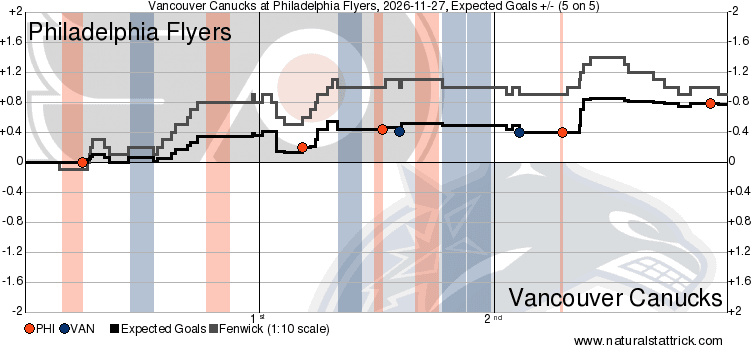
Slow starts have become all too familiar for the Canucks. Philadelphia held a 17-7 advantage in five-on-five shot attempts through the opening 20 minutes, marking the fifth consecutive game in which Vancouver has accounted for less than 34% of first-period expected goals.
That’s quite the departure from late October and early November, when the Canucks exceeded a 60 xGF% in five of six opening periods. Neither team registered a high-danger chance at five-on-five in Friday’s first period, but Vancouver struggled to create much offence at all, managing just three shots on goal to Philadelphia’s nine.
Play opened up in the second, with the teams combining for seven high-danger chances at five-on-five. Vancouver improved its expected-goals share to 43.67%, but nearly two-thirds of its offensive generation across all situations came on the power play.
Unlike Wednesday’s loss in Detroit, the quality of Vancouver’s offence evaporated in the final frame. Despite outshooting Philadelphia 6-5 at five-on-five, the visitors generated just 0.26 xGF and one high-danger chance.
Across their last five third periods, the Canucks have generated less than 0.50 xGF at five-on-five on three occasions. Vancouver should have more opportunities to create offence with opponents protecting leads, but the Canucks have consistently struggled to turn extended time on the attack into quality looks on net.
Heat Map
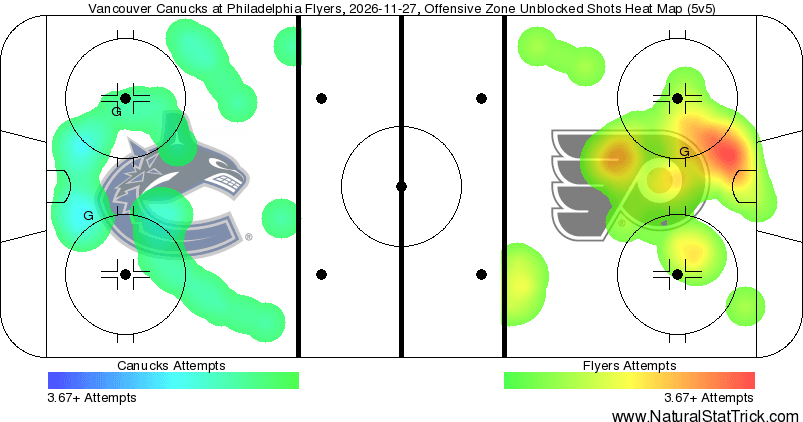
Philadelphia’s heaviest concentration of unblocked attempts came from the low slot, with another prominent cluster higher between the faceoff circles. Vancouver found some openings on either side of Dan Vladar’s crease, but much of its activity was spread along the outside of the circles.
It was similar to when these teams met at Rogers Arena earlier this month, when the home team generated just four high-danger chances at five-on-five. Friday marked the sixth consecutive game in which the Canucks have been outchanced in those areas, and Vancouver has lost that battle in 12 of its last 16 games.
Vancouver’s power play at least found more dangerous areas, generating four high-danger opportunities and 1.02 expected goals, nearly matching its combined output against Chicago and Detroit (1.06 xGF). Finishing those opportunities has been another matter. Dating back to Sunday’s loss to Chicago, Vancouver has gone 0-for-11 on the power play while allowing half of the opposition’s 14 shots with the man advantage to find the back of the net.
Having conceded 37 power-play goals through 28 games, the Canucks have seen their league-worst penalty kill sink to 59.3%. For perspective, the 1979-80 Los Angeles Kings hold the record for the worst penalty-killing percentage over a full season at 68.2%, nearly nine percentage points better than Vancouver’s current mark.
Individual Advanced Stats
Corsi Champ: Filip Chytil technically led Vancouver with an 80 CF% but logged just 2:54 at five-on-five before leaving with an injury. Among those who finished the contest, Tom Willander led the way at 51.72%, with a team-best plus-20.61 relative CF%. Willander has routinely been among Vancouver’s strongest possession players this season, but Friday’s performance shows the difference between shot volume and shot quality. Despite the Canucks holding a 15-14 edge in attempts during his minutes, Philadelphia generated nine scoring chances to Vancouver’s four, leaving the rookie with a less flattering 42.39 xGF% — which is particularly noteworthy given that he didn’t start a single five-on-five shift in the defensive zone.
Corsi Chump: Luke Schenn registered eight hits and picked up an assist, but Vancouver was outattempted 16-3 and failed to generate a scoring chance during his 9:29 at five-on-five. It’s the third time this month the veteran has finished with Vancouver’s lowest CF%, having previously earned Corsi Chump honours against Toronto on Halloween (35.29%) and Philadelphia on Nov. 9 (26.09%). Friday’s 15.79% was even worse.
xGF%: Despite being outattempted 10-8, Jamie Oleksiak’s ability to limit the quality of opposition chances stood out on Friday, as the 33-year-old surrendered just 0.19 xGA across 13:08 at five-on-five, finishing with a 71.36 xGF%. Oleksiak produced similarly favourable results against Utah earlier this month (74%), albeit in nearly six fewer minutes. Meanwhile, D-Petey’s 18.03 xGF% was his third sub-20% performance in the past four games.
GSAx: Leevi Meriläinen finished below expected for a third consecutive start, stopping 23 of 27 shots for a minus-0.99 GSAx. His performance at five-on-five was better though, as the 24-year-old turned aside 16 of 17 shots for a plus-0.69 GSAx. Dan Vladar had a relatively light workload by comparison, stopping 18 of 20 shots to finish marginally above expected (plus-0.10).
Statistical Musings
Rossi inherits a much bigger workload: Following Chytil’s latest injury, Marco Rossi played nearly eight minutes more than his average on Friday to reach 23 minutes for the first time this season. The diminutive forward led Vancouver with 15:38 at five-on-five and took 21 faceoffs, winning nine. His most frequently deployed combination with Liam Öhgren and Brock Boeser managed a 35.80 xGF% over 9:46, but a brief stint between Jake DeBrusk and Jonathan Lekkerimäki yielded an 89 xGF% in 2:26. With Elias Pettersson already unavailable, Manny Malhotra may have little choice but to give Rossi more responsibility than he’s accustomed to.
Buium gets a longer look on the power play: Power-play minutes were more evenly split between Filip Hronek and Zeev Buium on Friday, with the former logging 4:17 to the latter’s 3:46. Vancouver was still more dangerous with Hronek quarterbacking the power play, generating 0.91 xGF and all four of its high-danger opportunities during his minutes compared to just 0.11 xGF with Buium on the ice, but given the Canucks’ recent struggles with the man advantage, there’s little reason not to continue experimenting with the 20-year-old.
Quillan’s offensive production dries up: Jacob Quillan posted a team-low 3.15 xGF% at five-on-five, with Vancouver generating just 0.01 expected goals during his 12:22. Alongside Cole Reinhardt and Paul Cotter, the Canucks’ fourth line failed to register a shot on goal in 8:59 together and finished with a 4.02 xGF%. Reinhardt went the entire afternoon without an individual shot attempt, finishing with a 14.23 xGF% at five-on-five despite starting three shifts in the offensive zone and none in the defensive end.
Lekkerimäki finding other ways to contribute: Now goalless in eight consecutive games, Jonathan Lekkerimäki led the Canucks with 0.46 individual expected goals on Friday despite registering just one shot on net. All of that came on the power play, where the 22-year-old accounted for nearly half of Vancouver’s expected goals and two of its four high-danger opportunities. His offensive contributions at five-on-five came exclusively through his playmaking, as the Canucks outshot Philadelphia 6-3 during his 8:15 despite not registering a shot himself. His primary assist on DeBrusk’s goal was his 12th helper of the season, with assists now accounting for nearly two-thirds of his production.
As a team
CF% – 39.19% | HDCF% – 27.27% | xGF% – 35.26%
Accounting for the score and venue drops Vancouver’s five-on-five numbers to 35.82 CF%, 26.95 HDCF% and 34.05 xGF%. That’s the Canucks’ lowest adjusted share of shot attempts in their past six games, but perhaps more concerning is how infrequently they’ve generated better chances than their opponents over the past month.
Since posting a 64.19 xGF% against San Jose on Oct. 29, Vancouver has controlled the majority of five-on-five expected goals just once in 13 games in its victory over Vegas. Much of the discussion this season has centred on Vancouver’s special teams and goaltending, but those numbers point to a deeper issue with the Canucks’ five-on-five play.
When the Canucks last faced Philadelphia earlier this month, the Flyers controlled 70% of first-period shot attempts at five-on-five. Nearly three weeks later, against the same opponent, Vancouver somehow conceded an even greater share.
The Canucks have now allowed at least five goals in four of their last five games, and for all the individual development taking place throughout the lineup, establishing some semblance of defensive structure would go a long way toward putting those young players in better positions to succeed.
All statistics courtesy of naturalstattrick.com
Sponsored by bet365


Breaking News
- The Statsies: Canucks’ penalty kill nears historic lows in loss to Flyers
- Canucks recall Abbotsford captain Chase Wouters; Pettersson placed on IR
- The Stanchies: Canucks can’t beat Michkov-less Flyers; lose 5-2 in Black Friday matinee
- Instant Reaction: Canucks play from behind all game long once again in 5-2 loss to Flyers
- Canucks announce forward Filip Chytil will not return vs. Flyers

Vancouver CanucksTeam Cap Summary

Cap Summary
2026-27
2027-28
Projected Cap Hit
$88,379,919
$69,329,167
Projected Cap Space
$15,620,081
$44,170,833
Current Cap Space
$22,446,635
$44,170,833
Active Players
23/23
11/23
Draft Picks
Round
'27
'28
1
1
1
2
2
2
3
1
1