
CanucksArmy has no direct affiliation to the Vancouver Canucks, Canucks Sports & Entertainment, NHL, or NHLPA
The Statsies: Canucks lose the special teams battle vs. Blackhawks
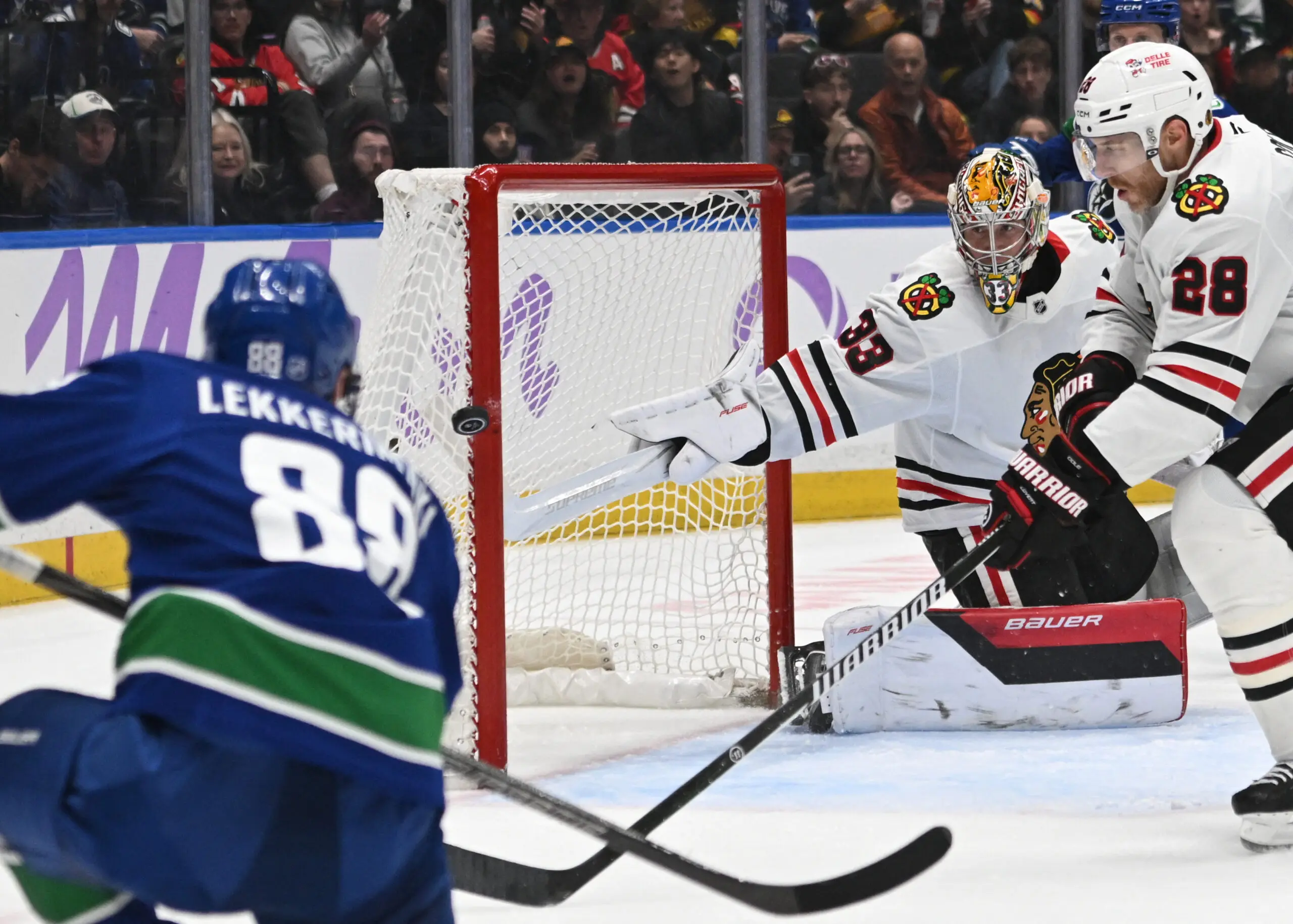
Photo credit: Simon Fearn-Imagn Images

Nov 23, 2026, 12:00 ESTUpdated: Nov 23, 2026, 12:02 EST


The Chicago Blackhawks had a 100% shooting percentage on the power play Sunday night. Unfortunately for the Vancouver Canucks, that’s not a typo.
All three shots on goal with the man advantage found the back of the net, helping Chicago cruise to a 6-3 victory and making Vancouver’s best five-on-five performance in three games feel largely irrelevant.
Roman Kantserov was the star of the night, scoring three goals on just 0.70 individual expected goals while adding an assist for a four-point night. The rookie was on the ice for four Chicago goals without conceding one, with the Blackhawks controlling 71.08% of expected goals and holding a 15-6 advantage in scoring chances during his shifts.
Game Flow
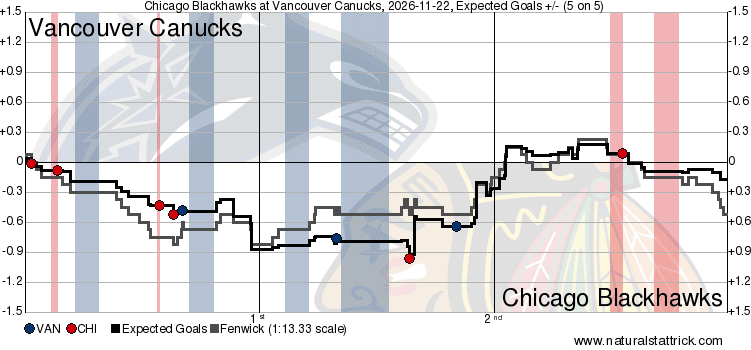
Right from the opening faceoff, Vancouver had little answer for Chicago’s attack. The Blackhawks outattempted the Canucks 22-12 at five-on-five and controlled 84.61% of expected goals, generating 1.07 xGF while allowing just 0.19. Worse still, the visitors accounted for six of the period’s seven high-danger chances.
Vancouver stabilized in the second, outattempting Chicago 19-10 at five-on-five and controlling 68.77% of expected goals. The Canucks generated 1.13 xGF while allowing just 0.51, with Chytil and DeBrusk helping cut the deficit to two.
Any hopes of completing the comeback faded when Chicago regained a 17-14 edge in five-on-five shot attempts during the third, although Vancouver narrowly led in expected goals, 0.65-0.57.
It’s becoming a familiar pattern for Vancouver, which has struggled to put together three competitive periods this season. Seattle controlled 87.22% of first-period expected goals at five-on-five Thursday, while Minnesota nearly doubled the Canucks’ output in the opening frame Saturday (1.11-0.54 xGF). Sunday’s second-period recovery was another glimpse of what this group can do once their legs are moving, but finding that level consistently has been the bigger problem.
Heat Map
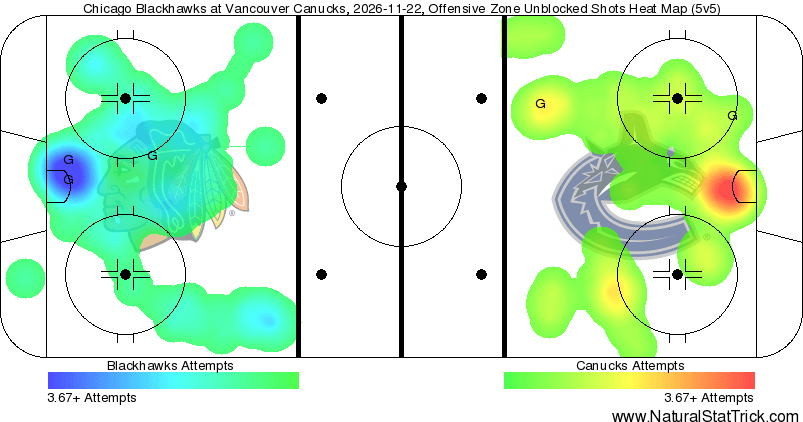
Chicago found repeated openings around Vancouver’s crease and through the inside of the faceoff circles. The Canucks had some activity near Drew Commesso’s net, but their attempts were spread across the right side and farther into the circles, without the same sustained pressure down the middle of the ice.
At five-on-five, the Blackhawks generated 10 high-danger chances to Vancouver’s seven and held a 28-17 advantage in scoring chances as a whole. That’s an improvement on Saturday’s 9-5 high-danger deficit against Minnesota, but still another game in which the opposition got the better looks.
As outlined earlier, special teams were an outright disaster for Vancouver. Chicago needed just 3:40 of power-play time to score three goals, despite generating only 0.61 expected goals, and at the other end, the Canucks squandered all five of their chances, including a four-minute double minor, producing just 0.90 xGF across 10 minutes with the man advantage.
Sunday’s heat map reflected a problem that has plagued Vancouver all season. Entering the contest, the Canucks ranked 30th in the NHL with just 37% of five-on-five high-danger chances and sat dead last with a 39.7 xGF%. Even against a Chicago team ranked 29th in high-danger share, Vancouver struggled to protect the middle of the ice or consistently create opportunities from those same areas.
Individual Advanced Stats
Corsi Champ: Brock Boeser led Vancouver with a 65.22 CF% at five-on-five, as the Canucks outattempted Chicago 15-8 during his 10:53 on the ice. His plus-22.96 relative CF% was particularly notable given the uneven underlying numbers throughout his career-high 11-game point streak. Boeser has collected four goals and 12 assists over that stretch, yet Vancouver has controlled less than half of expected goals during his five-on-five shifts in seven of those contests. Sunday’s performance was a welcome change, with his territorial play finally matching the production that has made him one of the few consistent bright spots this season.
Corsi Chump: Elias Pettersson’s recent struggles are a sharp departure from his impressive start to the season. Through Oct. 17, the young defenceman led Vancouver’s regulars with a 55 CF% and 51.5 xGF% at five-on-five, even earning himself a promotion to the top pairing. Those numbers have taken a beating lately. After posting a 27.27 CF% against Minnesota, Pettersson finished dead last again at 26.09% against Chicago, with the Canucks outattempted 17-6 and outchanced 7-0 during his 10:59. His 6.29 xGF% was even uglier, marking a second consecutive outing in which the 22-year-old has looked nothing like the player from a month ago.
xGF%: Boeser led again at 80.07%, followed by DeBrusk (75.28%) and Chytil (73.26%). Their line generated 0.94 expected goals against 0.22 and controlled all four high-danger chances in 8:57 together, even though Chicago scored the lone five-on-five goal during those minutes. That’s quite the change from Saturday, when the same trio mustered only 0.12 xGF over 13:55 against the Wild. On the other end of the ledger, Pettersson was joined by Bains (10.63%), Quillan (11.49%) and Karlsson (17.51%) below 20%.
GSAx: Nikita Tolopilo was left to fend for himself as Chicago generated six high-danger chances at five-on-five and scored twice on the power play, leaving the rookie facing an uphill battle before he was pulled just 12:44 into the contest. Still, allowing four goals on only 0.80 expected against produced an ugly minus-3.20 GSAx, a far cry from his plus-2.62 performance in Monday’s win over Utah. Kevin Lankinen fared considerably better in relief, allowing two goals on 1.96 xGA for a minus-0.04 GSAx, while Chicago’s Drew Commesso finished at plus-0.17 after surrendering three on 3.17 expected.
Statistical Musings
A fourth-line reversal: The Bains–Quillan–Cotter line was a surprise success on Saturday, posting a 91.21 xGF% and an 8-1 shot-attempt advantage in 8:07 against Minnesota, but those numbers flipped against Chicago. Across 8:34 together, the trio was outattempted 14-6, surrendered all three high-danger chances and posted a 12.74 xGF%. Buium’s first-period goal came with that group on the ice, but it disguised a rough territorial outing.
Quillan’s season under the hood: Quillan had a mixed night, picking up the secondary assist on Buium’s goal, winning five of seven faceoffs and delivering four hits. His 11.49 xGF% at five-on-five was far less impressive, with Vancouver outchanced 10-2 during his shifts. After recording five goals and seven points in seven games with Abbotsford, the 24-year-old now has two assists through four NHL appearances this season. Establishing himself as a reliable bottom-six centre is still a work in progress.
Buium making his case: After admitting he was hesitant with everything earlier this season, Zeev Buium has now scored in consecutive outings, with Sunday’s performance offering plenty of reasons for optimism. The 20-year-old recorded eight shot attempts and a 55.14 xGF% at five-on-five, a considerable improvement on his season-long mark of roughly 34%. Despite his strong showing, Buium received just 3:59 of power-play time compared with Filip Hronek’s 6:02, though that was considerably more than his November average of 1:31 entering the weekend. With Vancouver going 0-for-5 on the man advantage, maybe Manny Malhotra gives him a longer look on the top unit.
Mueller’s faceoffs came with a catch: Fresh off his recall from Abbotsford and with shades of Aatu Räty, Ty Mueller won 10 of his 14 draws, an impressive 71.4% in his first weekend back with the big club. But possession after the faceoff was another matter. Vancouver didn’t generate a single five-on-five scoring chance during his 11:17 while giving up four, and his line with O’Connor and Karlsson finished with a 20.90 xGF%. Even though the team has struggled on faceoffs under Malhotra, if Mueller wants to avoid following Räty out the door, he’ll need to offer more than win draws.
As a team
CF% – 47.87% | HDCF% – 41.18% | xGF% – 47.90%
Those raw five-on-five figures look considerably better than Vancouver’s 33.77 xGF% in Saturday’s win over Minnesota or 30.81% in Thursday’s loss to Seattle. But accounting for the score and venue knocks Sunday’s numbers back to 39.78 CF%, 34.26 HDCF% and 40.85 xGF%. That’s still the strongest adjusted expected-goals share of those three outings, however it’s a small consolation in a game largely decided in the first 12 minutes.
Sunday was supposed to be a chance for consecutive home victories for the first time in 20 months. Instead, the Canucks followed a spirited win over the league-leading Wild with another night spent trying to undo an early collapse.
Saturday showed they could steal points despite poor underlying numbers, but against Chicago, the five-on-five results improved and the score got worse. Until the Canucks show up ready to play in the first period and penalty kill becomes more reliable, even their better stretches won’t count for much.
All statistics courtesy of naturalstattrick.com
PRESENTED BY VIVID SEATS


Breaking News
- The Statsies: Canucks lose the special teams battle vs. Blackhawks
- Why Canucks management are prioritizing World Juniors for Braeden Cootes
- The Stanchies: Canucks gain edge in NHL Draft lottery with important loss to Blackhawks
- Instant Reaction: Buium scores again in Canucks’ 6-3 loss to Blackhawks
- NHL Notebook: Red Wings trade Larkin to Canadiens in 10 piece blockbuster

Vancouver CanucksTeam Cap Summary

Cap Summary
2026-27
2027-28
Projected Cap Hit
$88,406,788
$69,329,167
Projected Cap Space
$15,593,212
$44,170,833
Current Cap Space
$21,607,737
$44,170,833
Active Players
23/23
11/23
Draft Picks
Round
'27
'28
1
1
1
2
2
2
3
1
1