
CanucksArmy has no direct affiliation to the Vancouver Canucks, Canucks Sports & Entertainment, NHL, or NHLPA
How are the Canucks really doing on the draw under faceoff specialist Manny Malhotra?
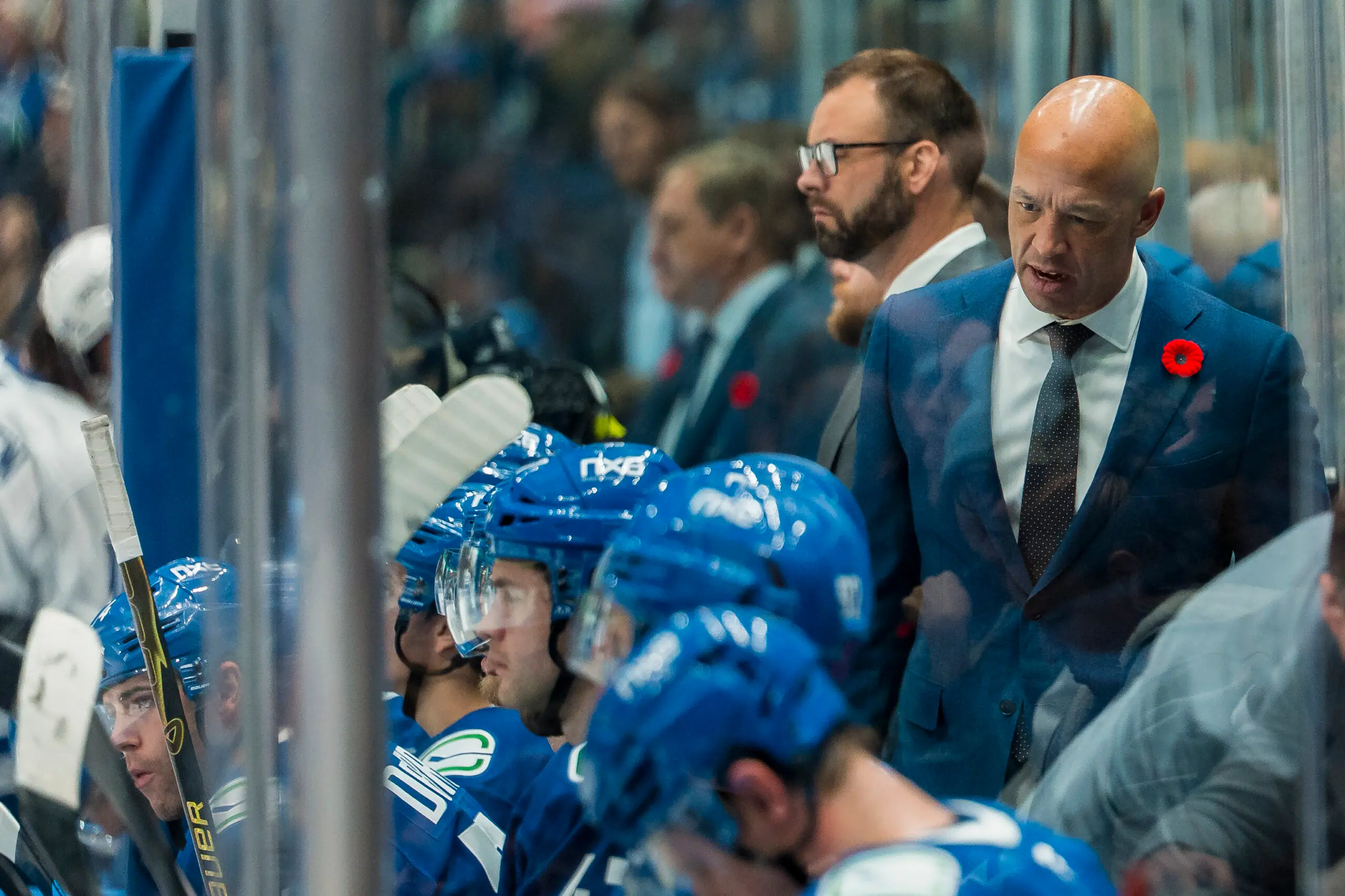
Photo credit: Bob Frid for IMAGN IMAGES via Reuters Connect

Nov 3, 2026, 12:45 EST


When we recently compared the Vancouver Canucks’ start in 2026-27 to their first month of games last year, a few things jumped out at us, and one in particular was surprising: these Canucks’ performance on faceoffs.
The Canucks hired Manny Malhotra as their head coach this summer, and if there’s one thing Malhotra was known for in his playing days, it was faceoff prowess. Malhotra’s 56.36% career winning percentage is still the 27th-highest of all time in the NHL. We’ve already seen a number of clips of him going head-to-head with his players in practice, trying to teach them the tools of his trade.
And yet, his Canucks are – thus far, anyway – worse at taking faceoffs than were Adam Foote’s 2025-26 Canucks. The 2026-27 squad is winning faceoffs at a rate of just 46.5%. That’s the fifth-worst rate in the league right now. The 2025-26 Canucks won them at a rate of 49.3%. It’s an almost three-percent drop, and in the department where it might have reasonably been least expected.
However, within the context of the roster Malhotra is working with, it actually makes plenty of sense. It basically comes down to a loss of Aatu Räty, first via regular healthy scratching, and then via a trade to the Toronto Maple Leafs.
When we say that Malhotra is one of the greatest faceoff-takers in NHL history, it’s true, but he’s still got nothing on Räty. As of this writing, Räty’s 59.09% all-time faceoff win rate ranks fourth all-time, behind just Yanic Perreault, Zenon Konopka, and Joe Nieuwendyk. He’s legitimately one of the best to ever do it, and his ability to do it somewhat ambidextrously only adds to that capacity.
Last year, Räty took a total of 777 faceoffs for the Canucks, including most of their important ones. He won them at a rate of 60.5%. This year, Räty was only around long enough to take 44 total faceoffs, of which he won 56.8%.
Without Räty on the ice, all those faceoffs fall to other, lesser faceoff-takers. And that, more than anything, explains the Canucks’ overall drop-off in faceoff percentage.
If we go player-by-player, two of the Canucks centres have actually improved under Malhotra. Marco Rossi was at 49.6% last year, and this year he’s up to 51.8%. That’s the first positive rating of his career. Max Sasson has had an even bigger climb, going from 42.1% last year to 45.6% this year, despite taking a lot more faceoffs overall.
Filip Chytil has seen his numbers drop from 49.2% to 46.7%, but that can probably be explained by the fact that he suffered a shoulder injury in the preseason, something that has to affect taking faceoffs.
A drop-off of nearly equal proportions, and far more consequential, has been had by Elias Pettersson. But this one is also easily explainable. Last year, Pettersson won faceoffs at a rate of 47.5%, which is slightly above his career average. This year, it’s down to 45.1%.
But Pettersson is being asked to take a lot more faceoffs this year than he ever has before. In 2025-26, Pettersson took 1,353 total faceoffs across 74 games. Thus far in 2026-27, he’s taken 337 in just 16 games. That translates to more than 1,700 total across a full season. Thus far, no other NHL centre has taken more faceoffs than Pettersson has in 2026-27.
Beyond that, Pettersson has been asked to take on most of Räty’s load on both important draws and all-situations draws. He’s taking draws in the offensive zone, the defensive zone, and the neutral zone. He’s taking them on his strong side and on his not-so-strong side. He’s taking them all, more or less.
Contrast that with last year, when on any given particularly difficult faceoff situation, Pettersson was almost certainly being replaced by Räty, at least for the draw. This pretty well explains why Pettersson’s personal faceoff numbers have dropped, and because he’s taking so many of the Canucks’ draws overall, it also pretty well explains why the Canucks’ overall faceoff numbers have dropped.
Another factor worth talking about is that these Canucks have played nine of 16 games on the road so far. Compare that to an even 50-50 split over the course of a full season. Home teams receive some clear advantages on faceoffs, including getting to put their stick down last for neutral zone draws, and the last change, which allows for more favourable matchups. As soon as the Canucks even up their number of home and away games, their faceoff percentage should tick a little bit upward as a result.
So, to summarize, the Canucks have only really technically gotten worse at faceoffs under Malhotra. A more accurate description is that they’ve, at the very least, tread water after losing one of the greatest faceoff-takers of all time from their roster, and that should probably be considered an accomplishment at the end of the day.
Some Canucks, like Rossi and Sasson, are getting noticeably better at faceoffs. And Pettersson, if his numbers aren’t going up, is at least becoming a more reliable, relied-upon faceoff-taker. Over time, one expects his numbers to at least trend upward, and if he keeps taking as many faceoffs as he has been, that’ll have to be considered an overall improvement.
Plus, at the end of the day, it’s only been 16 games, and there was a big road trip in the middle of that, which meant less practice time than usual. So, if you’re surprised that the Canucks aren’t already better at faceoffs under Malhotra, give it time.
As with all things, the Canucks are playing a long game here.
Sponsored by bet365


Breaking News
- The Statsies: Jake DeBrusk and Canucks’ top line tilt the ice despite loss to Ducks
- Should the Canucks claim Brad Lambert off NHL waivers from Winnipeg?
- Canucks prospect Anthony Romani named Big Ten Second Star of the Week
- The Stanchies: Canucks fight their way to another spirited near comeback, lose 5-4 to Ducks
- Instant Reaction: Canucks battle back late again to give Ducks a scare, but lose 5-4

Vancouver CanucksTeam Cap Summary

Cap Summary
2026-27
2027-28
Projected Cap Hit
$87,993,412
$71,329,167
Projected Cap Space
$16,006,588
$42,170,833
Current Cap Space
$19,530,051
$42,170,833
Active Players
23/23
13/23
Draft Picks
Round
'27
'28
1
1
1
2
2
2
3
1
1