
CanucksArmy has no direct affiliation to the Vancouver Canucks, Canucks Sports & Entertainment, NHL, or NHLPA
Are the Canucks playing their veteran players too much?
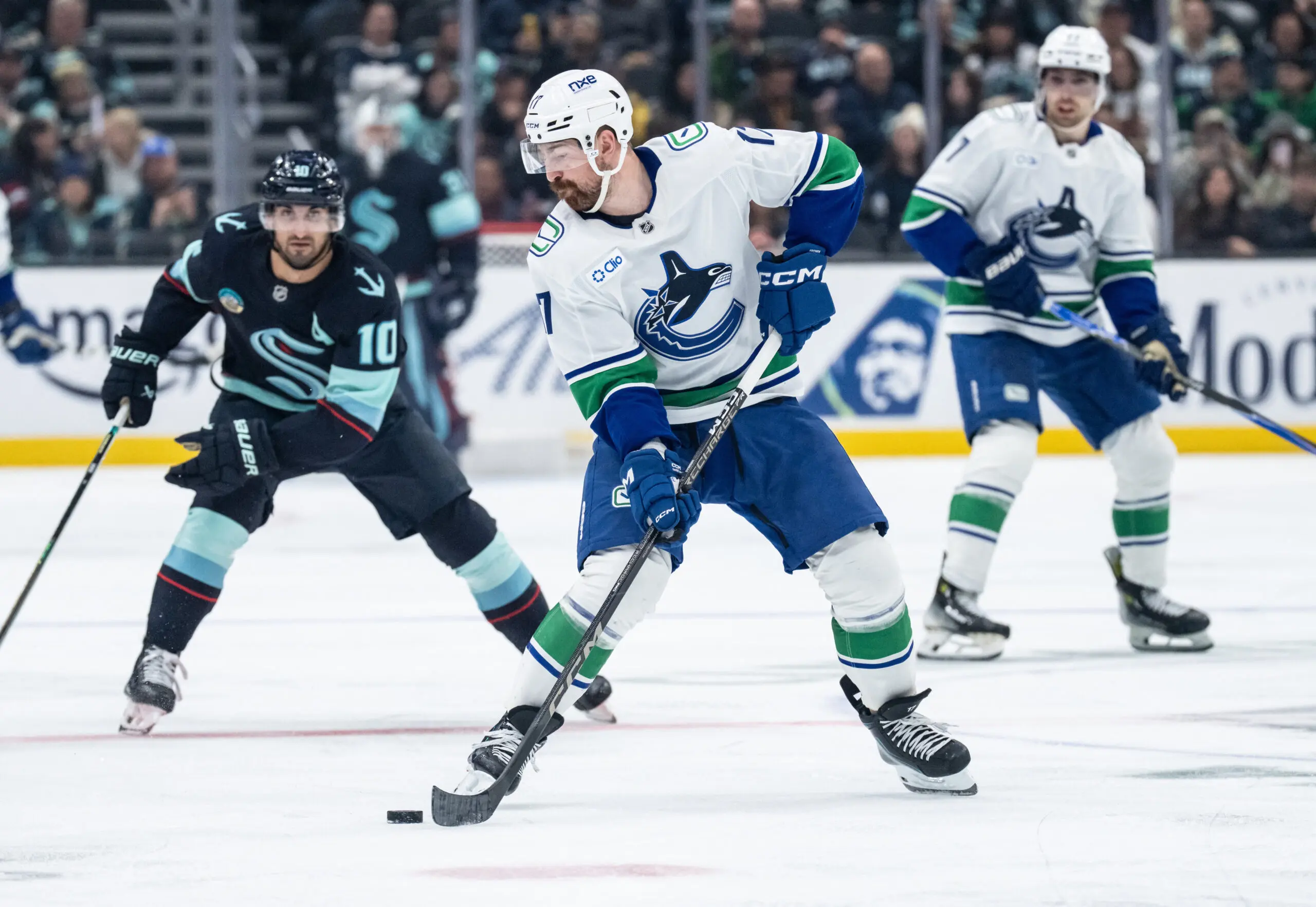
Photo credit: Stephen Brashear for IMAGN IMAGES via Reuters Connect

Nov 20, 2026, 13:44 EST


The Vancouver Canucks’ veterans are, for the most part, playing well right now. But are they playing too much? That is the question.
There’s not much debate to be had about whether the vets are playing a lot. That’s fairly indisputable. For the month of November, the 29-year-old Filip Hronek doesn’t just lead the Canucks in ice time; he leads the entire league with an average of 28:37 a night. Next up is his frequent D partner, Zeev Buium, who is not a veteran, at 23:05 a night. After Buium, however, come two veteran forwards: the 28-year-old Elias Pettersson (21:49 a night) and the 29-year-old Brock Boeser (21:32). Those are the 10th- and 13th-highest ice times for NHL forwards in November.
To be fair, Tom Willander (20:04) and the younger Elias Pettersson (20:02) are next up on the ice-time chart as the dedicated second blueline pairing. But on the forward side of things, it’s all veterans at the top. After Pettersson and Boeser come the 27-year-old Filip Chytil (18:53) and the 30-year-old Jake DeBrusk (17:13). You’ve got to go all the way down to Jonathan Lekkerimäki at 15:49 a night to find a young forward on the list.
The ice-time being tilted toward the veterans is perhaps most prominent on the power play. Through November, the Canucks’ five leaders in average PP ice time are DeBrusk (3:32), Pettersson Sr. (3:27), Lekkerimäki (3:26), Boeser (3:24), and Hronek (3:19). Again, only Lekkerimäki can be counted among that group as a non-veteran. Next on the list comes Buium at a relatively minuscule 1:31 a night.
It must be said that some of the vets are playing well under this workload. Pettersson remains at a point-per-game, DeBrusk’s scoring rate has increased, and Boeser has stepped up most of all. He now leads the team in scoring with 24 points, has 11 points through eight November games, and is on a nine-game point streak going back to October. Chytil, too, it should be mentioned, has only played four games in November, but has three goals in those four games.
There are some questions to be had about the impact all these minutes are having on Hronek. The overall effectiveness of his two-way game seems to be diminished of late, and his scoring pace has slipped.
But the greater question to be asked is this: whether or not playing the veterans this much is good for the Canucks in the short-term, is it good for them in the long-term?
The 2026-27 season itself is, and never has been, the priority. The rebuild and its needs supersede everything right now, or at least they should.
Based on the numbers, there’s little doubt that playing the veterans more than the youth gives Vancouver more chances to win hockey games. But what about player development? Players normally get better by playing more, and the Canucks have a lot more invested in the future performance of their various young players than they do in the current performance of anyone.
It’s easy enough to say, hey, this is a rebuild, and so, of course, the youth should be playing more. But there are other factors to consider here. NHL teams typically want minutes to be earned by performance. They also don’t want young players overwhelmed by minutes they’re not ready for yet. And none of Vancouver’s youth are beating down the door for more ice time via their performance right now, except for Lekkerimäki – and he’s getting the ice time.
There’s also the factor of trade value. Vancouver’s various young pieces all theoretically have years to grow and develop and figure out their games. Some of the veterans, on the other hand, will be moved out in the near future. If folks like DeBrusk, Pettersson, and Hronek are traded in the next year or two, maximizing their value by maximizing their minutes now makes some sense.
And we can’t go this entire article without talking about winning games. No, it’s not the primary object of the Canucks’ 2026-27 campaign. In fact, most want them to lose as much as possible. But losing too much and too hard can be demoralizing, and that can have a detrimental impact on development in and of itself. Playing the vets more now might be worth an extra win or two, and that might help the rest of the team from getting too down in the dumps.
Really, there is a balance to be struck here. And it’s probably one that the Canucks will need to adjust as the season wears on, and adjust back in the direction of youthful ice-time. The vets showing they can carry the team for a stint is all well and good, and could be a positive in terms of trade value. But at a certain point, those responsibility reins need to be handed off to the players who are eventually going to inherit them one way or another.
The power play is, again, the best example of this. Really, the PP is one of the few examples of success to be found on the Canucks’ stat page this year. They’ve got a 22.7% PP right now, which ranks 14th in the league and is less than two percentage points out of the top ten. That’s worth celebrating, but most of that success is down to DeBrusk, Boeser, Pettersson, and Hronek. Where does that leave the Canucks in a few years, when most of those players will be gone?
It seems best to use veterans to get the ball rolling, then hand it off to the youth. In the case of the power play, it’s probably time to start cycling some younger folks onto that top unit while it’s still hot. Swap Hronek out for Buium. Give DeBrusk’s spot to Liam Öhgren for a few games. Put Marco Rossi back out there.
Sure, the power play might dip a bit as a result. But it’s long-term gains over short-term pains, and we all know which one the Canucks should be focused on.
Which is all to say this: the Canucks’ current overplaying of their veteran players is not necessarily an issue…yet. Those players are playing the best right now, and are the ones who seem to have adapted to coach Manny Malhotra’s systems the quickest. But the keys have to be handed off sooner rather than later. If this is all set up for that slow-but-sure transition to the youth playing more as the vets get traded off, that’s wonderful. But if this sort of deployment continues all season, and even beyond, then real questions will have to be raised about the impact on player development.
Sponsored by bet365


Breaking News
- Are the Canucks playing their veteran players too much?
- Canucks: Filip Hronek’s agent reminds everyone his client has a full no-move clause
- The Statsies: Canucks post just 30.81 xGF% in deflated loss to Kraken
- The Stanchies: Canucks two-game winning streak snapped in 5-1 loss to Kraken
- Instant Reaction: Boeser extends point streak to nine games in Canucks’ 5-1 loss to Kraken

Vancouver CanucksTeam Cap Summary

Cap Summary
2026-27
2027-28
Projected Cap Hit
$87,211,195
$70,329,167
Projected Cap Space
$16,788,805
$43,170,833
Current Cap Space
$22,776,421
$43,170,833
Active Players
22/23
12/23
Draft Picks
Round
'27
'28
1
1
1
2
2
2
3
1
1