
CanucksArmy has no direct affiliation to the Vancouver Canucks, Canucks Sports & Entertainment, NHL, or NHLPA
The Statsies: Canucks post just 30.81 xGF% in deflated loss to Kraken

Photo credit: Stephen Brashear-Imagn Images

Nov 20, 2026, 10:15 ESTUpdated: Nov 20, 2026, 10:12 EST


Put the parade on hold.
After finally stringing together consecutive victories against the Vegas Golden Knights and Utah Mammoth, the Vancouver Canucks were brought back down to earth Thursday night, falling 5-1 to the Seattle Kraken in a game that could have gotten ugly much earlier.
Seattle completely overwhelmed Vancouver in the opening period, controlling 80.56% of the five-on-five shot attempts and 87.22% of expected goals. The Kraken held an 8-1 advantage in high-danger chances and outshot the Canucks 24-5, yet somehow Leevi Meriläinen’s 23 saves sent the visitors into the intermission tied 1-1.
Jake DeBrusk’s power-play marker was all Vancouver could muster offensively, with Brock Boeser picking up an assist to extend his point streak to nine games. That was about the only positive for the winger, who finished with a team-worst 25.81 CF% at five-on-five. His line with Filip Chytil and Paul Cotter didn’t fare any better, getting outattempted 18-5 and surrendering five high-danger chances while generating just one.
After Nikita Tolopilo helped steal Monday’s victory in Utah, Vancouver once again needed its goaltender to overcome a lopsided territorial performance. But this time, there was no silver lining, as the Canucks finished with just 30.81% of the expected goals at five-on-five.
Here’s the game, by the numbers. And as always, you can find our glossary guide of advanced stats here.
Game Flow
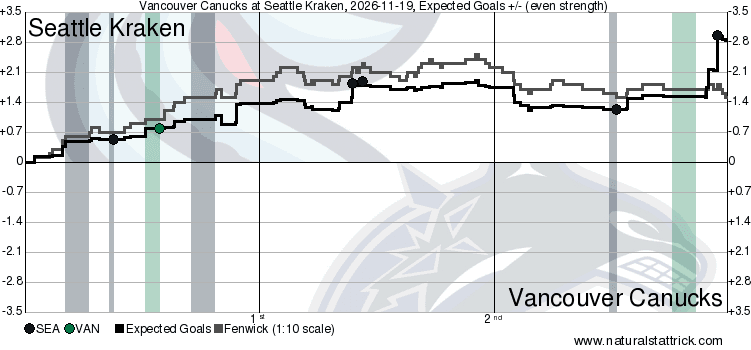
The Canucks managed to make things a little more interesting in the second period, but their uptick in puck possession didn’t equate to much on the scoreboard.
Vancouver narrowed the five-on-five shot-attempt differential to 23-21 in Seattle’s favour, with scoring chances nearly even at 11-10. The Kraken still generated twice as many high-danger opportunities though, and controlled 59.86% of expected goals.
By the third period, the shot-attempt battle had swung in the Canucks’ favour, with a 14-8 advantage at five-on-five and a 63.64 CF% as they pushed to get back into the game.
Unfortunately, the extra possession wasn’t very threatening. Despite holding the territorial advantage, the Canucks generated just 0.43 expected goals against Seattle’s 0.45, with the two sides combining for only three high-danger chances.
Heat Map
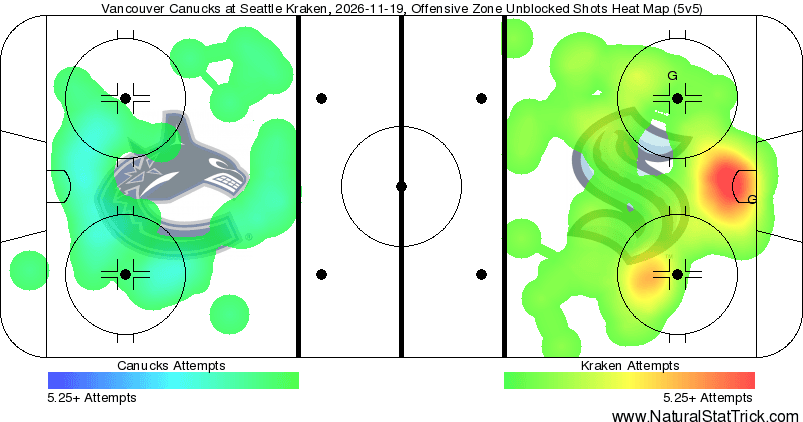
Vancouver’s end of the heat map lights up like a crime scene under a forensic UV lamp, with red showing up just about everywhere you wouldn’t want it.
At five-on-five, the Kraken generated 3.18 expected goals to the Canucks’ 1.41. Seattle found plenty of room from the faceoff circles down, with a particularly noticeable concentration of attempts just outside of Vancouver’s crease. At the other end, the Canucks were largely kept to the perimeter, struggling to generate much of anything through the middle of the ice.
Seattle was just as dangerous with the man advantage. Across five minutes on the power play, the Kraken produced four high-danger chances and 1.11 expected goals, converting twice on four opportunities.
Meanwhile, DeBrusk’s first-period tally accounted for Vancouver’s only success with the man advantage. The Canucks managed three shots and 0.27 expected goals during their 2:23 of five-on-four time, with their second opportunity producing nothing on net.
Seattle didn’t need much help finding quality looks at even strength, but Vancouver’s tragic penalty kill gave the home side another avenue to pile on the pressure.
Individual Advanced Stats
Corsi Champ: Max Sasson takes the honours with a team-leading 58.82 CF% at five-on-five, and in just 6:25, Sasson helped the Canucks to a 10-7 advantage in shot attempts and a 6-3 edge in scoring chances. The centre was particularly active himself, recording five shot attempts and three shots on goal, making the most of his opportunities despite playing fewer minutes than any other Vancouver forward. His 21.18 percentage-point advantage in relative CF% was another encouraging number, showing how much better the Canucks controlled possession with him on the ice compared to when he was on the bench.
Corsi Chump: We’ve already touched on Brock Boeser’s struggles, but his individual five-on-five results are even uglier. Across 12:13, Vancouver was outshot 10-2 with the winger on the ice, while Seattle held a 12-5 advantage in scoring chances. For all the offensive success he’s enjoyed lately, Thursday was a night when the Canucks spent far too much time defending whenever their leading goal scorer was on the ice.
xGF%: Sasson led Vancouver in expected-goals share as well, finishing at 58.24% after generating 0.36 xGF against 0.26 xGA. Linus Karlsson (53.12%) and Marco Rossi (52.29%) were the only other Canucks to finish above 50%, while Liam Öhgren narrowly missed joining them at 48.82%. Things weren’t nearly as rosy for Filip Chytil, who finished dead last on the team with a 13.62 xGF%. During Chytil’s 15:48 at five-on-five, the Canucks generated just 0.25 expected goals while surrendering 1.57 with him on the ice
GSAx: It’s hard to fault Meriläinen for much of what happened Thursday night. The netminder stopped 38 of 42 shots, finishing with a .905 save percentage and allowed four goals against 4.28 expected, working out to a plus-0.28 goals saved above expected. He turned aside 31 of 33 shots at five-on-five and finished with a plus-1.18 GSAx. With Vancouver’s goaltending situation under scrutiny, Meriläinen gave critics little to complain about. In the opposite crease, Philipp Grubauer had a quieter evening, stopping 22 of 23 shots and finishing with a plus-1.46 GSAx, turning aside all 18 shots he faced at even strength.
Statistical Musings
Beniers was everywhere: Matty Beniers was a nightmare for Vancouver’s defence, and his line with Kaapo Kakko and Mackie Samoskevich gave Vancouver very little room to breathe whenever they were on the ice. Through 12:24 together at five-on-five, the trio outattempted the Canucks 19-6 and controlled 77.34% of expected goals. Beniers recorded seven shots on goal and five individual high-danger chances, and across all his five-on-five shifts, the Kraken generated 1.50 expected goals against just 0.26, giving the centre an impressive 85.36 xGF%.
At least one line showed up: Liam Öhgren, Marco Rossi and Linus Karlsson gave the Canucks something positive, even if their efforts were largely buried beneath Seattle’s onslaught. In 11:11 together, the trio outattempted the Kraken 12-9 and split high-danger chances 2-2. Their 50.62 xGF% was nothing spectacular, but they were Vancouver’s only regularly deployed forward combination to finish on the right side of both shot attempts and expected goals. Considering how badly some of the other lines struggled, keeping this trio together seems like an easy decision.
Willander’s night under the microscope: Tom Willander logged a team-high 20:55 at five-on-five among Vancouver defencemen and managed to break even in the shot-attempt battle, with 21 attempts for and against. Unfortunately, Seattle held a 6-3 advantage in high-danger opportunities during his shifts, leaving the rookie with a 34.09 xGF% despite his plentiful possession numbers. For the rest of the blue line, things were even uglier. Zeev Buium finished with a 34.09 CF% and 26.07 xGF% while Filip Hronek managed just 36.00% of shot attempts. Overall, Thursday did little to ease concerns about Vancouver’s young blue line.
As a team
CF% – 41.18% | HDCF% – 28.57% | xGF% – 30.81%
Even accounting for score and venue adjustments, the Canucks’ numbers weren’t getting much prettier. Their CF% dropped to 39.52%, while their adjusted xGF% barely budged at 30.98%.
This is a difficult game to find many positives from: Seattle had little trouble dictating play, and the handful of Vancouver’s steady individual performances weren’t nearly enough to make up for the struggles elsewhere in the lineup.
Two straight wins had given Canucks fans something to get excited about, but Thursday was a reminder that putting together a couple of good results isn’t quite the same as turning a corner.
For now, those parade plans can probably stay in the drawer.
All statistics courtesy of naturalstattrick.com
PRESENTED BY VIVID SEATS


Breaking News
- The Statsies: Canucks post just 30.81 xGF% in deflated loss to Kraken
- The Stanchies: Canucks two-game winning streak snapped in 5-1 loss to Kraken
- Instant Reaction: Boeser extends point streak to nine games in Canucks’ 5-1 loss to Kraken
- Why short-term pain is necessary for long-term gains for Canucks penalty kill
- Scenes from morning skate: Meriläinen looking to lead Canucks to third straight win vs. Kraken

Vancouver CanucksTeam Cap Summary

Cap Summary
2026-27
2027-28
Projected Cap Hit
$87,211,195
$70,329,167
Projected Cap Space
$16,788,805
$43,170,833
Current Cap Space
$22,776,421
$43,170,833
Active Players
22/23
12/23
Draft Picks
Round
'27
'28
1
1
1
2
2
2
3
1
1