
CanucksArmy has no direct affiliation to the Vancouver Canucks, Canucks Sports & Entertainment, NHL, or NHLPA
The Statsies: Jake DeBrusk and Canucks’ top line tilt the ice despite loss to Ducks
Photo credit: Bob Frid-Imagn Images

Nov 4, 2026, 12:00 ESTUpdated: Nov 4, 2026, 11:59 EST


Four goals, two fights from the new guy, and a regulation loss. That’s about as fun as rebuilding hockey gets.
The Vancouver Canucks had plenty to feel good about Tuesday night, but their 5-4 defeat to the Anaheim Ducks came down to a familiar problem: keeping the puck out of their net. Jake DeBrusk scored twice, the top line dominated its five-on-five minutes, and Jacob Quillan gave fans something to cheer about with a pair of fights.
Unfortunately, Anaheim’s power play had other ideas, scoring three times on just four shots. Even Vancouver’s latest third period flurry of offence couldn’t undo the damage, leaving the Canucks with their third consecutive loss.
Game Flow
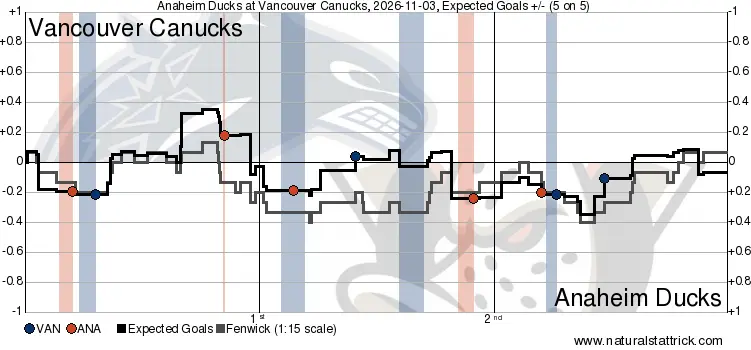
Anaheim held a slight advantage in possession during the opening period, controlling 54.55% of shot attempts while generating 0.81 expected goals to Vancouver’s 0.78. The Canucks managed four high-danger opportunities against three, but couldn’t convert that into an even-strength goal.
Vancouver controlled 60% of shot attempts and 70% of scoring chances at five-on-five in the second period. However, the quality of those opportunities told a different story. Anaheim generated 0.63 expected goals against Vancouver’s 0.42, leaving the Canucks with a disappointing 40.14 xGF% despite spending more time on the attack.
It was the second straight game in which a disconnect between possession and shot quality was particularly noticeable after Saturday’s loss to Toronto, when Vancouver struggled to turn a strong opening period into a complete performance.
By the third, the Canucks started generating better chances, controlling 58.22% of expected goals at five-on-five, and holding a 4-2 advantage in high-danger opportunities. Across the full game, Vancouver finished with a 51.69 CF% and 49.03 xGF% at five-on-five. Those numbers dropped to 46.77 CF% and 44.38 xGF% after score and venue adjustments, suggesting the time spent chasing the game helped flatten the Canucks’ possession totals.
Heat Map
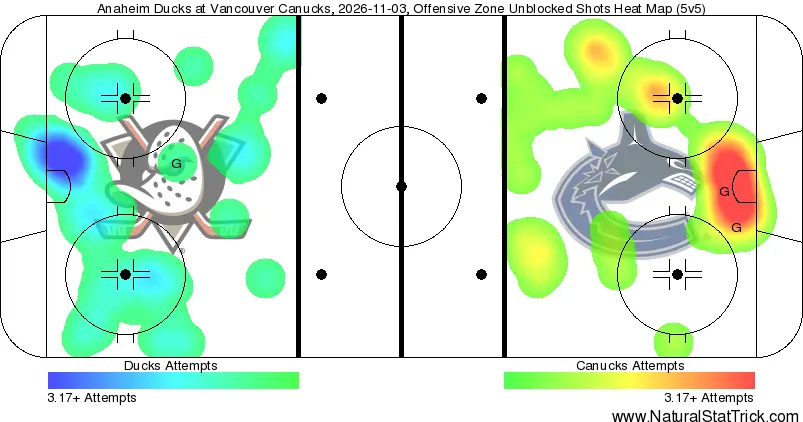
Unlike some of Vancouver’s earlier performances this season, the heat map actually showed a team capable of generating dangerous opportunities around the opposition’s net.
The Canucks produced a concentrated area of attempts near Anaheim’s crease, and finished with nine high-danger chances to the Ducks’ eight at five-on-five. Their 23-18 advantage in scoring chances was another positive, even if Anaheim generated slightly more expected goals.
Penalty killing, or the lack thereof, almost completely wipes that out, though. Anaheim needed just 2:46 of power-play time to score three goals, generating only 0.49 expected goals from four shots. Vancouver’s penalty killers surrendered seven scoring chances during those opportunities, three of them classified as high-danger. For a team whose early-season penalty-killing problems were already a serious concern, Tuesday offered another painful example of how quickly an encouraging performance at 5-on-5 can unravel.
Vancouver’s own power play was productive, scoring twice on five shots while generating 0.67 expected goals. However, allowing a shorthanded goal to Leo Carlsson made those contributions considerably less valuable.
Individual Advanced Stats
Corsi Champ: Linus Karlsson was Vancouver’s strongest possession player, finishing with a team-leading 73.33 CF% at five-on-five. During his 11:27, the Canucks out-attempted Anaheim 11-4 and controlled six scoring chances to just one. After entering the game with just one assist over his previous five outings, as noted in Tuesday’s morning-skate report, Karlsson delivered one of his more convincing performances this campaign.
Corsi Chump: Liam Öhgren had a difficult evening at five-on-five, finishing with a team-worst 23.81 CF%. Anaheim out-attempted Vancouver 16-5 during his 12:41, while the Canucks failed to generate a single scoring chance and surrendered eight.
xGF: Victor Mancini quietly put together one of Vancouver’s better individual performances from the blueline. Albeit in a small sample of 7:39 at five-on-five, Mancini posted an 82.23 xGF%, with the Canucks controlling scoring chances 9-2 and high-danger opportunities 4-0. Zeev Buium was another positive, finishing with a 66.90 xGF% and a 10-5 advantage in scoring chances during his 19:21.
GSAx: Making his first start in nearly two weeks, Lankinen stopped just 17 of 22 shots for a .773 save percentage. He allowed five goals against 2.42 expected goals, producing a dismal minus-2.58 goals saved above expected. On the other hand, his five-on-five performance was substantially better, stopping 15 of 16 shots for a .938 save percentage and a positive 0.87 GSAx. Anaheim’s Laurent Brossoit wasn’t particularly convincing either, allowing four goals against 2.53 expected goals for a minus-1.47 GSAx.
Statistical Musings
DeBrusk finally gets rewarded: After going nine games without a goal, Jake DeBrusk broke through with two in the third period. DeBrusk generated seven individual scoring chances and three high-danger opportunities across all situations, recording 0.44 individual expected goals. At five-on-five, his 69.44 CF% and 79.92 xGF% ranked among Vancouver’s best, with the Canucks controlling scoring chances 13-5 during his minutes. His combination with Elias Pettersson and Brock Boeser out-attempted Anaheim 24-11, generated six high-danger chances against two and controlled 78.64% of expected goals.
Quillan makes his presence felt: Jacob Quillan provided substance outside of his trips to the penalty box, finishing with a 63.64 CF% and 76.49 xGF% at five-on-five, with Vancouver controlling both scoring chances recorded during his 9:36. More impressively, his line with Drew O’Connor and Karlsson posted a 75% CF% and 86.89 xGF% in 7:43 together, allowing no scoring chances. For a player recalled following Filip Chytil’s injury, those numbers make a strong argument for keeping him in the lineup.
Rossi’s line struggles again: During 8:41 together, the combination of Öhgren, Marco Rossi and Jonathan Lekkerimäki controlled just 33.33% of shot attempts and 14.17% of expected goals. Rossi’s individual on-ice figures were even more concerning after the coaching staff rearranged the lines at Monday’s practice. He finished with a 25% CF% and 10.60 xGF% at five-on-five, with Vancouver generating no scoring chances during his 12:28.
As a team
CF% – 51.69% | HDCF% – 52.94% | xGF% – 49.03%
Vancouver had plenty of success at five-on-five, particularly with its top line and Quillan’s group on the ice, but allowing three power-play goals and giving up another while on the man advantage proved too costly for the home team to overcome. The penalty kill continued to leak goals, and Lankinen’s struggles in net only made matters worse.
For a rebuilding team, the loss provided some of what fans want: signs of progress without banking points. Still, after scoring four goals and putting together several strong individual performances, the Canucks probably would’ve preferred to leave Rogers Arena with something other than some moral victories.
At least the offence is starting to look alive, if only the penalty kill could stop doing the opposite.
All statistics courtesy of naturalstattrick.com
Sponsored by bet365


Breaking News
- The Statsies: Jake DeBrusk and Canucks’ top line tilt the ice despite loss to Ducks
- Should the Canucks claim Brad Lambert off NHL waivers from Winnipeg?
- Canucks prospect Anthony Romani named Big Ten Second Star of the Week
- The Stanchies: Canucks fight their way to another spirited near comeback, lose 5-4 to Ducks
- Instant Reaction: Canucks battle back late again to give Ducks a scare, but lose 5-4

Vancouver CanucksTeam Cap Summary

Cap Summary
2026-27
2027-28
Projected Cap Hit
$87,993,412
$71,329,167
Projected Cap Space
$16,006,588
$42,170,833
Current Cap Space
$19,530,051
$42,170,833
Active Players
23/23
13/23
Draft Picks
Round
'27
'28
1
1
1
2
2
2
3
1
1