
CanucksArmy has no direct affiliation to the Vancouver Canucks, Canucks Sports & Entertainment, NHL, or NHLPA
The Statsies: Canucks’ new-look fourth line posts 91.21 xGF% in 4-3 win over Wild
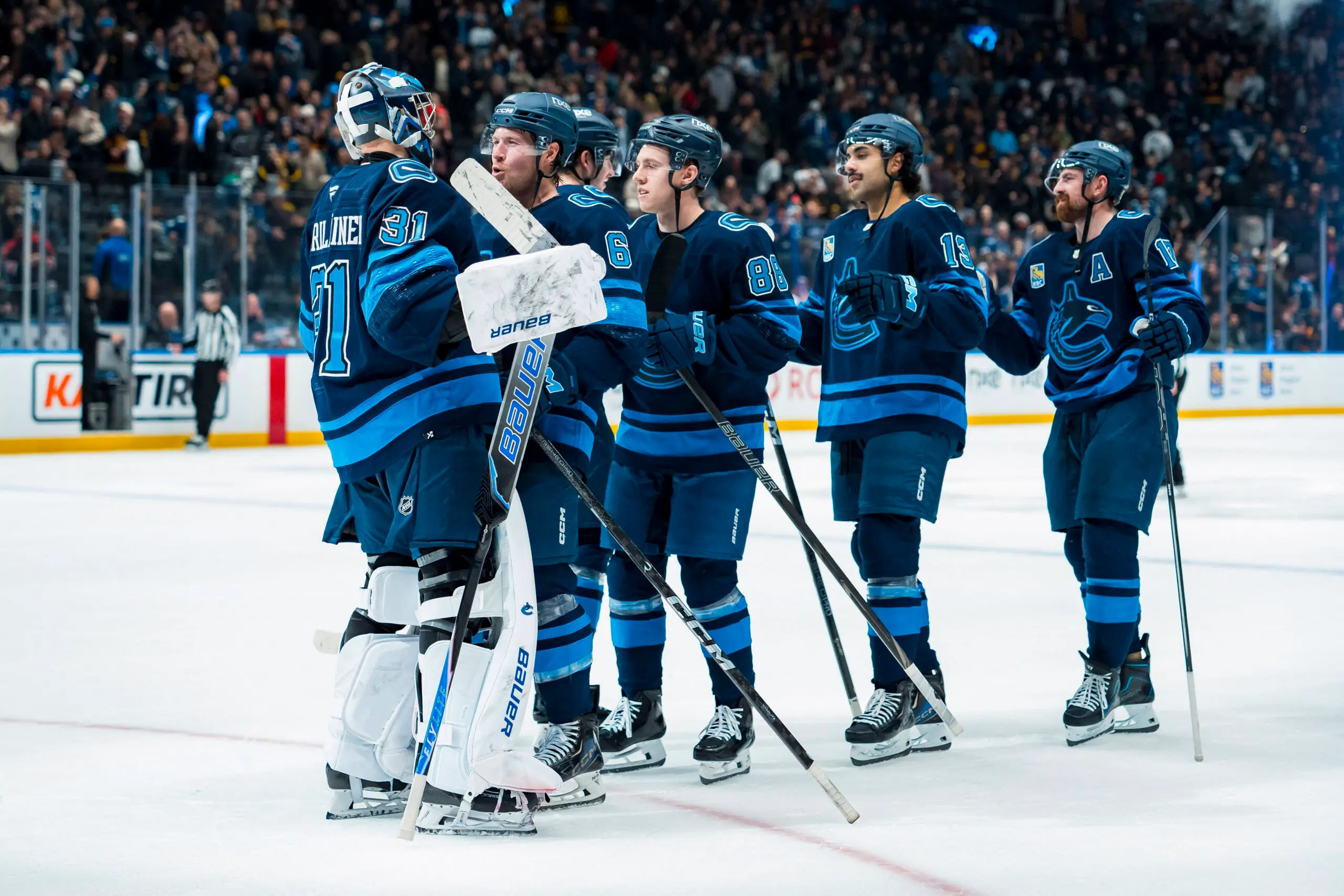
Photo credit: Bob Frid-Imagn Images

Nov 22, 2026, 12:43 EST


Marco Rossi must have had Saturday night circled on his calendar.
After going 20 games without a goal, the former Minnesota Wild centre picked a matchup against his old club to score twice, helping the Vancouver Canucks escape with a 4-3 shootout victory.
Zeev Buium scored Vancouver’s other regulation goal, meaning both players acquired in the Quinn Hughes trade found the back of the net against their former club.
Minnesota entered as the NHL’s top team and looked the part for much of the evening, taking 66.23% of the expected goals at five-on-five while holding Vancouver to just five high-danger chances.
Brock Boeser collected three more assists; meanwhile, a newly assembled fourth line was responsible for some of the Canucks’ best territorial play. It wasn’t always pretty, but the Canucks found a way to win despite being outplayed for much of the night.
Game Flow
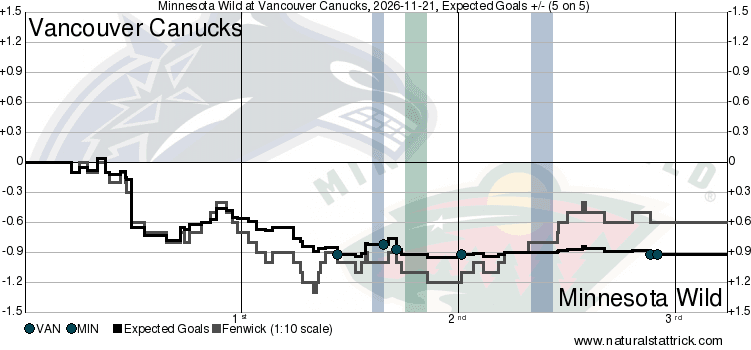
The Wild outattempted the Canucks 19-15 at five-on-five, held a 10-4 advantage in shots on goal, and their 1.11 expected goals nearly doubled Vancouver’s 0.54, as Vancouver spent much of the opening period trying to get out of their own end.
Things didn’t improve much in the middle frame, as Minnesota enjoyed a 56.25 CF% and an even larger 71.14 xGF%, generating four high-danger chances to Vancouver’s one. Rossi’s power-play deflection briefly pulled the Canucks even, but it lasted only 72 seconds before Jared Spurgeon restored the visitors’ lead.
Vancouver got its act together in the third. A 68.18 CF% at five-on-five was a substantial improvement over the first 40 minutes, as the Canucks outattempted Minnesota 15-7. The quality of those attempts wasn’t ideal though, producing only 0.15 xGF in the third at five-on-five, compared with Minnesota’s 0.12, and neither club registered a high-danger chance at even strength.
Overtime was another adventure, with Minnesota recording 0.49 xGF against Vancouver’s 0.25, before Jake DeBrusk settled matters in the shootout.
It was quite a reversal from their previous meeting with Minnesota, when the Wild dominated the third period with a 76.19 CF% and 81.68 xGF%. Still, Vancouver’s lack of dangerous opportunities felt all too familiar. In Thursday’s loss to Seattle, the Canucks enjoyed a 63.64 CF% in the final frame but generated just 0.43 expected goals against the Kraken’s 0.45. Getting more pucks toward the net late in games is a start, but it hasn’t necessarily translated into better scoring chances.
Heat Map
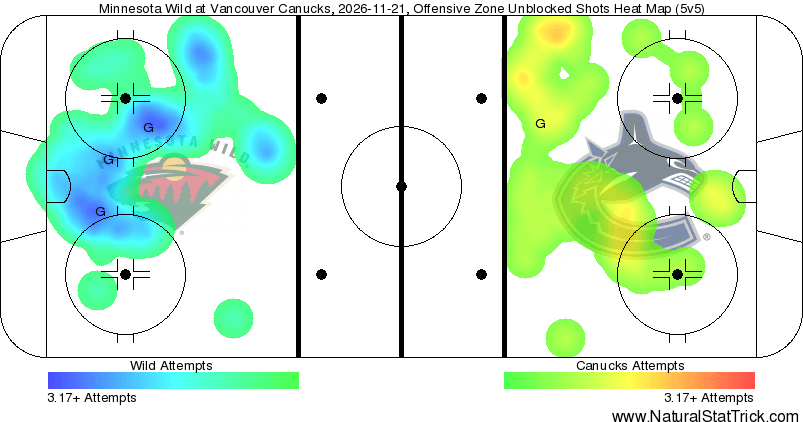
Minnesota’s heaviest concentration of attempts came from just below the upper faceoff dot, with additional clusters directly in front of the crease and across the lower slot, where the Wild repeatedly found shooting lanes close to Meriläinen. Vancouver’s distribution was much less threatening, relying more heavily on shots from the perimeter.
At five-on-five, the Canucks and Wild finished tied with 44 shot attempts apiece, yet Minnesota held a 9-5 advantage in high-danger chances and generated 1.88 expected goals to Vancouver’s 0.96. The line of Kirill Kaprizov, Joel Eriksson Ek and Matt Boldy was a good example of that disparity. Minnesota was outattempted 11-10 with the trio on the ice, but the quality of their chances was enough to produce a 79.01 xGF%.
Across 3:01 of power-play time, Vancouver generated just 0.18 expected goals from three shot attempts, two scoring chances and one high-danger opportunity. Most of that production came on the opening advantage, which accounted for 0.11 xGF and Rossi’s goal. Their second opportunity produced only 0.07 xGF without a high-danger look. The Canucks managed those numbers without Elias Pettersson, who was sidelined with an upper-body injury, leaving Vancouver without one of its usual power-play fixtures.
Even without Quinn Hughes, who was sidelined by an injury, Minnesota’s power play generated three shot attempts during its lone two-minute advantage, though only one was unblocked. The Wild failed to register a shot on goal or a scoring chance, finishing with just 0.04 xGF.
During last Sunday’s win over Vegas, the Canucks generated 15 high-danger chances against eight for the Golden Knights despite being outattempted 51-38. Since then, those opportunities have been harder to come by. Utah held an 11-4 advantage in high-danger chances on Monday, and Minnesota followed with a 9-5 edge on Saturday.
Individual Advanced Stats
Corsi Champ: The sky might actually be falling. After spending so much time in Corsi Chump territory, Paul Cotter has somehow landed on the other side of the ledger. The winger led Vancouver with a 69.23 CF% at five-on-five, with the Canucks outattempting Minnesota 9-4 and holding a 6-3 edge in scoring chances during his 11:01 of ice time.
Corsi Chump: Elias Pettersson, the defenceman, had a difficult outing, finishing with a team-low 27.27 CF%. Vancouver was outattempted 16-6 and outchanced 10-3 during his 13:41 of five-on-five action. He was on the ice for all three Wild goals at full strength, although Vancouver surrendered three goals with him on the ice, even though the chances Minnesota generated amounted to just 0.65 expected goals against.
xGF%: Cotter also led the Canucks with a 79.59 xGF%, but Rossi finished at 56.82%, making him one of the few Vancouver forwards to generate more expected goals than he surrendered at five-on-five, while Boeser sat at the bottom of the team with just 13.15%. Despite assisting on all three regulation goals and extending his point streak to 10 games, Boeser’s underlying numbers continued to tilt in the wrong direction. Alongside Filip Chytil (16.15 xGF%) and Jake DeBrusk (13.47%), the winger’s line generated just 0.12 expected goals in 13:55 together at five-on-five.
GSAx: Meriläinen stopped 22 of 25 shots against 2.40 expected goals, finishing with a minus-0.60 goals saved above expected, but that hardly captures his entire contribution to the win. The 24-year-old turned aside all three Minnesota shootout attempts and made several timely stops early before Vancouver found its footing. Saturday’s numbers were a slight step down from his recent outings against Vegas (+0.49) and Seattle (+0.28), but nowhere near his struggles against Winnipeg (minus-2.76). Jesper Wallstedt allowed three goals on 1.48 xGA, finishing with a minus-1.52 GSAx.
Statistical Musings
Quillan wasted little time getting comfortable: With Max Sasson traded and the Canucks dealing with injuries down the middle, Jacob Quillan was thrown into the lineup alongside Bains and Cotter, and the combination looked remarkably comfortable for a group assembled on short notice. Across 8:07 together, Vancouver outattempted Minnesota 8-1, generated six scoring chances to one and posted a 91.21 xGF%. Two high-danger opportunities went the Canucks’ way, with none surrendered.
Öhgren wasn’t just along for the ride: Rossi and Buium will get most of the attention, but Liam Öhgren was heavily involved in Saturday’s winning result. The Swedish winger led Vancouver’s forwards with four shots on goal and seven individual attempts, finding himself in promising positions even if his finishing let him down. Alongside Rossi and Lekkerimäki, Öhgren helped the Canucks to a 19-9 advantage in shot attempts over 10:28 together, good for a 67.86 CF%. Their 48.47 xGF% was less encouraging, but the trio was spending considerably more time attacking than defending. Rossi’s work wasn’t limited to his two goals, either, with the centre winning 12 of 16 faceoffs.
Different night, same problem: Blake Coleman, Michael McCarron and Bobby Brink picked up right where they left off during the two teams’ previous meeting on Oct. 25. Minnesota’s third line posted a staggering 90.66 xGF%, outattempting the Canucks 19-7 while holding an 8-1 edge in high-danger chances. Nearly a month later, Vancouver still had no answer for the trio. In 9:17 together Saturday, the Wild outattempted the Canucks 13-4, generated all four high-danger chances and finished with an 84.63 xGF%.
Willander’s impressive night in transition: Tom Willander kept humming with a 68.00 CF% at five-on-five as the Canucks outattempted Minnesota 17-8 with him on the ice, despite beginning four shifts in the defensive zone compared with just one in the offensive end. His 51.90 xGF% wasn’t spectacular, but overall, those are useful results from a young defenceman still finding his way in the league. With Filip Hronek being asked to carry an enormous workload, getting dependable minutes from a right-handed defenceman elsewhere on the blue line would be a considerable help.
As a team
CF% – 50.00% | HDCF% – 35.71% | xGF% – 33.77%
After accounting for the score and venue, the Canucks’ already poor five-on-five numbers dropped further, to 47.91 CF%, 32.53 HDCF% and 31.35 xGF%. But Vancouver controlled the faceoff dot, winning 63.5% of the draws, even though that didn’t result in an advantage in dangerous scoring opportunities.
For a team sitting near the bottom of the standings, beating the league leaders is something worth enjoying, although it doesn’t erase the defensive problems that made Meriläinen’s night so busy, nor does it change the struggles of the top line that finished with three assists and very little else statistically.
Still, with several regulars sidelined and a depleted lineup facing the NHL’s top team, the Canucks showed some much-needed gumption, finding a way to claw back twice in the third period and come away with two points.
The Wild had the better underlying numbers, but Vancouver got the last laugh with a rare victory on home ice.
All statistics courtesy of naturalstattrick.com
Sponsored by bet365


Breaking News
- The Statsies: Canucks’ new-look fourth line posts 91.21 xGF% in 4-3 win over Wild
- The Stanchies: Rossi scores twice in Canucks’ 4-3 shootout win against the Hughes-less Wild
- Instant Reaction: Rossi and Buium score against former team as Canucks win 4-3 in shootout vs. Wild
- Canucks GM Johnson details the Max Sasson trade, what’s next to address, and more
- ‘Seeing it hurt a lot’: Canucks’ Karlsson and Bains react to Max Sasson trade

Vancouver CanucksTeam Cap Summary

Cap Summary
2026-27
2027-28
Projected Cap Hit
$88,401,633
$69,329,167
Projected Cap Space
$15,598,367
$44,170,833
Current Cap Space
$21,461,583
$44,170,833
Active Players
23/23
11/23
Draft Picks
Round
'27
'28
1
1
1
2
2
2
3
1
1