
CanucksArmy has no direct affiliation to the Vancouver Canucks, Canucks Sports & Entertainment, NHL, or NHLPA
The Statsies: Canucks overwhelmed at 5v5 in Hughes’ return after a strong first period
Photo credit: Bob Frid-Imagn Images

Oct 26, 2026, 13:00 EDTUpdated: Oct 26, 2026, 12:59 EDT


Well, that first period was nice while it lasted.
The Vancouver Canucks opened Sunday with a 66.67% share of five-on-five shot attempts against the Minnesota Wild, but whatever was working early quickly disappeared after 20 minutes of play. Vancouver finished with just 26.75% of expected goals, surrendered 17 high-danger chances and spent much of the final 40 minutes chasing the puck.
While Quinn Hughes’ return dominated the conversation, Minnesota’s third line quietly put together one of the most lopsided statistical performances of the night.
Here’s the loss, by the numbers. As always, you can find our glossary guide of advanced stats here.
Game Flow
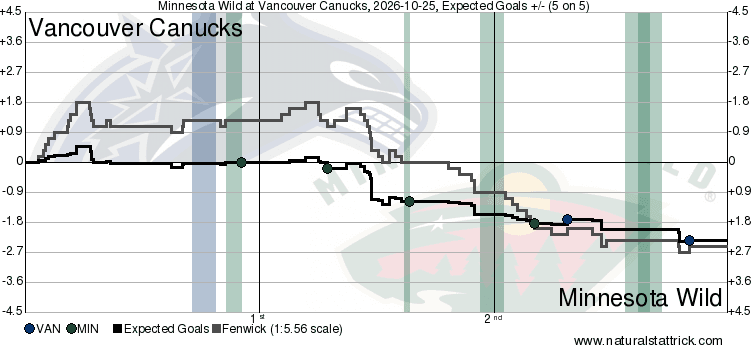
Vancouver controlled a 66.67 CF% in the opening period, out-attempting Minnesota 18-9 at five-on-five. That translated into a 10-5 advantage in overall shots on goal, and the Canucks were able to establish some sustained pressure against their former captain’s new squad.
However, the expected-goals battle was virtually even at five-on-five, with Vancouver holding a 49.48 xGF%. Minnesota generated four high-danger chances to the Canucks’ three despite being out-attempted by a two-to-one margin.
Then came the second period.
Minnesota took complete control of the underlying numbers, posting a 65.71 CF% while out-attempting Vancouver 23-12. The difference in scoring opportunities was even more pronounced, with the Wild generating 10 high-danger chances to the Canucks’ three.
That translated into a 2.05-0.48 advantage in expected goals, leaving Vancouver with a miserable 19.09 xGF% during the middle frame. By the time the period ended, Vancouver’s strong opening frame had become a distant memory.
The third offered little improvement, as Minnesota recorded a 76.19 CF% and an 81.68 xGF%, with the Canucks managing just five shot attempts at five-on-five. Two late goals made the final score respectable, but Vancouver finished with a 26.75 xGF% over the entire game at five-on-five.
Heat Map
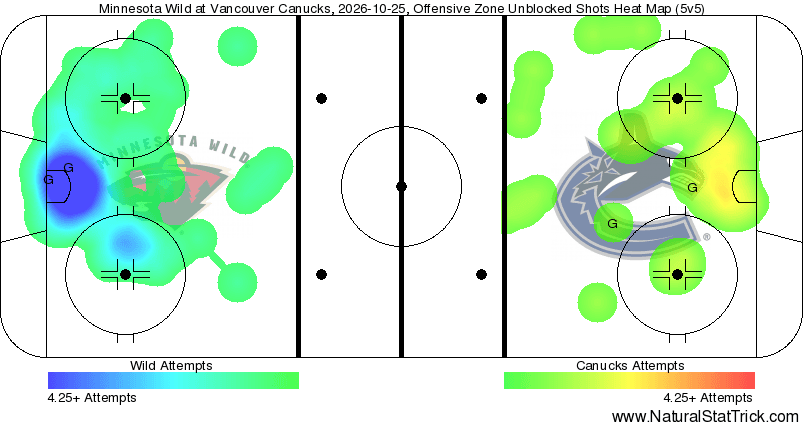
This was an ugly picture for the Canucks.
Minnesota generated a cluster of unblocked shot attempts directly around Vancouver’s crease, while the Canucks’ strongest concentration appeared near the right side of the net, without anything approaching the intensity of Minnesota’s net-front pressure.
At five-on-five, the Wild generated 17 high-danger chances compared to seven for the Canucks, producing a 70.83 HDCF% for Minnesota, which was already creating more attempts and converting those opportunities into significantly better looks.
The second period was especially rough. Vancouver surrendered 10 high-danger chances in just over 18 minutes of five-on-five play, accounting for more than half of Minnesota’s total in the game.
Even with their early territorial advantage, the Canucks struggled to generate quality opportunities. They finished with 22 scoring chances against Minnesota’s 32, and just seven high-danger opportunities across all three periods.
Individual Advanced Stats
Corsi Champ: Elias Pettersson was one of the few Canucks defencemen to turn in a strong possession performance, leading the team with a 62.96 CF% at five-on-five. The younger Pettersson was on the ice for 17 shot attempts for and 10 against, giving him an impressive 30.82 CF% relative to his teammates. His deployment was favourable, with two offensive-zone shift starts and none in the defensive zone, but he still managed to keep play moving in the right direction.
Corsi Chump: Guillaume Brisebois had a particularly difficult evening. The defenceman finished with a team-worst 23.33 CF%, watching Minnesota generate 23 shot attempts to Vancouver’s seven during his 11:05 at five-on-five. His relative Corsi sat at minus-29.50 percentage points. Things looked even worse when examining shot quality. Brisebois was on the ice for a 15-4 deficit in scoring chances and a 9-1 disadvantage in high-danger opportunities. Luke Schenn didn’t fare much better, recording a 28.13 CF% as the Canucks’ third defensive pairing spent far too much time defending dangerous opportunities.
xGF: Linus Karlsson led Vancouver with a 60.26 xGF%, the best individual share on the team. Karlsson was on the ice for a 7-5 advantage in scoring chances, while the high-danger opportunities were even at two apiece. His 0.40 expected goals for compared favourably with the 0.26 conceded during his 10:45 at five-on-five. Those results came without a single offensive-zone shift start, although Karlsson did participate in three offensive-zone faceoffs.
GSAx: Leevi Meriläinen’s .882 save percentage hardly tells the whole story of his night. The Canucks goaltender stopped 30 of 34 shots, finishing with a positive 1.12 goals saved above expected. Minnesota generated 5.12 expected goals against him across all situations, suggesting Vancouver’s defensive play could easily have produced an even uglier scoreline.
All four goals Meriläinen conceded were classified as high-danger, and he faced 14 high-danger shots in total. His five-on-five numbers were especially respectable, stopping 23 of 25 shots against 3.69 expected goals for a positive 1.69 GSAx. Given how frequently Minnesota created chances around the crease, Meriläinen did about as much as could reasonably be expected.
Statistical Musings
Minnesota’s third line did whatever it wanted: The combination of Blake Coleman, Michael McCarron and Bobby Brink was a nightmare for Vancouver’s defence. In just 8:53 together at five-on-five, the trio controlled a 73.08 CF% and an incredible 90.66 xGF%.
Minnesota generated 19 shot attempts to Vancouver’s seven with that line on the ice, including a 12-2 advantage in shots on goal and an 8-1 lead in high-danger chances. The performance of that line helps explain why Minnesota was able to dominate for long stretches without relying entirely on Kaprizov and Hughes.
A particularly rough night for Rossi: Facing his former team, Marco Rossi finished with some of Vancouver’s worst underlying numbers. His 34.48 CF% was poor enough, but his 7.59 xGF% was the lowest among all Canucks skaters at five-on-five.
During Rossi’s 12:49, Vancouver generated just 0.16 expected goals while surrendering 2.00. The scoring-chance battle finished 14-5 in Minnesota’s favour, including seven high-danger chances against. His line with Jake DeBrusk and Brendan Gallagher struggled to create quality offence, managing a 12.57 xGF% across 6:38 together.
Hughes doing Hughes things: The former captain finished with an 81.87 xGF% at five-on-five, with Minnesota generating 1.93 expected goals and allowing just 0.43 during his 17:53. Even more impressive was the high-danger differential, where the Wild held an 11-1 advantage in those chances with Hughes on the ice.
As a team
CF% – 42.17% | HDCF% – 29.17% | xGF% – 26.75%
The Canucks gave their fans an entertaining opening period, but Minnesota controlled the dangerous areas of the ice and generated enough quality chances to make the final score look somewhat generous for Vancouver.
Ten consecutive losses have left the Canucks at 2-10-1, and their inability to generate sustained offence continues to stifle their results. Next, Vancouver heads to Anaheim on Tuesday, Oct. 27, looking to finally snap its losing streak.
Stats provided by naturalstattrick.com
Sponsored by bet365


Breaking News
- The Statsies: Canucks overwhelmed at 5v5 in Hughes’ return after a strong first period
- The Stanchies: Boo birds rain on Hughes in return to Vancouver; Canucks lose 4-2 to Wild
- Instant Reaction: Canucks start strong but fall 4-2 to Wild in Hughes’ return to Vancouver
- Canucks: What happened the last time a controversial former captain returned to Vancouver?
- Scenes from morning skate: Canucks looking to snap winless skid and spoil Quinn Hughes’ homecoming

Vancouver CanucksTeam Cap Summary

Cap Summary
2026-27
2027-28
Projected Cap Hit
$87,295,050
$71,329,167
Projected Cap Space
$16,704,950
$42,170,833
Current Cap Space
$19,290,240
$42,170,833
Active Players
23/23
13/23
Draft Picks
Round
'27
'28
1
1
1
2
2
2
3
1
1