
CanucksArmy has no direct affiliation to the Vancouver Canucks, Canucks Sports & Entertainment, NHL, or NHLPA
What the Dylan Larkin trade means for the Canucks and the NHL trade market
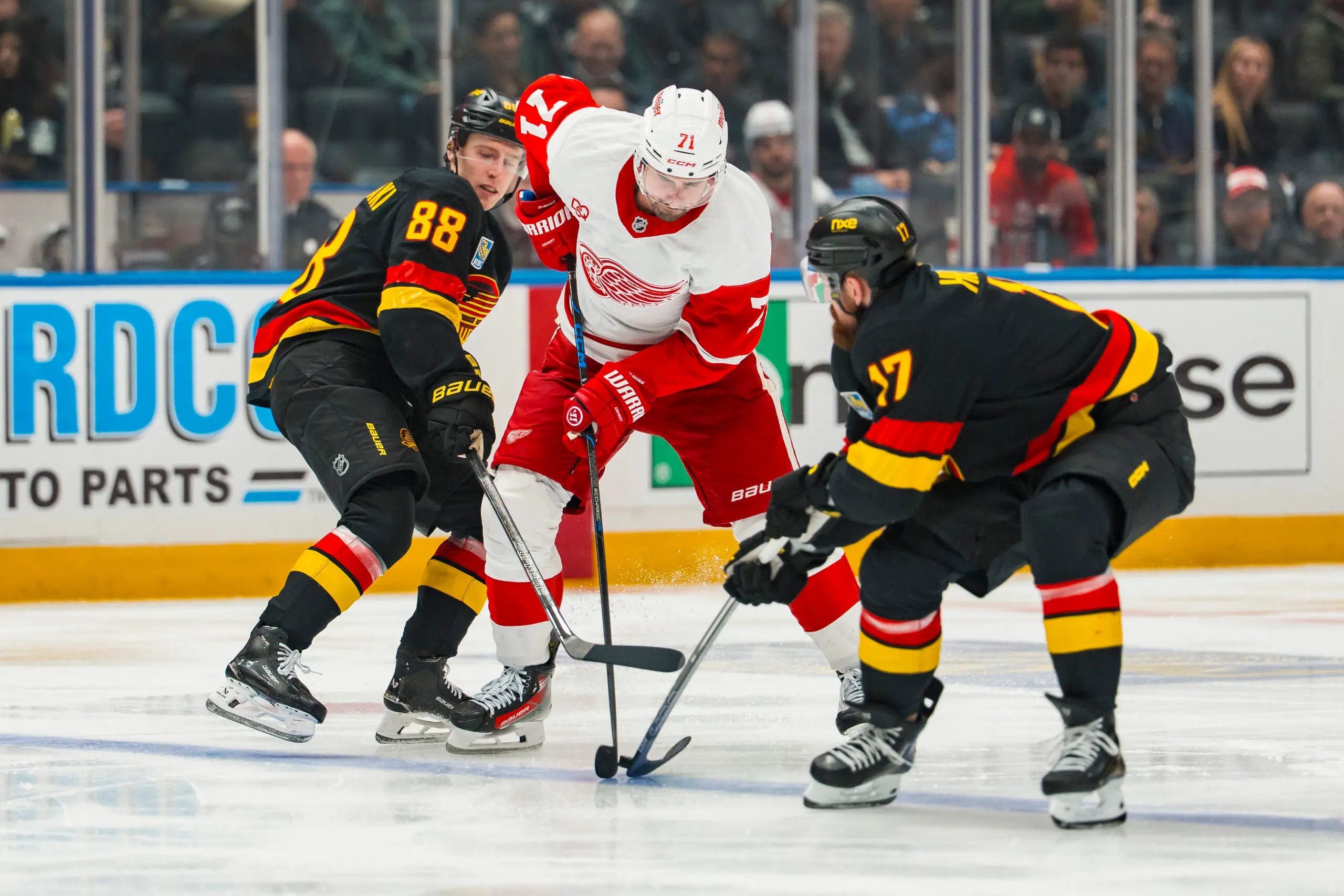
Photo credit: Bob Frid for IMAGN IMAGES via Reuters Connect

Nov 24, 2026, 09:00 ESTUpdated: Nov 24, 2026, 00:03 EST


Late Sunday, the Detroit Red Wings finally completed their long-awaited, highly requested trade of former captain Dylan Larkin. And it was a trade of truly massive proportions.
The Red Wings sent Larkin, a 2028 second-round pick, and a 2027 third-round pick to the Montreal Canadiens. In return, they got back centre Kirby Dach, goaltender Sam Montembeault, top-centre prospect Michael Hage, a top-ten-protected 2027 first-round pick, a top-ten-protected 2029 first-round pick, a 2027 second-round pick, and a 2028 fourth-round pick.
While Dach and Montembeault were effectively cap ballast in this deal, that’s still a ridiculous amount of future assets being exchanged here.
And when a trade this big happens, it can’t help but have ripple effects all over the rest of the NHL. That definitely includes Vancouver, where the Canucks hope to be cooking up some consequential trades of their own.
The impact on the centre trade market
The clearest and most immediate impact should be felt in the centre trade market, something that Vancouver has no doubt had its eye on.
Larkin was not just the biggest name available on the centre market; he was a name so big that he could have reasonably been holding up the entire process. As in, many of the teams looking for a top-six centre were probably waiting to see how the Larkin deal shook out, and whether they had a shot at participating in it, before moving on to other targets. Now, with Larkin off the market, they’ll move on.
The thing is, there just aren’t that many top-six-quality centres available, either in theory or in actuality. And if Elias Pettersson is one of them, he might just be the best and most available of the bunch.
In other words, some of the teams that were pursuing Larkin and came up short could now shift their focus to Pettersson.
It’s still unknown whether the Canucks truly plan to trade, or even attempt to trade, Pettersson this 2026-27 season. With a full no-movement clause, he controls that decision anyway. But if he’s amenable to a move, the offers from around the league should start getting better in a post-Larkin environment. And given what was just given up for Larkin himself, ‘better offers’ might just equate to something too good for the Canucks to pass up.
If the Montreal Canadiens themselves were one of the teams with interest in Pettersson, they’ve taken themselves out of the running. But in doing so, they might have made any other team’s pursuit of Pettersson that much more serious.
In fact, one of those teams might reasonably be the Detroit Red Wings themselves, who landed a great prospect in Hage but no immediate replacement for Larkin in this trade. They’ve had some reported interest in Pettersson before, and that should only increase from here on out.
Keep in mind, too, that although the Larkin trade makes Montreal a stronger contender, it by no means puts them over the top into a slam-dunk situation. If anything, this kick-starts a bit of an arms race, especially in the highly competitive Eastern Conference. That should have a trickle-down effect on the entire centre market.
Again, that primarily impacts the potential offers for Pettersson, but it might also have an impact on the Canucks’ ability to move Marco Rossi for a decent return – so long as he actually starts playing like a top-six centre again with some consistency.
But the primary impact will be on Pettersson, who, if available, might be the only other non-Larkin centre with true top-line capabilities on the trade block within this season. That’s the sort of exclusivity that can lead to sizeable profit.
The impact on the overall trade market, in general
The Larkin trade might be so big that it doesn’t just impact the trade market for centres, but the overall trade market itself, especially as it pertains to star players.
This is a trend that has been picking up steam ever since the end of the flat-cap era. Whether through cap spending or trade assets, teams are more willing than ever to pay up for true top-of-the-lineup talent. The Larkin trade might be our largest example yet, but we’ve seen huge packages given back for names like Brady Tkachuk, Bowen Byram, Connor Hellebuyck, and, of course, Quinn Hughes over the past year, among others.
That tells us that any team selling any top-of-the-lineup players can count on a larger-than-ordinary return, and that makes it all the more likely that those teams will wind up selling said players.
The thing is, there just aren’t that many teams out there selling these days, which is all the more reason for the Canucks to ensure they’re one of them.
It’s especially interesting that most folks seem to like both sides of this trade. Detroit supporters are obviously thrilled to get that much back for a player who had chosen to sit on the sidelines awaiting a trade. Montreal supporters are ecstatic that this trade might put them over the top. That dual warm reception makes it all the more likely that further blockbusters like this will occur, whenever the limited market allows it.
The Canucks have two top-of-the-lineup players potentially available in Pettersson and Filip Hronek. Two top-of-the-lineup players still under contract at pre-inflation rates for a considerable time yet, as was Larkin. And as we already mentioned in the Pettersson section, both possess full NMCs, which means they only move if they want to, as Hronek’s agent recently and vehemently reminded us.
Pettersson’s NMC lasts the duration of his contract, giving him full control over his fate. Hronek’s, however, transforms into a modified 15-team no-trade clause as of July 1, 2028. That means the Canucks will be much freer to deal him in about a year and a half’s time. In fact, it might mean they’re more free to trade him as soon as the summer of 2027, which will be the last offseason during which Hronek holds full control over his destination.
But what this Larkin return really tells us is that whenever the Canucks are able to trade Pettersson and/or Hronek, they better pull the trigger. While both have been valuable veterans within this 2026-27 season and have the potential to be valuable beyond, the number one thing this rebuild needs is high-quality future-based assets, and Larkin just returned so many of those that it cannot be ignored.
If the prices on top-of-the-lineup players are this high, the Canucks really can’t afford to miss out on the opportunity. Getting back multiple first-round picks and blue-chip prospects in what has become a premium seller’s market is just too tempting and too necessary for the Canucks to be planning on anything other than selling their top pieces – if not now, then eventually.
Sponsored by bet365


Breaking News
- What the Dylan Larkin trade means for the Canucks and the NHL trade market
- Goldeneyes Weekly: KK Harvey Mania and Walter Cup aspirations mark first week of training camp
- Canucks prospect Caleb Malhotra named Hockey East player of the week
- Canucks claim forward Cole Reinhardt off NHL waivers
- Canucks send Nikita Tolopilo back down to AHL Abbotsford, but for how long?

Vancouver CanucksTeam Cap Summary

Cap Summary
2026-27
2027-28
Projected Cap Hit
$88,379,919
$69,329,167
Projected Cap Space
$15,620,081
$44,170,833
Current Cap Space
$21,800,689
$44,170,833
Active Players
23/23
11/23
Draft Picks
Round
'27
'28
1
1
1
2
2
2
3
1
1