
CanucksArmy has no direct affiliation to the Vancouver Canucks, Canucks Sports & Entertainment, NHL, or NHLPA
The younger Elias Pettersson took a sophomore step back in 2025-26: Year in Review
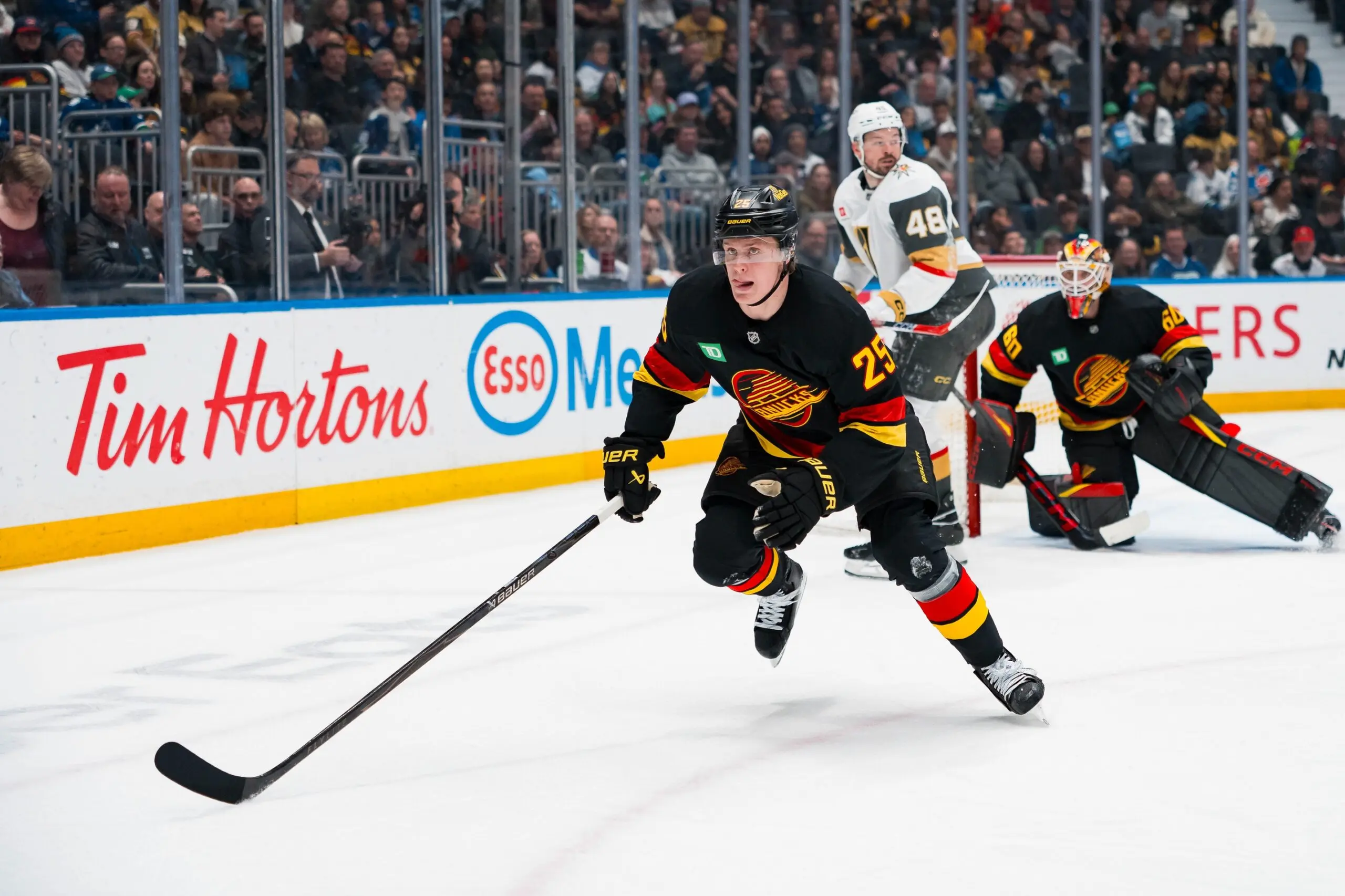
Photo credit: © Bob Frid-Imagn Images

Apr 27, 2026, 13:00 EDTUpdated: Apr 27, 2026, 12:57 EDT


It’s a bit difficult to find the right tone when summarizing the second NHL season of the Vancouver Canucks’ second Elias Pettersson. It was not a great year for the 22-year-old by any measure, and represented a significant statistical step back from Pettersson’s rookie performance in 2024-25.
Now, that step back came amid a total team collapse that saw the Canucks put forth the worst team performance of the entire 2025-26 season, by far, and one can hardly blame Pettersson for that. There’s little doubt that the Canucks’ overall defensive woes had an impact on Pettersson’s game as an individual, and it’s tough to say that anything we’ll mention in this article can be separated from that context, or that anything here is directly the fault of Pettersson as a player.
At the same time, however, this is not a sophomore slump entirely without consequence. Pettersson has been identified as an important component of the long-term rebuild, so it’s vital that his development trend in the right direction. That Pettersson didn’t just plateau in 2025-26, but instead outright regressed a bit, is not exactly a great sign, and has already been pointed to by some as a reason for further change, primarily with the coaching staff.
For now, however, a review of said performance will have to suffice.
Elias Pettersson’s Season
The best way to assess Pettersson’s 2025-26 is probably to hold it up directly against his 2024-25 rookie campaign. But first, we require some context.
The 2024-25 Canucks were nothing to write home about, but they were nowhere near as bad as the 2025-26 edition. The Canucks’ point-percentage was cut by almost a third, going from .549 last year to .354 this year. Goals for per game dropped from 2.84 to 2.56. Goals against per game went from 3.06 to 3.83.
So, as a non-play-driving defender still finding his feet at the NHL level, it was virtually impossible for the difference in quality of team to not cause an across-the-board drop in Pettersson’s own defensive statistics. As, indeed, was the case.
Pettersson’s second NHL season was, at the very least, twice as long as his first. He played in 70 Vancouver games this year (and three more down in Abbotsford), compared to just 28 last year (and 38 in Abbotsford). His average time on the ice increased from 12:49 up to 14:59, year-to-year. He also began to take a regular shift on the penalty kill, averaging 1:10 a night there, something he did not do as a rookie.
Pettersson also increased his rate of scoring, just a little. He had one goal and three points through those 28 games in 2024-25, and that rose to three goals and seven points through 70 games. Pettersson’s hits-per-60 (6.51 to 7.78), blocks-per-60 (2.67 to 4.86), and especially his rate of takeaways-per-60 (0.16 to 0.80) all saw notable increases, too.
But those surface-level measurements are about where the good news ends.
Pettersson was one of the Canucks who managed to keep their heads above water with limited minutes and deployment in 2024-25. That was not the case in 2025-26, however, where Pettersson definitely engaged in a bit of light drowning.
His personal even-strength Corsi dropped from 51.13% to 43.28%. His rate of expected goals dropped from 50.13% to 40.53%. His control of high-danger scoring chances fell from 52.73% to 40.11%.
As we said at the outset, not all of this can be laid at Pettersson’s skates. His on-ice save percentage went from 93.66% in 2024-25 to 89.18% in 2025-26, for example. And Pettersson did take on a far more defensive deployment as a sophomore than as a rookie, with his rate of defensive zone starts rising from 41% to 68%, and on a much worse defensive team, at that.
But, then, Pettersson’s personal PDO was actually higher in 2025-26 than it was in 2024-25, due to an outsized 2025-26 on-ice shooting percentage of 8.66, meaning Pettersson had more puck-luck than the average Canuck this year. And while Pettersson spent more time in the defensive end, his minutes were still relatively sheltered in terms of his quality of competition, and that changed little from his rookie season to his sophomore.
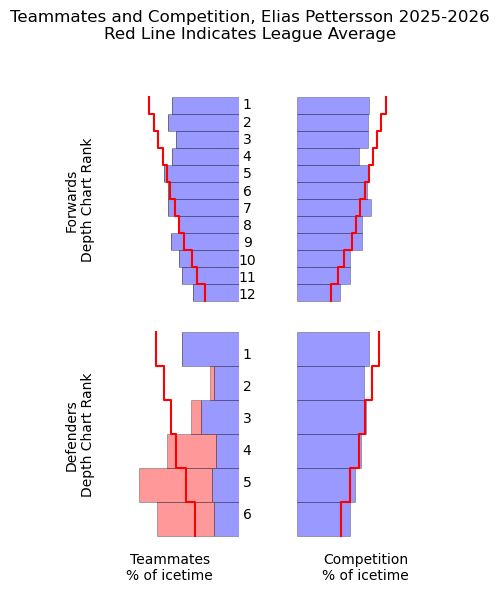 HockeyViz
From HockeyViz.com
And in terms of quality of teammates, Pettersson probably got more direct support this season, spending about 40% of his shifts paired with Team MVP Filip Hronek. Last year, his most common partner was Derek Forbort. Injuries were a factor for Pettersson this year, but only a minor factor.
The best way to sum it all up might be this: Pettersson played on a worse team this year, and so his stats all taking a plummet is an understandable thing. But at the same time, there are also definite signs – both on the stat-page here and visually throughout the season – that Pettersson was also playing worse as an individual. And that, at the very least, is a slightly troubling sign.
Fortunately, the book is far from written on Pettersson, and he remains a big part of the Canucks long-term plans as they exist now. The sophomore slump is a common phenomenon in the sport of hockey. Pettersson’s next challenge is ensuring that his does not become any sort of career-defining.
On the topic of the long-term future, and as we aim to end with something positive for a player who is still, ultimately, full of NHL potential, we go back to discussion of linemates. Pettersson spent most of the season paired with veterans Hronek and Tyler Myers, but he did also spend about 20% of his even-strength minutes paired with fellow youngster Tom Willander. And those proved to be Pettersson’s best minutes, with the two somehow managing a positive 8-6 goal differential. That chemistry is important, as is the developing off-ice chemistry that Pettersson seemed to be constantly involved in.
As much of a stepback 2025-26 was for Pettersson, it won’t take much of a step back forward for him to get right back on track to becoming a bruising, ultra-competitive defensive defender at the NHL level. Continuing to pair well with Willander is a big part of that, and the two of them finding success together as some sort of shutdown pairing could still be a big part of the Canucks’ long-term rebuild plans.
Sponsored by bet365


Breaking News
- Canucks: What happened the last time a controversial former captain returned to Vancouver?
- Scenes from morning skate: Canucks looking to snap winless skid and spoil Quinn Hughes’ homecoming
- Canucks place defenceman Jack Thompson on NHL waivers
- Could the Canucks swing a trade for Capitals forward Ivan Miroshnichenko?
- Canucks’ Ohgren responds to healthy scratch: ‘I know I have to play harder’

Vancouver CanucksTeam Cap Summary

Cap Summary
2026-27
2027-28
Projected Cap Hit
$87,295,050
$71,329,167
Projected Cap Space
$16,704,950
$42,170,833
Current Cap Space
$19,290,240
$42,170,833
Active Players
23/23
13/23
Draft Picks
Round
'27
'28
1
1
1
2
2
2
3
1
1