
CanucksArmy has no direct affiliation to the Vancouver Canucks, Canucks Sports & Entertainment, NHL, or NHLPA
Canucks won’t cut corners under Johnson and Sedins, and that’s a big deal: Wagner’s Weekly
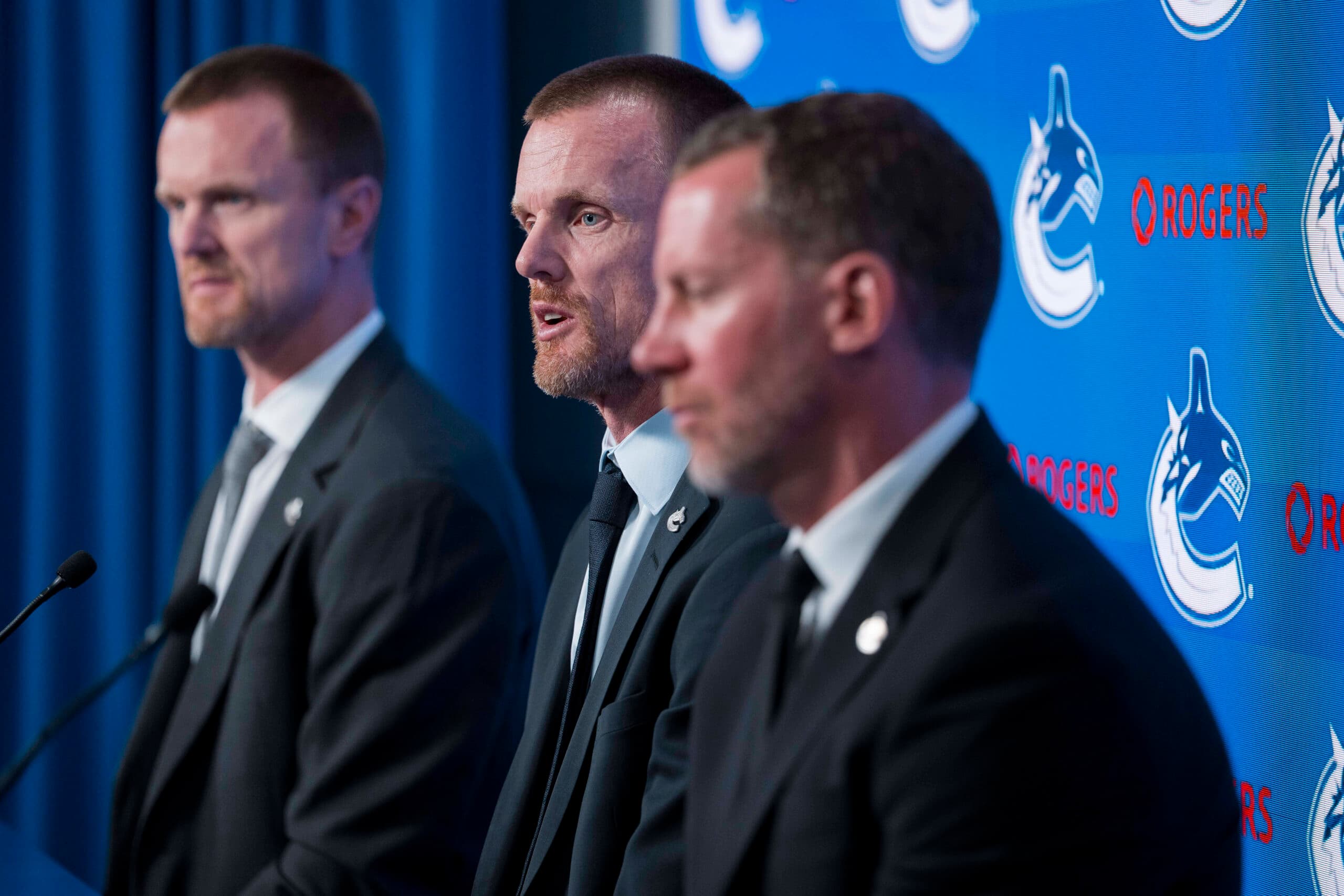
Photo credit: © Bob Frid-Imagn Images

May 17, 2026, 13:00 EDTUpdated: May 17, 2026, 12:09 EDT


In my opinion, Henrik Sedin had the best quote in the press conference that introduced himself, his brother Daniel, and Ryan Johnson as the Vancouver Canucks’ new executive team.
“To do this as fast as possible, we’ve got to be very careful and go slow,” said Henrik.
It was not just a pithy quote, but also a refreshing perspective to hear from a Canucks executive.
“We’re not going to race through it”
Canucks fans have seen clear proof of the inverse over the past 10+ years. Repeated attempts to rush a rebuild or avoid a rebuild entirely have led to too many wasted years.
When Jim Benning was hired, he said the Canucks were “a team we can turn around in a hurry.” His actions backed up those words, as he consistently sacrificed long-term assets for short-term gain. He looked for shortcuts, aggressively trading away draft picks and prospects for reclamation projects and middling NHL players.
The end result of his rush for short-term success was, damningly, no short-term success.
Jim Rutherford and Patrik Allvin were arguably more justified in seeking a quick turnaround, given where the Canucks were in their lifecycle when they took over the team, but their attempts to find a quick path to success were about as successful as Benning’s, resulting in just one trip to the playoffs.
The clear message from Johnson and the Sedins was that they won’t be looking for any shortcuts to success, and that makes me the most optimistic about the future of the Canucks than I have been for years.
“I think to put any type of timeline is unfair to the process,” said Johnson. “I think it’s more about building the environment first. It’s making sure that the staples are there, the things that we believe in: creating a safe environment where players can improve, can make mistakes, and have resources. But we’re going to do this step-by-step, and we’re not going to race through it.”
What that means, of course, is that the Canucks are likely to miss the playoffs again, for one or two — maybe three or more — years. But that’s what they’ve already been doing while trying to just get into the playoffs year after year without any sort of view towards long-term, sustainable success.
So, why not experience that same pain of missing the playoffs but with the benefit of some long-term hope?
Canucks want sustainable success
The rhetoric coming from Johnson and the Sedins is that they have no interest in just getting into the playoffs — they want to win a championship.
“We have a vision and a plan that we’re going to need to stick to, to not just get into a playoff one time, but that is sustainable,” said Johnson on the Canucks Insider Podcast. “I think you can cut some corners to try to get in [the playoffs]…I think if you try to skip the line, you can get a taste of it, but then take a step backwards.”
That’s a key insight: if your focus is making the playoffs, shortcuts will always be tempting, because they can work. The series of moves that Allvin and Jim Rutherford made when they took over the Canucks did lead to making the playoffs in 2024, but it cost the Canucks a lot. Ultimately, they had a taste of the playoffs, then, sure enough, took a step backwards.
Off a cliff.
Of course, a long-term, slow-and-steady approach requires patience from the fanbase, but Canucks fans seem very eager to be patient after years of seeing the results of an impatient owner and executive. Still, Johnson knows that fans will still be looking for results.
“With our fanbase, they need to see that there’s growth,” said Johnson. “I think they’ll be less focused on the wins and losses and trust the process when they see that.”
Seeing that growth on the ice will be key to getting buy-in from Canucks fans, but one of the most important messages coming out of that introductory press conference involved what the team will be doing off the ice to connect with fans.
Making people “proud to be a Canucks fan again”
“Looking back 26 years ago, when we flew into the city, Brian Burke told us that this was the number one organization in the league when it comes to community involvement,” said Daniel. “We need to get to that point. We should be the number one organization in the NHL when it comes to community involvement.
“We’re going to ask our players to do a lot. I think it was so important for us as players when we did those things, I think it puts perspective in life. I think fans will respect that. You might have a bad game here and there, but if you’re out, you do the work in the community, I think they can certainly buy into what we’re trying to be.”
“That’s a big part of the connected piece as well. We’ve got to bring that back,” said Henrik. “Just to have the people in this city and this province to be proud to be a Canucks fan again.”
The Sedins, of course, are well-versed in community involvement, with Henrik the only two-time recipient of the King Clancy Memorial Trophy from the NHL for a “significant humanitarian contribution to his community,” receiving it once in 2016 and then again with Daniel in 2018.
The Canucks’ connectedness to the community has been a key part of the organization since its inception, with players like Orland Kurtenbach and Stan Smyl creating a lifelong connection with the city. Under the leadership of Pat Quinn and Trevor Linden, community involvement became further ingrained as a fundamental part of the team’s DNA.
Linden would regularly drop by B.C. Children’s Hospital to visit with kids, even stopping by after games to ask if any kids were having trouble falling asleep, so he could talk to them or read them a book to help them settle down. When he set up a box seat at games to host kids who otherwise couldn’t afford tickets, the Canucks suggested a partnership with a sponsor to pay for the program. Linden refused, saying he would only do it without a sponsor, as he didn’t want it to be seen as using the kids to gain publicity for a company.
That’s something that continued after Linden with other players, such as Alex Edler’s “Eagle’s Nest” or Brock Boeser’s “Boeser’s Beauties” programs that brought kids to games without any corporate sponsorship.
Linden learned from Smyl, and that was passed on to the likes of Markus Näslund, the Sedins, and Edler, but it seemed like there was a disconnect in that lineage with the present-day team. Perhaps it was because the likes of Quinn Hughes and Elias Pettersson never played with the Sedins, or the social distancing requirements of COVID-19 severed some of the community connection, and it never started up again.
Whatever the reason, the Sedins’ commitment to making the Canucks a leader in community involvement once again is a positive sign.
Because if the Canucks aren’t going to be good for a while, they should at least be likeable.
Sponsored by bet365


Breaking News
- Former Canucks captain Quinn Hughes speaks ahead of return to Vancouver
- How Canucks’ Cootes is doing compared to other 2025 first-round picks playing in the AHL
- Scenes from practice: Pettersson and Boeser reunited as Canucks skate at UBC on Saturday
- Abbotsford Canucks preview: Players to watch in weekend rematch with the Wranglers
- How the Canucks can fix their early-season defensive breakdowns

Vancouver CanucksTeam Cap Summary

Cap Summary
2026-27
2027-28
Projected Cap Hit
$87,295,050
$71,329,167
Projected Cap Space
$16,704,950
$42,170,833
Current Cap Space
$19,176,096
$42,170,833
Active Players
23/23
13/23
Draft Picks
Round
'27
'28
1
1
1
2
2
2
3
1
1