
CanucksArmy has no direct affiliation to the Vancouver Canucks, Canucks Sports & Entertainment, NHL, or NHLPA
The other times the Canucks picked twice in the first round | Wagner’s Weekly
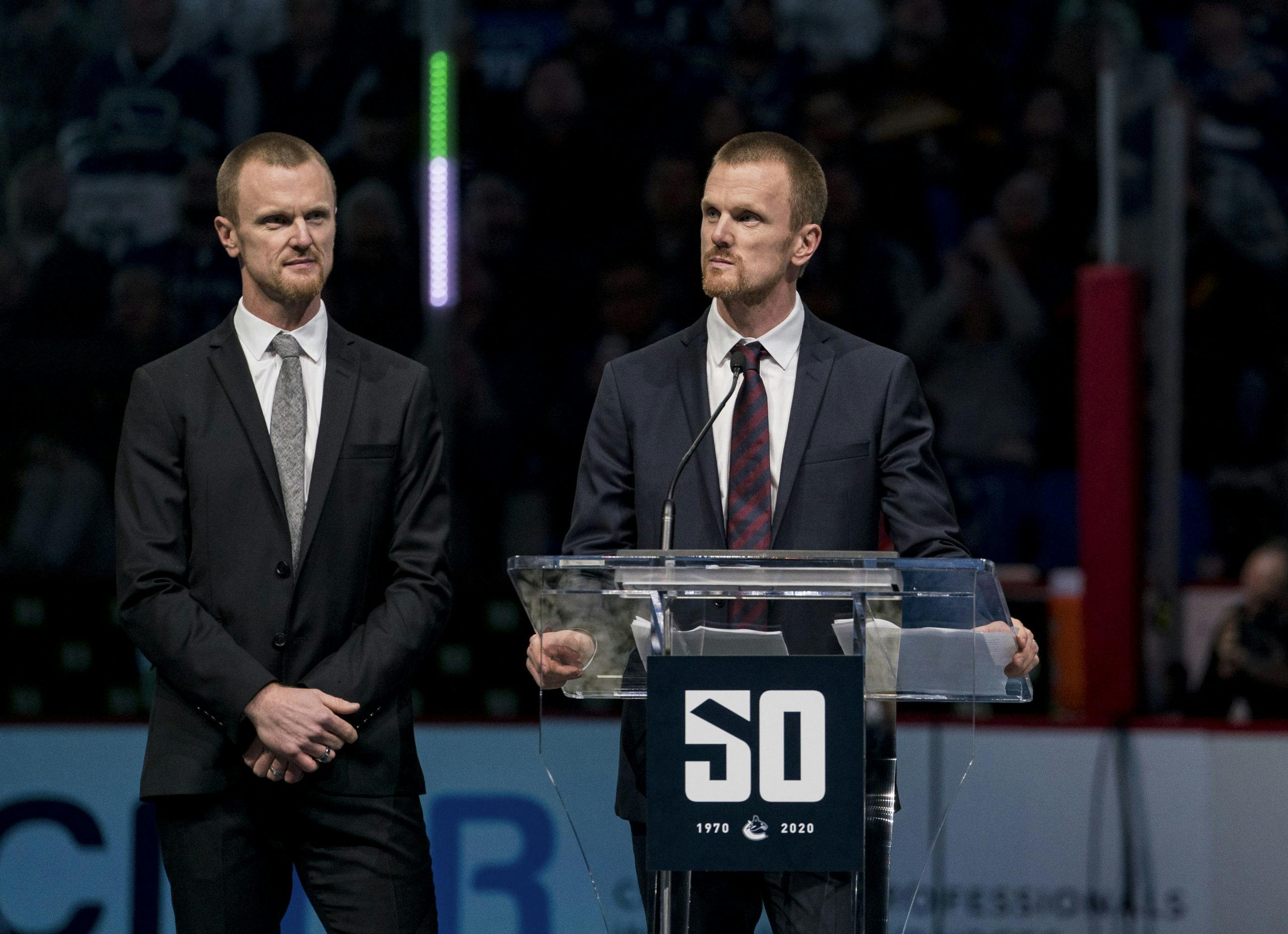
Photo credit: Bob Frid-USA TODAY Sports

May 31, 2026, 16:01 EDTUpdated: May 31, 2026, 22:56 EDT


The Vancouver Canucks have never picked three times in a single first round of the NHL Entry Draft.
Barring a stunning trade, that will still be the case after this year’s draft. The Canucks have, however, had two first-round picks in five drafts throughout their history.
Heading into the 2026 draft, the Canucks have two first-round picks: the third-overall pick from finishing last in the standings and falling two spots in the draft lottery, and the 24th-overall pick from the Quinn Hughes trade. Those two picks are vitally important; whether the Canucks get them right will go a long way towards determining how long their rebuild will take.
So, let’s take a look back at the five other times the Canucks have picked twice in the first round and see where they went right or (mostly) wrong.
2014: Jake Virtanen and Jared McCann
The most recent two-pick first round for the Canucks was in 2014. The Canucks fell short of the playoffs and were rewarded with the sixth-overall pick, then added the 24th-overall pick in the Ryan Kesler trade, making this an incredibly awkward draft year to talk about in terms of off-ice allegations.
The Canucks used the sixth-overall pick on Jake Virtanen, then drafted Jared McCann 24th.
Even without considering his character issues and allegations, Virtanen was a terrible pick. What’s worse is that it was a predictably bad pick, with multiple people in the public sphere pointing out that William Nylander or Nikolaj Ehlers would be much better and safer choices.
Those people, some of whom now work for NHL teams, were correct.
McCann, at least, turned out to be a solid player and exactly what you hope for late in the first round: a legitimate top-six forward, who has already played over 700 games in his NHL career and has a 40-goal season under his belt. It just hurts that he was taken one pick before David Pastrnak and was traded for Erik Gudbranson after just one season in Vancouver.
2013: Bo Horvat and Hunter Shinkaruk
A shocking trade at the 2013 draft didn’t just get the Canucks a second first-round pick; it got them into the top ten.
The Canucks already had the 24th-overall pick when general manager Mike Gillis, unable to move Roberto Luongo, decided to instead trade Cory Schneider to the New Jersey Devils for the ninth-overall pick. It was all part of the first steps of a stealth rebuild that came to a screeching halt a year later when Gillis was fired.
But the first part of that intended rebuild was using that ninth-overall pick to select the Canucks’ next captain, Bo Horvat.
That pick worked out well for the Canucks, even if the team was never good enough to make the most of his talent. Horvat is third in goals among players drafted in 2013 behind only Nathan MacKinnon and Jake Guentzel.
The 24th-overall pick, Hunter Shinkaruk, didn’t work out quite as well.
Shinkaruk was highly ranked heading into the draft, with some placing him ahead of Horvat, including TSN’s Craig Button and The Athletic’s Corey Pronman. But Shinkaruk, who racked up points in junior and was solid in the AHL, could never make the jump to the big leagues, playing in just 15 NHL games, with only one of those games coming with the Canucks before he was traded to the Calgary Flames for Markus Granlund.
Given that Shinkaruk never made it, that was seemingly a pretty good trade, but there’s a reason why the “Sea of Granlunds” became synonymous with that era of the Canucks, as he was about as non-descript as an NHL player can be.
1999: Daniel and Henrik Sedin
Yeah, this worked out pretty well.
Just like this year, the Canucks held the third overall pick heading into the 1999 draft. But then-GM Brian Burke knew he needed another top pick in order to draft both of the Sedin twins. So, he traded a top defenceman (hint, hint, current Canucks) in Bryan McCabe and made a few other moves to get the second-overall pick.
The result? Two Hall-of-Fame forwards with 1000+ point careers, all with the Canucks.
1990: Petr Nedved and Shawn Antoski
Despite the best efforts of Trevor Linden in his sophomore season, the 1989-90 Canucks finished last in the Campbell Conference with a 25-41-14 record for 64 points. They couldn’t hold a candle to the Quebec Nordiques, who finished 12-61-7 for 31 points, so the Canucks had to settle for the second-overall pick.
When the Nordiques took Owen Nolan, the Canucks happily took Petr Nedved, who had scorched the WHL for 65 goals and 145 points in 71 games with the Seattle Thunderbirds.
Neved was highly-hyped — too highly, to be honest.
“If the Vancouver Canucks take Nedved in Saturday’s NHL Entry Draft, they’ll get nothing less than an apprentice to Gretzky’s genius,” said Province columnist David Banks at the time.
There was no possible way for Nedved to live up to that hype, and he didn’t. Nedved played just three seasons in Vancouver before a nasty contract dispute in 1994 forced a trade to the St. Louis Blues. That trade ultimately led to the Canucks getting Bret Hedican, Nathan Lafayette, and Jeff Brown.
As second-overall picks go, Nedved wasn’t bad. He had a solid 982-game career, with 310 goals and 717 assists. Of course, Jaromir Jagr, picked fifth overall, was slightly better.
In fairness to the Canucks and the other three teams that passed up on drafting the legend, Jagr apparently told teams that he wouldn’t be coming over to North America right away, making a big deal about supposed compulsory military service. But he told the Pittsburgh Penguins that he would “be there tomorrow” if they drafted him.
The real problem with the 1990 draft was the Canucks’ second first-round pick.
The Canucks traded fan-favourite defenceman Harold Snepsts and two-way winger Rich Sutter to the Blues in 1990 for Adrien Plavsic and a first-round pick, 18th-overall. It was a classic rebuilding type of move, as Snepsts was at the end of his career, and Sutter was a useful player, but not likely to still be useful by the time the Canucks were good again. Getting a young defenceman and a first-round pick from the Blues was a decent deal.
Unfortunately, the Canucks used the 18th-overall pick on Shawn Antoski.
It’s the type of pick that would never be made today. Antoski was in his third year of draft eligibility as a 20-year-old winger and had failed to crack a point per game in the OHL with the North Bay Centennials. Using any draft pick on a prospect with that profile would raise eyebrows these days, let alone a first-round pick.
But Antoski was big and fast, and teams were obsessed at the time with finding the next Bob Probert — a big power forward who could fight and score in equal measure.
But no one could really be the next Bob Probert. Heck, Bob Probert was barely Bob Probert.
Antoski wasn’t even close, managing just 8 points in 183 career games in the NHL. What made it worse is that the next player taken was one of the best power forwards of all time: Keith Tkachuk.
“Antoski was no good,” said Mike Penny, who was the Canucks’ head scout at the time, when I spoke to him for On The Clock. He said he pushed for Tkachuk, but was overruled by GM Pat Quinn. “[Tkachuk] had only played a few games, had a bad ankle injury. Pat said, ‘I’m gonna overrule you here, we’re gonna take Shawn Antoski.’ I said to him, ‘Are you sure you want to do this?’ He said, ‘Yep.’
“About two years later, Pat says to me, ‘Don’t ever let me do that again.’”
The Canucks could have had Jagr and Tkachuk with their two first-round picks in 1990. Imagine adding those two to Trevor Linden and Pavel Bure.
1973: Dennis Ververgaert and Bob Dailey
The first time the Canucks picked twice in the first round was in 1973 after their third season in the NHL. The Canucks were bad that season, but nowhere near as bad as the New York Islanders and California Golden Seals, so they got the third-overall pick on their own demerits.
They then added the ninth-overall pick from the Montreal Canadiens in exchange for their first-round pick in the 1974 draft.
With two picks in the top-10, the Canucks surely added two key prospects to turn their fortunes around, right? Well, not so much.
Don’t get me wrong, they got a couple of solid players. Dennis Ververgaert had some decent seasons for Vancouver, including 37 goals and 71 points in 80 games in 1975-76. And Bob Dailey, one of three-straight Bobs selected in the first round, was a legitimately very good defenceman, sort of a prototypical Chris Pronger with his towering size and mean streak to go with his sneaky skill and heavy shot.
The trouble was who was picked around Ververgaert and Dailey.
One pick after Ververgaert, the Toronto Maple Leafs selected Hall of Famer Lanny McDonald. One pick ahead of Dailey, the Montreal Canadiens took Hall of Famer Bob Gainey. It’s tough to be happy with “solid” when other teams are getting Hall-of-Fame talent.
You can’t fault the Canucks for missing out on Gainey, of course, but you can definitely fault them for McDonald. It was legitimately surprising when the Canucks picked Ververgaert over McDonald, with some speculating that McDonald’s expected contract demands scared them off. Missing out on a Hall-of-Fame talent over penny-pinching — incredible.
Thankfully, with standardized entry-level contracts, that isn’t an issue in the modern era. If the Canucks’ scouts miss out on a Hall-of-Famer in this year’s draft, they’ll only have themselves to blame.
Sponsored by bet365


Breaking News
- ‘Important to stay together’: Gallagher leaning on togetherness amid Canucks’ losing streak
- Scenes from practice: Canucks promote Linus Karlsson to top line; Rossi absent due to illness
- Abbotsford Weekly: Canucks’ Braeden Cootes a point-per-game player through 6 AHL games
- Canucks: Why Elias Pettersson is benefitting from playing under Manny Malhotra
- 3 Canucks Stars of the Week: Pettersson and Willander stand out on the blue line

Vancouver CanucksTeam Cap Summary

Cap Summary
2026-27
2027-28
Projected Cap Hit
$87,295,050
$71,329,167
Projected Cap Space
$16,704,950
$42,170,833
Current Cap Space
$18,625,059
$42,170,833
Active Players
23/23
13/23
Draft Picks
Round
'27
'28
1
1
1
2
2
2
3
1
1