
CanucksArmy has no direct affiliation to the Vancouver Canucks, Canucks Sports & Entertainment, NHL, or NHLPA
How have other NHL teams done after hiring franchise icons in the front office?
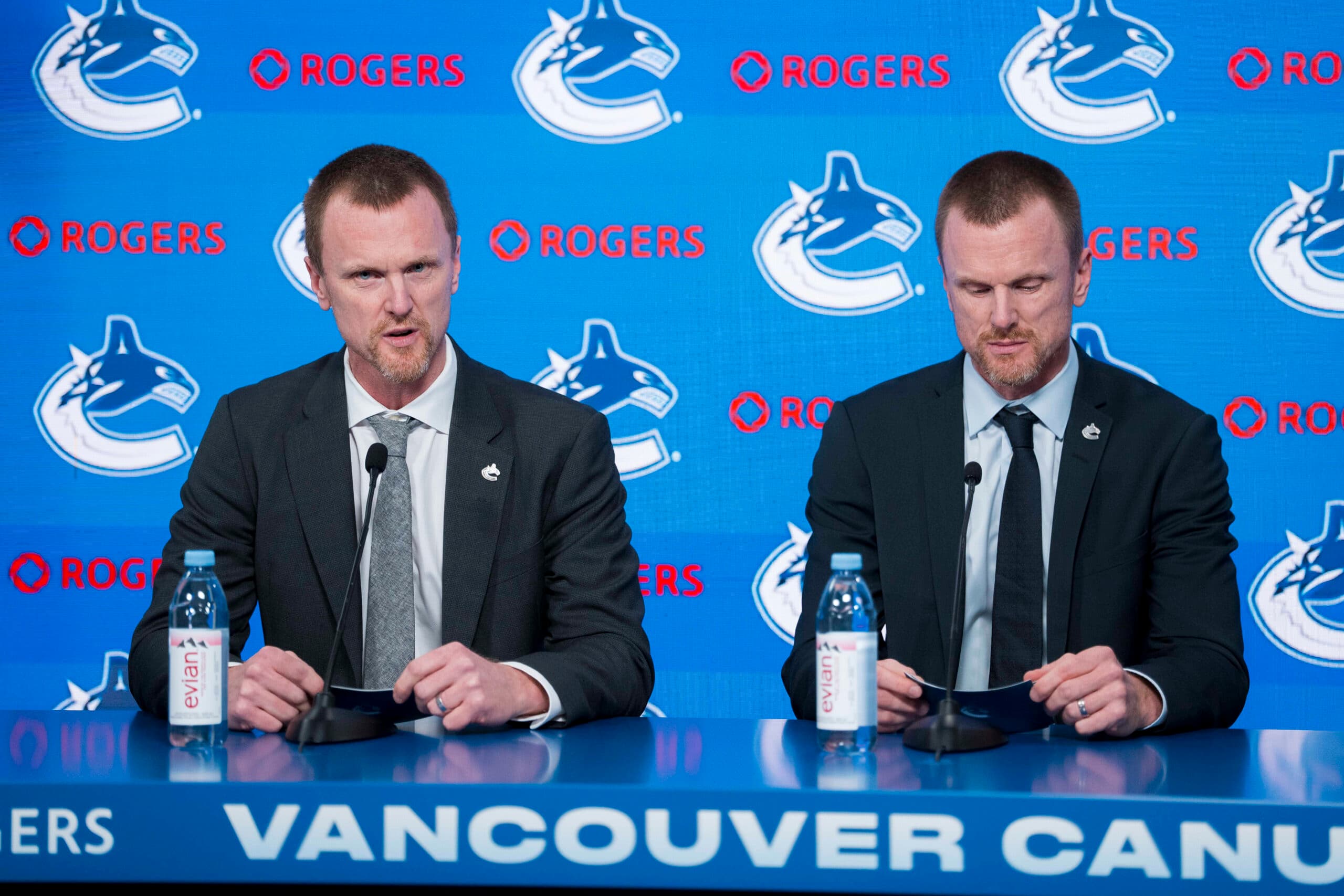
Photo credit: Bob Frid-Imagn Images

Jun 5, 2026, 10:00 EDTUpdated: Jun 5, 2026, 01:42 EDT


The Vancouver Canucks are hardly alone in looking inward for leadership. With Henrik and Daniel Sedin now serving as Co-Presidents, Ryan Johnson elevated to General Manager and Manny Malhotra hired as head coach, the Canucks have placed four former players at the helm of their next chapter. Across the NHL, other organizations have made similar bets on familiar faces.
Some franchises have turned to former stars during periods of instability, such as the Toronto Maple Leafs, who recently brought Mats Sundin into the fold as a senior advisor. Others have viewed franchise icons as uniquely qualified to preserve a sense of organizational identity. The results have ranged from Stanley Cups to prolonged mediocrity, offering some useful lessons as the Canucks begin their own rebuilding experiment.
Among the most notable examples are a handful of franchise legends who moved from the ice to the executive suite.
Colorado Avalanche: Joe Sakic
Joe Sakic is the model every franchise hopes to follow when it brings a legendary former player into the front office.
Colorado hired Sakic as executive advisor and alternate governor in March 2011, promoted him to executive vice president of hockey operations in 2013, and later made him general manager in 2014. After the Avalanche won the Stanley Cup in 2022, he moved into the role of president of hockey operations. With Chris MacFarland taking over as GM and President of Hockey Operations with the Nashville Predators as of June 2, Sakic will reassume duties as GM of the Avalanche.
Sakic’s success came through a series of calculated roster-building decisions. He resisted calls for major changes after Colorado’s disastrous 48-point season in 2016-17, keeping both Nathan MacKinnon and head coach Jared Bednar in place. He drafted franchise cornerstone Cale Makar fourth overall in 2017, acquired Devon Toews from the New York Islanders for two second-round picks, and added Nazem Kadri in a trade with Toronto for Tyson Barrie. He was also able to insulate his stars with productive supporting pieces, including Valeri Nichuskin and Artturi Lehkonen.
When Colorado officially handed Sakic the general manager’s title, the Avalanche were coming off a surprise division title. Eight years later, he left the position having delivered the franchise’s first Stanley Cup in 21 years.
Detroit Red Wings: Steve Yzerman
When the Detroit Red Wings brought franchise icon Steve Yzerman back as executive vice-president and general manager in April 2019, the move was intended to restore direction to a team in limbo.
Yzerman was a mythical figure in the Detroit market: the captain who helped define the Red Wings’ modern legacy, won three Stanley Cups as a player, and had already established executive credibility with the Tampa Bay Lightning. Detroit, meanwhile, was entering a painful rebuild after its 25-year playoff streak ended.
The Cranbrook, BC, native’s key moves have included drafting Moritz Seider, Lucas Raymond, and Marco Kasper, and acquiring Alex DeBrincat to flank Dylan Larkin. The executive also dealt Filip Hronek to Vancouver for the draft pick that resulted in Axel Sandin-Pellikka. Yzerman retained Jeff Blashill behind the bench after being hired, then pivoted to Derek Lalonde in 2022, a coach he knew from Tampa Bay, and later to Todd McLellan in 2024.
For all the patience built into the Yzerplan, the Red Wings have continued to flounder, missing the playoffs for a 10th consecutive season this year. And after yesterday’s news of Captain Larkin requesting a trade, the Yzerplan may be in hot water if that results in the organization taking another step back than propelling forward.
Boston Bruins: Cam Neely
Cam Neely became the Bruins president in June 2010 after spending several years in Boston’s front office. The Bruins were in a fragile state when the former Canuck took over. Boston had just blown a 3-0 series lead to Philadelphia in the 2010 playoffs, creating pressure on a team that was close but still had not broken through.
With Peter Chiarelli still operating as general manager, Neely helped oversee a group built around Zdeno Chara, Patrice Bergeron, Brad Marchand, Tim Thomas, David Krejci and Milan Lucic. The Bruins added Nathan Horton and later Tomas Kaberle before their successful 2011 Stanley Cup run.
As president, Neely also played a major role in shaping the organization’s long-term direction. During his tenure, Boston drafted and developed key players such as David Pastrnak, Charlie McAvoy, and Jeremy Swayman, while maintaining a culture that consistently kept the Bruins a contender. He was involved in major organizational decisions, including the hiring of Don Sweeney as general manager in 2015 and the club’s continued emphasis on strong drafting and development.
Boston’s success did not stop after its 2011 Stanley Cup win. Under Neely’s leadership, the Bruins returned to the Stanley Cup Final in 2013 and 2019, won multiple division titles, captured the Presidents’ Trophy in 2020 and again in 2023, and set an NHL record with 65 wins and 135 points during the 2022-23 regular season. While Boston has not won another Stanley Cup since 2011, the Bruins have remained one of the league’s most consistently successful franchises throughout Neely’s tenure.
Vancouver Canucks: Trevor Linden
When the Canucks hired Trevor Linden as president of hockey operations in April 2014, the former Canucks captain brought a wealth of credibility within the province of British Columbia.
Linden had spent 16 seasons with the organization, served as team captain and remained one of the most respected figures in franchise history. His appointment came after a disappointing season to end the Mike Gillis era, leaving the team searching for a new direction.
During Linden’s tenure, Vancouver began a long-term transition away from the Sedin era. He hired Jim Benning as general manager, helped oversee the selections of Brock Boeser, Elias Pettersson and Quinn Hughes, and advocated for a patient rebuild. That vision ultimately created tension within the organization, and Linden departed in 2018 amid philosophical differences.
While he never saw the rebuild through, a handful of the core pieces acquired during his tenure remain in the fold today. Linden’s experience demonstrated that to get the job done in Vancouver, the executive chair requires more than market familiarity alone.
Beyond the franchise icons who became the faces of their organizations, several other teams have recently turned to former players in hopes of finding the same connection between on-ice experience and front-office success.
Calgary Flames: Craig Conroy
Calgary also brought in a familiar face in the recent past when the Flames promoted Craig Conroy to general manager in May 2023.
Conroy spent nine seasons with the Flames as a player, captained the club, and remained with the organization in various front-office roles after retiring. His appointment came during a turbulent period for the Flames following the departures of Johnny Gaudreau and Matthew Tkachuk and a disappointing 2022-23 season.
Over the next two seasons, Conroy did not pursue short-term fixes, and he moved several veteran players approaching unrestricted free agency, including Elias Lindholm, Noah Hanifin, Chris Tanev, and Jacob Markström. The trades brought back a collection of draft picks, prospects, and younger players, giving the organization a clearer long-term outlook.
The Flames remain in the early stages of that rebuild, making Conroy difficult to fully evaluate. What is clear, however, is that Calgary entrusted a franchise favourite with one of the most important transitions in team history, betting that his understanding of the market and organization could help guide the next era of Flames hockey.
Philadelphia Flyers: Daniel Brière
The Flyers have fully embraced the former-player model, bringing franchise alumnus Daniel Brière back as general manager, Keith Jones as president of hockey operations, and former captain Rick Tocchet behind the bench as head coach.
Brière was named interim general manager in March 2023 before having the title made permanent two months later. Another former captain, Brière inherited an organization desperate to contend after years of inconsistency and unsuccessful attempts to rebuild on the fly.
Since taking over, Brière has committed to a patient rebuild centred on youth and asset accumulation. While Matvei Michkov has shown flashes of the elite talent that made him one of the league’s most intriguing young players, his future in Philadelphia is not without questions. Despite a productive rookie season, reports of friction with head coach Rick Tocchet and concerns about how he fits within the coach’s system have created uncertainty about his long-term fit with the organization. How the Flyers navigate that relationship could significantly impact the direction of their rebuild.
The rebuild is still a work in progress, meaning Brière’s ultimate legacy will depend on whether Philadelphia can turn promising young talent into a Stanley Cup championship.
New York Islanders: Garth Snow
The New York Islanders took a big swing when they promoted long-time Islanders goaltender Garth Snow to general manager in July 2006, just weeks after retiring from his NHL career.
The Islanders were struggling both on and off the ice. The franchise had missed the playoffs in six of the previous seven seasons, ownership uncertainty lingered, and the club was fighting to remain relevant in the crowded New York market. Snow was brought in by owner Charles Wang as part of an effort to think differently. At just 36 years old, he became one of the youngest general managers in NHL history and took the job without any previous executive experience.
Under his guidance, the Islanders drafted players such as John Tavares, Mathew Barzal, Ryan Pulock, and Brock Nelson to help rebuild the organization’s talent base and establish a core. However, the club struggled to score, had inconsistent goaltending, and the team never became a consistent contender during Tavares’ tenure. He also oversaw the team’s move from Nassau Coliseum to Brooklyn and eventually back to Long Island.
New York won only a single playoff series during his 12-year tenure as general manager, as several of Snow’s most notable roster moves produced mixed results. The Islanders committed significant money to free agents such as Andrew Ladd in 2016, while acquisitions such as Thomas Vanek and Johnny Boychuk provided short-term boosts but failed to translate into playoff success.
Snow was dismissed in June 2018 when Lou Lamoriello was hired to oversee the Islanders’ hockey operations. His tenure serves as a cautionary tale: playing experience and leadership can be valuable assets, but successfully pivoting into management requires a distinct set of skills.
Now, Vancouver is once again trying to solve the puzzle with pieces from their own past whether this version fits better than the ones before it will depend on whether the Sedins, Johnson, and Malhotra can turn familiarity into something much bigger.
The examples above have varying results. Sakic and Neely delivered Stanley Cups while building two of the NHL’s most consistent contenders. However, Yzerman continues to search for the next step in Detroit’s rebuild, and Linden’s tenure ended before his vision could fully materialize.
The common thread is that playing credentials alone were never enough. The executives who found success surrounded themselves with strong staff, trusted their scouting departments and stayed committed to a clear organizational vision. As the Canucks begin shaping a new future, those are the lessons that matter most.
Sponsored by bet365


Breaking News
- How Canucks’ Cootes is doing compared to other 2025 first-round picks playing in the AHL
- Scenes from practice: Pettersson and Boeser reunited as Canucks skate at UBC on Saturday
- Abbotsford Canucks preview: Players to watch in weekend rematch with the Wranglers
- How the Canucks can fix their early-season defensive breakdowns
- ‘Glad to be somewhere I’m wanted’: Jacob Quillan excited for new opportunity with Canucks

Vancouver CanucksTeam Cap Summary

Cap Summary
2026-27
2027-28
Projected Cap Hit
$87,295,050
$71,329,167
Projected Cap Space
$16,704,950
$42,170,833
Current Cap Space
$19,063,296
$42,170,833
Active Players
23/23
13/23
Draft Picks
Round
'27
'28
1
1
1
2
2
2
3
1
1