
CanucksArmy has no direct affiliation to the Vancouver Canucks, Canucks Sports & Entertainment, NHL, or NHLPA
Filip Hronek’s goals and expectations for 2026-27 go well beyond his counting stats
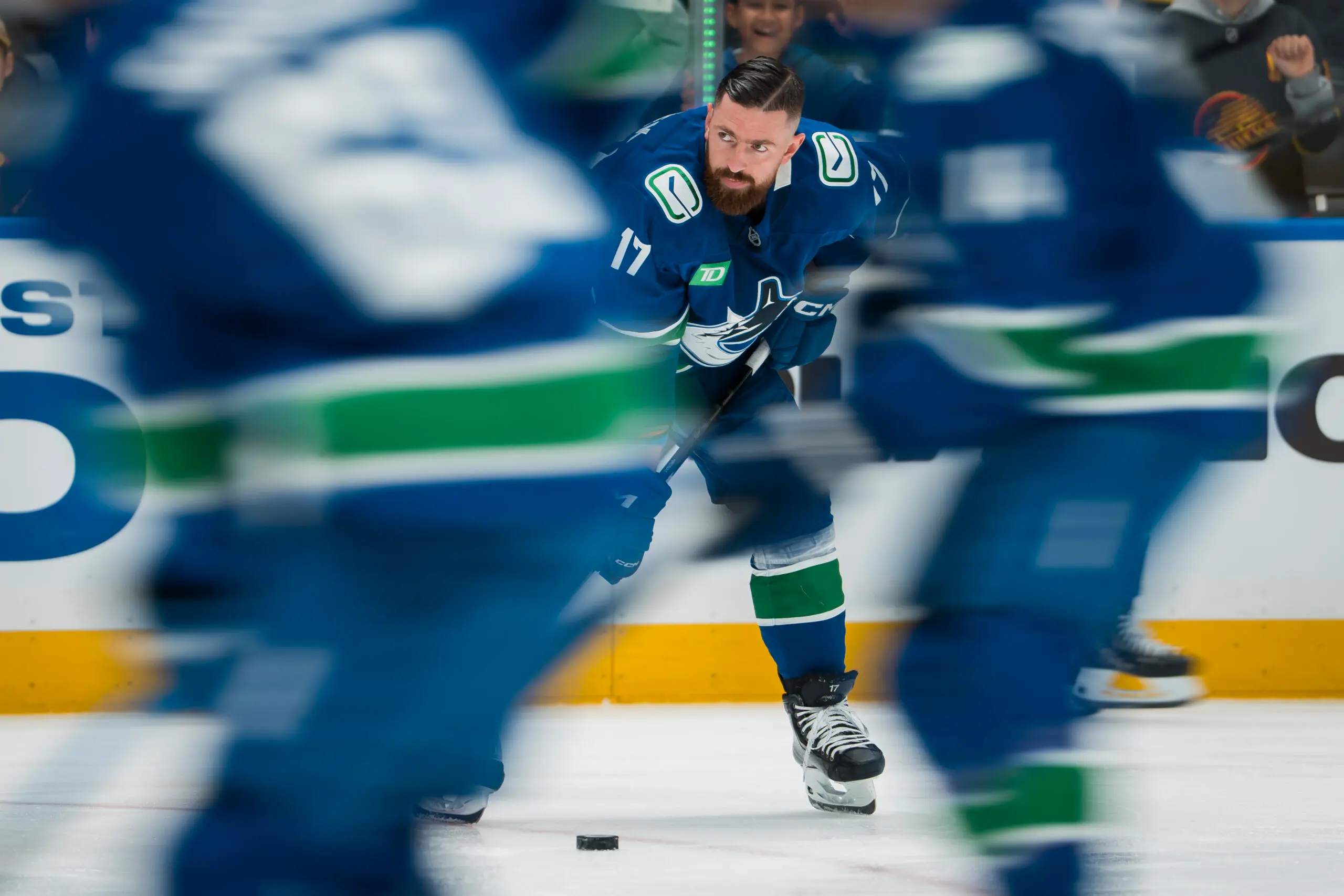
Photo credit: © Bob Frid-Imagn Images

Aug 4, 2026, 12:00 EDTUpdated: Aug 4, 2026, 01:02 EDT


Filip Hronek enters the 2026-27 season with a larger role than the Vancouver Canucks have ever asked him to fill.
For the past three years, Hronek has served as Quinn Hughes’ partner, complementing one of the NHL’s premier puck-moving defencemen while helping Vancouver control play from its top pairing. That arrangement ended when the Canucks traded Hughes to the Minnesota Wild in December.
Hronek responded by proving he could handle more responsibility.
The 28-year-old finished the season with eight goals and a career-high 41 assists and 49 points across all 82 games. He led Vancouver’s blue line in scoring, averaged 25:23 per game after the Hughes trade, and became one of only three NHL players to record at least 40 points, 100 blocked shots and 100 hits.
Canucks fans recognized his value by voting him the winner of both the Cyclone Taylor Trophy as team MVP and the Walter “Babe” Pratt Trophy as Vancouver’s best defenceman. The Hradec Kralove, Czechia, native absorbed difficult matchups, played on both special teams units and appeared in all 82 games for the first time in his NHL career.
Now, Hronek enters the season as Vancouver’s clear No. 1 defenceman, the likely anchor of a top pairing with Zeev Buium and one of the strongest candidates to become the franchise’s next captain. So, what should a successful season look like for Vancouver’s top defender?
Meeting expectations: Stabilize the top pair and help Buium develop
Buium’s progress may ultimately be the best measure of Hronek’s success this campaign.
The sophomore defenceman possesses the skating, creativity, and confidence to become Vancouver’s next high-end puck mover, but he is also entering only his second NHL season and could spend much of it facing opponents’ top scoring lines beside Hronek. For a developing blueliner still getting accustomed to the NHL, that type of assignment will require some patience.
Hronek and Buium showed promising stretches together last season, particularly when moving the puck and generating shot attempts, but they struggled to turn that possession into favourable scoring chances and goals. A successful season would see the pairing spend more time above 50% in expected goals while giving new head coach Manny Malhotra a dependable matchup option.
Hronek will likely rotate through several partners over the course of the season. Jamie Oleksiak could move up to the top pair when a matchup calls for a more experienced, defensively oriented presence, or when Buium or the younger Elias Pettersson needs a reset.
Regardless of his partner, Hronek could easily approach 25 minutes per game again, given Vancouver’s roster. The Canucks would benefit, however, from limiting the 28- and 30-minute nights that have become more common since the Hughes trade.
Regularly pushing Hronek into the minute leaders among defencemen increases his injury risk, something the Canucks cannot afford given his importance to the lineup and potential value as a trade asset. Hronek’s full no-movement clause gives him control over his immediate future, and he has shown no eagerness to leave Vancouver, but that should not prevent the organization from protecting its options.
During one difficult 26-game stretch following the Hughes trade, Natural Stat Trick had Hronek at 50.8% five-on-five shot share and 50.5% expected-goal share, despite Vancouver posting a 7-16-3 record. MoneyPuck’s full-season numbers were less flattering, with his expected-goal and actual-goal shares finishing below 50%. The Canucks still performed worse without him, but the overall profile fell short of what a legitimate No. 1 pairing should deliver.
Hronek will meet expectations if he keeps Vancouver’s top pair around break-even or better, helps Buium become more comfortable against elite competition, and gives Malhotra stability during another transitional season.
Above expectations: Eclipse 50 points while becoming a complete No. 1 defenceman
The veteran defenceman finished one point shy of 50 last season, but reaching that mark again may prove more difficult.
His scoring leaned heavily on the power play, where he collected 20 five-on-four points, one of the NHL’s highest rates among defencemen. That level of power play production seems unlikely to repeat because the Canucks need to determine whether Buium can become a legitimate NHL power play quarterback.
Hronek should still receive opportunities on the first unit, especially if Buium struggles or the power play fails to produce. However, he may need to make up for some of the lost special teams offence at five-on-five.
NHL Edge data support the idea that he can remain an effective all-situations defenceman. Hronek ranked near the top of the league in total skating distance, reached a top speed above 22 miles per hour and recorded a shot above 95 mph.
The ex-Red Wing’s skating allows him to join the rush and recover when plays break down. His shot gives Vancouver a Sami Salo-esque threat from the point, but producing more offence at even strength would strengthen his case as a true top-pair driver, rather than a player whose numbers depend on the power play.
An above-expectations season would also see growth on the penalty kill.
Hronek played more than 220 shorthanded minutes last season on a Vancouver penalty kill that struggled mightily throughout the year. Better reads around the slot, improved coverage through passing lanes, and fewer cross-seam opportunities would help him establish a more complete defensive profile.
An individual season of seven to 10 goals and at least 50 points would be impressive, but pairing that production with stronger five-on-five results and a penalty kill that escapes the league’s bottom tier would represent Hronek’s best season as a Canuck.
Below expectations: Defensive results decline under an unsustainable workload
Hronek has already demonstrated that he can produce offence and play heavy minutes — the concern is whether Vancouver will ask him to do too much on a nightly basis.
The Canucks are rebuilding their defence around Buium, Willander, and Pettersson, but none of those players are ready to handle Hronek’s workload. Oleksiak and Luke Schenn provide experience and stability, although they’re unlikely to drive play, leaving Hronek as the player Malhotra may turn to in every situation.
If his minutes regularly climb toward 28 or 30 per night, fatigue could affect his defensive reads and decisions with the puck, and a decline in his five-on-five numbers would place even more pressure on Vancouver’s inexperienced defence, making it even harder for Buium to settle into a top-pair role.
The former 2016 second-round pick cannot allow his offensive impact to completely disappear if his power play time declines. Falling into the mid-30s in points would be understandable if Buium asserts himself on the first unit. However, Hronek will still need to buoy a second-unit power play, contribute more playmaking at even strength in transition, and generate higher shot volume.
A below-expectations season would see his expected-goal share remain below 50%, the penalty kill continue to struggle, and the Canucks become increasingly reliant on him without receiving top-pair results.
Injury would present the worst-case outcome. Hronek is signed through 2031-32 at a $7.25-million cap hit and holds a full no-movement clause until after the season. Losing him for an extended period would remove Vancouver’s most experienced puck-moving defenceman and leave the club with few proven options for difficult minutes.
When Hughes missed time with a hand injury during the 2024-25 season, Vancouver’s defence struggled considerably, and the group could face a similar fate if Hronek is sidelined for an extended period.
2026-27 goals for Hronek
- Keep his primary pairing above 50% in expected goals
- Help Buium establish himself as a dependable top-four defenceman
- Record at least 40 points and anchor the second power play unit
- Help the penalty kill escape the league’s bottom tier
- Average approximately 23-25 minutes per night without regularly exceeding 28
Hronek’s season should ultimately be judged by how well he handles responsibility rather than whether he reaches another career high in points. Vancouver needs him to manage difficult minutes, give its younger defencemen room to develop, and prevent an inexperienced blue line from becoming overwhelmed. They don’t need him to be Quinn Hughes.
The Canucks may not be ready to contend, but Hronek can help ensure the club is inching towards meaningful progress. If he remains a positive influence in the locker room without growing frustrated by the team’s lack of results and elevates the players around him, he will have delivered exactly what Vancouver needs from its most important defenceman.
Sponsored by bet365


Breaking News
- How the Canucks can fix their early-season defensive breakdowns
- ‘Glad to be somewhere I’m wanted’: Jacob Quillan excited for new opportunity with Canucks
- Canucks: What kind of reception will Quinn Hughes get when he returns on Sunday?
- The Canucks are one of the smallest teams in the NHL, but can they change that?
- NHL Notebook: Jets trade Hellebuyck to Devils for package of four players and two draft picks

Vancouver CanucksTeam Cap Summary

Cap Summary
2026-27
2027-28
Projected Cap Hit
$87,295,050
$71,329,167
Projected Cap Space
$16,704,950
$42,170,833
Current Cap Space
$19,063,296
$42,170,833
Active Players
23/23
13/23
Draft Picks
Round
'27
'28
1
1
1
2
2
2
3
1
1