
CanucksArmy has no direct affiliation to the Vancouver Canucks, Canucks Sports & Entertainment, NHL, or NHLPA
Regret-rospective: The disastrous legacy of the OEL/Garland trade
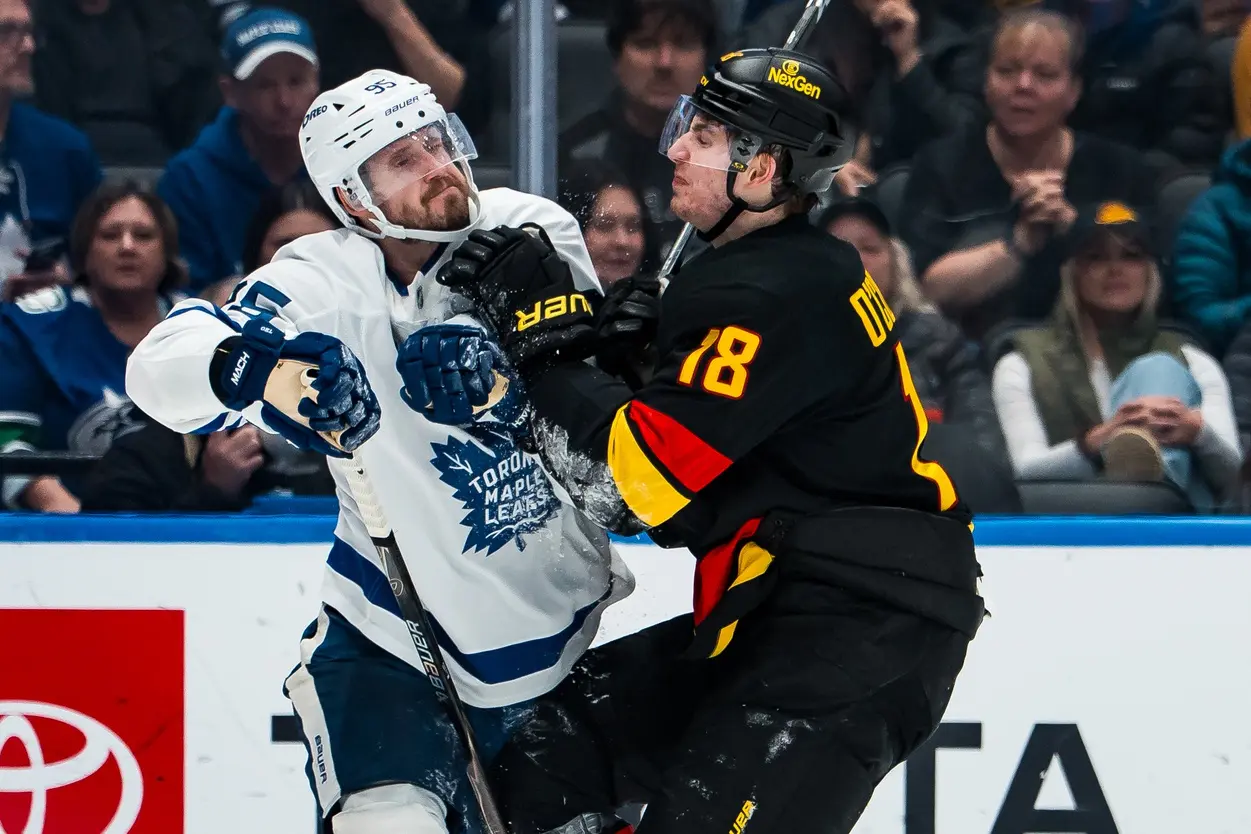
Photo credit: © Bob Frid-Imagn Images

May 15, 2026, 15:35 EDT


The Vancouver Canucks’ 2025-26 season went so comically poorly that at various points, we almost expected to hear a record scratch and hear someone say to the camera, “You’re probably wondering how we got here.”
That question is usually rhetorical, but less so with the Canucks. Their supporters have a pretty darn good idea how the team got where it is today, and it involves a series and sequence of unfortunate decisions. Going back over those bad choices, with the acknowledged power of hindsight, is the purpose of the Regret-rospective series. And today, we cover perhaps the most regrettable move in recent franchise history.
Oliver Ekman-Larsson’s name has been in the media a lot lately. He’s had an excellent run since being bought out by Vancouver, winning a Cup with the Florida Panthers in 2023-24 and then continuing to play as a top-four defender for the Toronto Maple Leafs. He was just named the captain of Sweden’s entry at the 2026 World Championships. The word on the street was that the Leafs were asking for a first-round pick back for OEL at this most recent deadline. While they did not have their price met, it’s a fine demonstration of how this player has turned around his own value from the point at which the Canucks were literally willing to pay him to leave.
And they’re still paying him, by the way. OEL’s buyout is still on the books for next year’s 2026-27 campaign at a $4.77 million cap hit. That’s more than the Maple Leafs are paying him to actually play for them. The cap penalty drops to $2.13 million for the next two years after that, then disappears.
OEL’s buyout penalty, among other lingering costs for departed staff, has been floated as one of the financial burdens currently placed on the Canucks that may have affected their ability to negotiate with potential new managers.
In other words, Ekman-Larsson was a costly mistake that remains one mistake today, three years after his departure. But the disastrous legacy of the trade that brought him to Vancouver in the first place goes a lot farther than just a buyout.
The full trade saw the Canucks send to Arizona the final years of contracts for Jay Beagle ($3 million), Antoine Roussel ($3 million), and Loui Eriksson ($6 mArizona, as well as the already-slotted ninth overall pick in the 2021 draft, and the Canucks’ own second round pick in 2022 and their seventh in 2023.
In return, they got back Ekman-Larsson, with six years remaining on an $8.25 million AAV contract that Arizona would retain 12% of, and Conor Garland, a pending RFA at the time.
The dumping of Beagle, Roussel, and Eriksson could have been seen as a positive. But each of those players only had the 2021-22 season left on their deals. That was a season in which the Canucks missed the playoffs by a considerable margin, so there was little gained from the extra cap space. Especially since the incoming salaries of Ekman-Larsson and Garland quickly eclipsed the $12 million in cap space gained. The rest of any space was given to names like Nate Schmidt, Jaroslav Halak, and Tucker Poolman, all busts in Vancouver.
In retrospect, the Canucks would have been far better off eating the final year of the Beagle, Roussel, and Eriksson contracts and walking into 2022-23 free and clear of any onerous deals.
For a time, the acquisition of Garland was seen as a saving grace in this trade. And Garland certainly had more success than OEL in Vancouver. Whereas OEL had probably the two worst seasons of his career as a Canuck, Garland immediately put up a career-high 52 points and then maintained that 50ish-point average all the way through his four full seasons in Vancouver. That fell apart in this final 2025-26 campaign, but it was a good run until then.
Unfortunately, it was not a run that did much for the Canucks at the end of the day. Garland only played 13 playoff games in Vancouver, all of them in 2024, when he scored a paltry five points.
Aside from that, the real legacy of Garland is the second contract he signed with the Canucks. This contract was a six-year, $6 million AAV extension that still hasn’t kicked in yet (it begins in 2026-27), and has now more or less been admitted as an ill-fated attempt to convince Quinn Hughes to stick around.
That contract, combined with Garland’s shoddy numbers this past season, has absolutely tanked his trade value. The Canucks managed to get a 2028 second-round pick and a 2026 third-rounder back for Garland. And given how Garland only scored seven points in 21 games with the Columbus Blue Jackets thereafter, it’s starting to feel like the Canucks traded him just before his value tanked even farther.
At least, then, the Canucks have something to show for this portion of the trade. They got less than nothing out of the cap space they dumped; they got such a negative impact from OEL that they’re still paying for it, but at least Garland ultimately yielded a couple of draft picks.
Of course, that really pales in comparison to the picks the Canucks gave up in the first place. We can forget about the seventh rounder. It was eventually flipped to the San Jose Sharks and used on someone named Yegor Rimashevsky, who remains a long-shot prospect.
The 2022 second-rounder had more inherent value. The Coyotes wound up flipping that pick to Minnesota for the RFA rights to Jack McBain. The Wild used the pick on forward Hunter Haight, who ranks somewhere on the periphery of their top-10 prospect list.
McBain, meanwhile, has gone on to play 316 games for the Coyotes/Utah Mammoth since then, and has developed into a rough, tough 6’4” centre with 30-point potential and some serious pugilism skills. At 26, he’s a player the Canucks could very much use on their current, rebuilding roster, and he’d certainly be more welcome in these parts than the likes of OEL and Garland.
But all that doesn’t hold a candle to the lost potential of trading the ninth overall pick. The Coyotes famously used it on Dylan Guenther, who has since scored 91 goals and 183 points in 227 NHL games across four seasons (and five points in six playoff games as of this year). At 23, he’s a genuine young star in this league and has put himself on the radar for Team Canada opportunities as early as the World Cup of Hockey in 2028.
He’s not only a player who would have provided superior production to Garland in four of his five seasons with the Canucks, he’s also someone who would have held considerable value for them moving forward. At 23, Guenther wouldn’t just be ideally situated to be part of the rebuild; he’d be considered a central piece. Guenther would be the best forward on the team, now and into the future, and might be neck-and-neck with Zeev Buium and Tom Willander as the team’s overall top player asset prior to the 2026 Draft.
And, sure, getting retrospective over draft picks is always a little questionable, and some of the names that went directly after Guenther in the draft were less impressive, like Tyler Boucher, Cole Sillinger, and Isak Rosen. But then again, this trade happened on the day of the 2021 Draft. Guenther was a fairly slam-dunk pick at ninth overall at that point, and several pundits had already predicted that the Canucks would take him there – if they were lucky enough to still have him available. Thus, it’s a little more valid than it usually is to say that the Canucks lost out on Guenther, specifically, when they traded the ninth overall pick.
That’s a gap in their asset management that they still haven’t filled. That, more than the buyout, more than the Garland extension, is the most disastrous part of the disastrous legacy of this trade. And the Canucks are going to feel that missed opportunity, working to make up for it, long after OEL is fully off the books in a couple of years.
Sponsored by bet365


Recent articles from Stephan Roget
Breaking News
- Manny Malhotra and Brock Boeser offer up slightly different theories for Canucks’ struggles
- The Stanchies: Jonathan Lekkerimäki notches a goal and an assist, and that’s all we’ll say
- ‘It’s embarrassing’: Brock Boeser brutally honest following Canucks’ ninth straight loss
- Instant Reaction: Canucks go nearly 40 minutes without a shot in 5-2 loss to Red Wings
- What’s behind ex-Canuck Conor Garland’s struggles in Columbus?

Vancouver CanucksTeam Cap Summary

Cap Summary
2026-27
2027-28
Projected Cap Hit
$87,295,050
$71,329,167
Projected Cap Space
$16,704,950
$42,170,833
Current Cap Space
$18,951,815
$42,170,833
Active Players
23/23
13/23
Draft Picks
Round
'27
'28
1
1
1
2
2
2
3
1
1