
CanucksArmy has no direct affiliation to the Vancouver Canucks, Canucks Sports & Entertainment, NHL, or NHLPA
Regret-rospective: The Jason Dickinson debacle cost the Canucks three rounds worth of draft picks
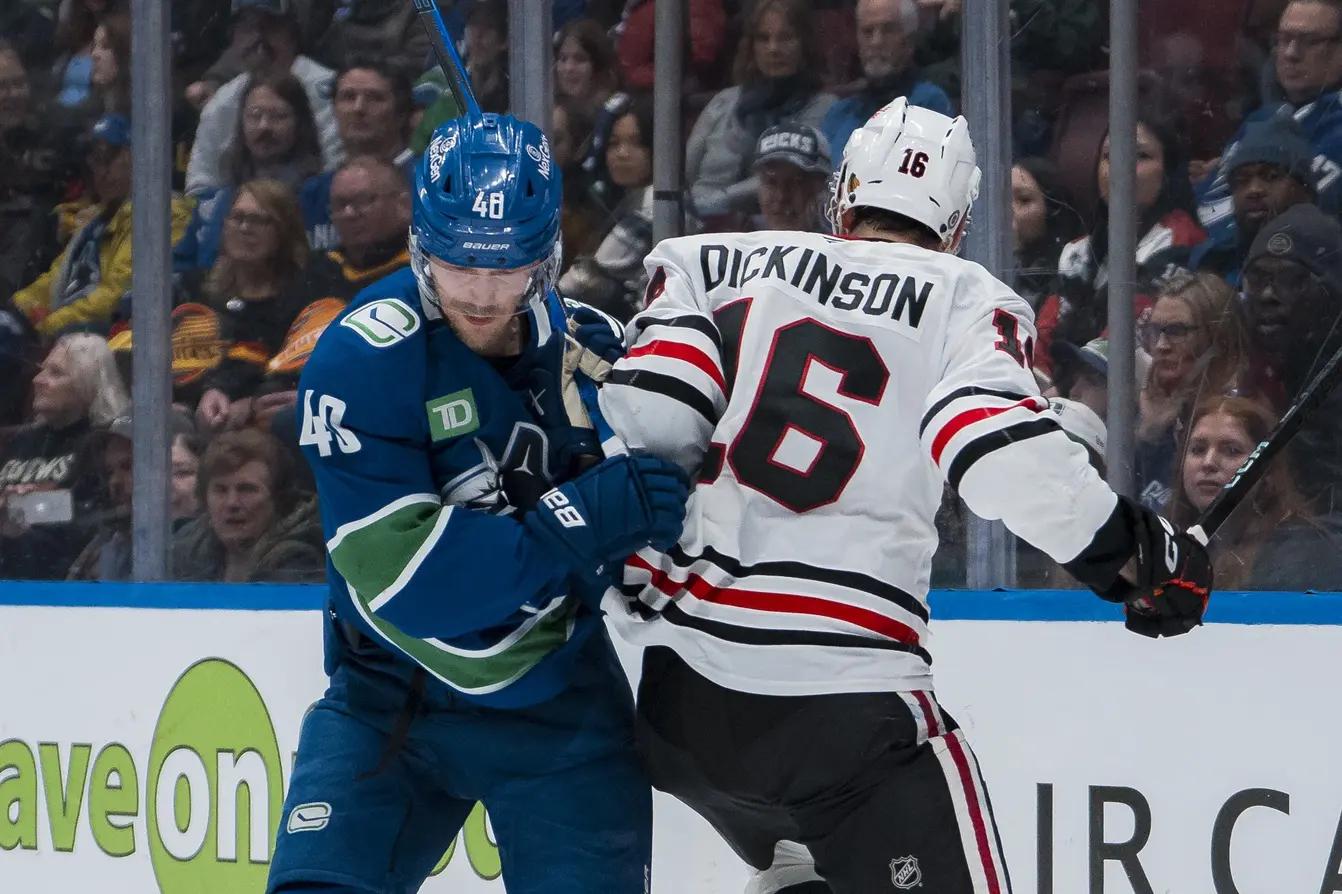
Photo credit: © Bob Frid-Imagn Images

Mar 26, 2026, 16:00 EDTUpdated: Mar 26, 2026, 15:39 EDT


If you get right down to it, most supporters of the Vancouver Canucks are at least a little bit glad that the team is in its current circumstances. While anyone in their right mind would rather be cheering for a contender, there’s real value to be had in the Canucks no longer being in any danger of lapsing into the mushy middle, and instead fully embracing things like the tank, the rebuild, and the drastic restructuring of the roster that is needed to achieve them.
That said, you don’t make it to last place in the NHL without some regrets. And the Canucks, as a franchise, have plenty in recent memory worth talking about, and that’s the basic idea behind these new Regret-rospective articles.
One might guess that the first piece in this series would be centred around the now-infamous Oliver Ekman-Larsson/Conor Garland trade, and we will indeed get to that one eventually. But that’s also a topic that’s been trodden plenty of times already. There’s another recent sequence of trade-related events that may be smaller in its scope, but has proved similarly disastrous and regrettable in retrospect, and that hasn’t got nearly as much coverage.
Our first subject is the three-part Jason Dickinson story; something that can only be referred to as a Saga of Escalating Draft Pick Loss.
Interestingly, the Dickinson story begins with the final offseason of one Jim Benning as GM of the Vancouver Canucks. Benning and Co. traded a 2021 third-round pick to the Dallas Stars for then-unsigned RFA Dickinson on July 17, 2021 – just six days ahead of the aforementioned swap with the Arizona Coyotes.
Even more interestingly, the Benning component of this story is the only part where the Canucks come out any sort of ahead. Looking back at his body of work since, we can say that a third round pick was a fine price to pay for Dickinson. Even the contract that Benning signed Dickinson to following the trade, a three-year commitment with a $2.65 million cap hit, was reasonable value at the time, and would become reasonable value again after a brief dip in Vancouver.
Benning may have made many regrettable moves in his time at the helm in Vancouver, but trading for Dickinson wasn’t one of them. It’s later that the regrets would come into play.
The 2021-22 season would be Dickinson’s only season with the Canucks, and it wasn’t a very good one for him or the team. The Canucks themselves got off to a historically bad start, fired everyone – including Benning – and then brought in Bruce Boudreau to go on a meaningless late-season run that only scuppered their draft-pick placement.
On an individual basis, Dickinson was one of many Canucks to have awful years, and his was easily the worst of his NHL career to date. He accomplished just five goals and 11 points in 62 games, received diminishing ice-time and responsibilities along the way, and even suffered his weakest year ever in the faceoff circle.
Of course, there were complicating factors at play for Dickinson. One of which, apparently, was a broken hand that went undiagnosed in Vancouver and was only noticed after Dickinson had been dealt to Chicago. Dickinson only exited the Vancouver lineup twice that season, once for COVID-19 and another time late in March with an undisclosed injury, which means that whenever the hand-break occurred, Dickinson did not miss any time – he just played through. Obviously, that injury had an impact on Dickinson’s performance throughout 2021-22 and goes a long way toward explaining his anomalously poor performance.
But the Canucks themselves did not seem to be aware of this injury, and neither did the rest of the league, which might trade for him. So, with a new regime in charge in the form of POHO Jim Rutherford and GM Patrik Allvin, the Canucks looked to move Dickinson again in the summer of 2022, and they looked to do so in the form of a cap dump.
Having brought in a series of free agents of their own already, like Andrei Kuzmenko, Ilya Mikheyev, Dakota Joshua, and Curtis Lazar, Rutherford and Allvin were most interested in ditching Dickinson to create both roster and cap space. In the end, the Chicago Blackhawks took him – and the remaining two years of that Benning extension – but the Canucks had to give up a 2024 second round pick in the exchange.
All the Canucks got back in the trade was Riley Stillman, one of the worst defenders to skate for this franchise in recent memory.
In Chicago, Dickinson both got his bone break diagnosed and benefited from a summer of recovery time. He became a near-overnight success, hitting career-highs in goals (9), assists (21), and points (30) in that first 2022-23 season with the Blackhawks. He played well as an individual, but he also didn’t do anything to prevent the Hawks from finishing in the lottery and drafting Connor Bedard.
The next year, Dickinson proved even more valuable, offering some centre-ice depth and stability behind the rookie Bedard and also popping in a new-career-high 22 goals. From cap dump to 22-goal scorer, in the span of about 20 months!
That was enough for GM Kyle Davidson to sign Dickinson to an extension, and a raise at that, with a two-year, $4.25 million AAV deal.
Dickinson suffered through more injuries in the 2024-25 season, managing just 16 points in 59 games. He got off to a similar start for 2025-26, and was up to just 13 points through 47 games when Trade Deadline Week rolled around.
And that’s when the Blackhawks flipped Dickinson – at half retention – to the Edmonton Oilers, along with Colton Dach, in exchange for Andrew Mangiapane and a 2027 first round pick.
Now, it’s not quite accurate to say that the Hawks got a first back for Dickinson. Clearly, part of that price tag applies to the retention, and part of it applies to taking on the cap dump of Mangiapane. But since we’re talking Canucks-related regrets in this article, we’ll note that the Canucks could have easily afforded both that retention and that cap dump. Heck, Mangiapane is probably an asset the Blackhawks will eventually be able to retain and flip for a profit.
Thus, it’s not hard to see how this whole sequence was an unmitigated win for the Blackhawks. They got a second-round pick and a first-round pick out of it, and they also got three-and-a-half decent years out of Dickinson as a bonus.
The Canucks, meanwhile, have an even bigger loss on their hands. One could make the argument that the Dickinson debacle ultimately cost them a full three-round slate of draft picks – the third round pick paid for him in the first place, the second round pick paid to dump him on Chicago, and the first round pick the Canucks didn’t get back for him at this deadline because the Blackhawks got it instead.
If one really wants to layer the regret extra-thick, there is the fact that Dickinson went on to injure Filip Chytil with a hit-from-behind in the 2024-25 season, knocking the Canucks’ forward out of the lineup just shortly after he was featured in the JT Miller trade. That said, it’s impossible to pin all of Chytil’s injury woes on any one player or any one incident.
A truer source of bonus regret might be the fact that Dickinson is now an Edmonton Oiler. The Oilers have had their struggles this season, but they remain a genuine contender. If Dickinson goes on to help the Oilers achieve glory, directly after costing the Canucks three rounds of draft picks – more or less – well, then we might actually be approaching the same ballpark of regret in which the OEL/Garland trade resides.
Sponsored by bet365


Recent articles from Stephan Roget
Breaking News
- Manny Malhotra and Brock Boeser offer up slightly different theories for Canucks’ struggles
- The Stanchies: Jonathan Lekkerimäki notches a goal and an assist, and that’s all we’ll say
- ‘It’s embarrassing’: Brock Boeser brutally honest following Canucks’ ninth straight loss
- Instant Reaction: Canucks go nearly 40 minutes without a shot in 5-2 loss to Red Wings
- What’s behind ex-Canuck Conor Garland’s struggles in Columbus?

Vancouver CanucksTeam Cap Summary

Cap Summary
2026-27
2027-28
Projected Cap Hit
$87,295,050
$71,329,167
Projected Cap Space
$16,704,950
$42,170,833
Current Cap Space
$18,951,815
$42,170,833
Active Players
23/23
13/23
Draft Picks
Round
'27
'28
1
1
1
2
2
2
3
1
1