
CanucksArmy has no direct affiliation to the Vancouver Canucks, Canucks Sports & Entertainment, NHL, or NHLPA
How feasible is trading Canucks’ Filip Hronek for another top-five draft pick?
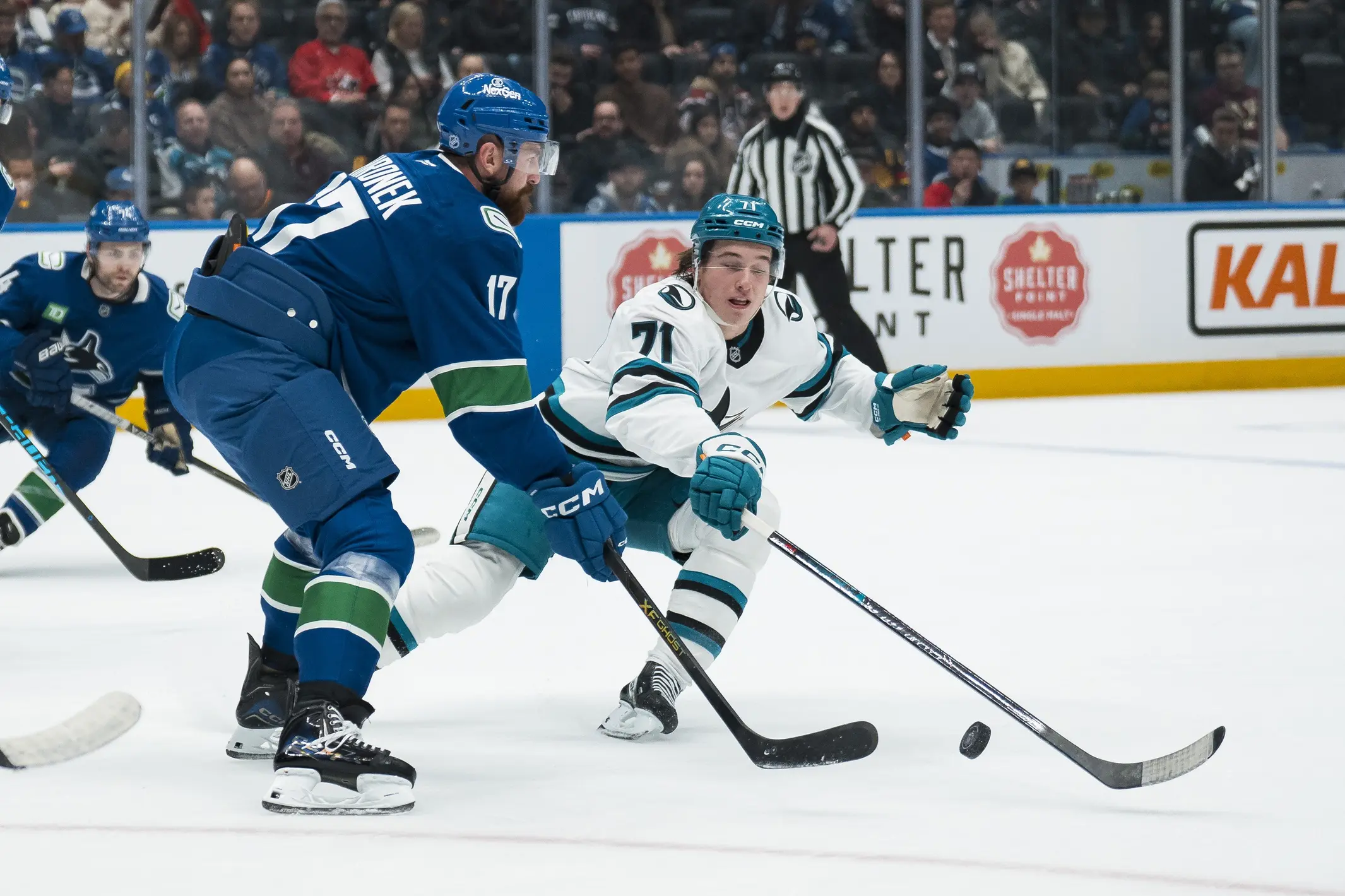
Photo credit: © Bob Frid-Imagn Images

Jun 1, 2026, 18:00 EDTUpdated: Jun 1, 2026, 17:27 EDT


A couple of weeks back, we asked a question about trading Filip Hronek via our regular WDYTT call-and-response article. And the overwhelming response from fans of the Vancouver Canucks was that Hronek might be traded eventually, but that there was no real reason to trade him now, save for an offer that was truly too good to refuse.
Several commenters specifically mentioned the idea of trading Hronek to the San Jose Sharks for their second overall pick this year, won via the most recent Draft Lottery. It’s an idea that has been floated around by fans and media alike since the lottery, and we’ve now heard it repeated enough that we think it’s worth looking into the feasibility.
We’ll start with the logic behind the potential trade. From the Canucks’ perspective, they’re in the earliest stages of a rebuild and have a primary need for more young premium talent. We’ve already heard ample debate about whether or not they should be targeting Ivar Stenberg or Caleb Malhotra with their own third overall pick. ‘Why not both’ is the thinking here, and as much as the Canucks could use Hronek as a veteran support and mentor over the next few years, another 18-year-old future star is just so much more useful in the long run.
Another bridge to be crossed is Hronek’s no-movement clause, but then that could be taken care of by the prospect of a move to California to play with one of the most exciting young cores in hockey.
Speaking of that San Jose perspective, the thinking goes that the Sharks are ready to take that next step into true contention. They’ve got one of the best players in the world in Macklin Celebrini already putting up 115 points as a 19-year-old, and there’s no reason they can’t start competing now, while he’s still got his whole playing prime ahead of him.
But if they’re going to compete, the Sharks are going to need to change the shape of their blueline. It’s currently a collection of broken-down veteran cast-offs and just one young defender, Sam Dickinson, with notable talent. It’s the reason why many prognosticators think the Sharks will pass up on picking Stenberg or Malhotra themselves, and instead skew toward one of the defenders at the top of the draft class, like Chase Reid or Carson Carels.
Trading the second overall for Hronek would be a method of speeding up the blueline restructuring. It would give the Sharks a top-pairing defender on the difficult-to-staff right side of the ice, and one signed through to 2032 – all the way through Celebrini’s prime – at a bargain rate, to boot. Start with a Dickinson/Hronek top pair and work your way down from there, and suddenly the San Jose blueline is in a lot better place than it was before.
But here comes the cold water. Hronek is an incredibly valuable trade piece. Aside from the third overall pick itself, he’s easily the most valuable asset the Canucks have on hand. Were he to be traded, he’d no doubt bring back an absolutely massive return, perhaps even one rivalling what Vancouver got back for Quinn Hughes.
But a second overall pick? That is an awful lot to ask, even if we’re trading in optimism. Some really, really good players have been traded over the past decade or so – names like Jack Eichel, Mikko Rantanen, Matthew Tkachuk, and more – and none of them have brought back a draft pick anywhere close to that high.
In fact, a veteran-for-lottery-pick trade is so rare as to be almost unprecedented. As we’ve mentioned before, it’s happened by accident a few times, like when the San Jose Sharks, fittingly enough, dealt a first-round pick for Erik Karlsson that later wound up being the third overall selection (and Tim Stutzle).
But for a team to knowingly trade a top-five draft pick for a veteran? That’s almost never happened. The closest and most recent example we can find isn’t all that recent, and isn’t even a straight-up trade. The Tampa Bay Lightning traded the fourth overall pick in 2002 to the Philadelphia Flyers in exchange for Ruslan Fedotenko and the 34th and 52nd overall picks. The Lightning had to be happy with the exchange, too, as Fedotenko helped them win a Cup in 2004, and because that fourth overall was used on Joni Pitkanen, who saw injuries overshadow his career.
In other words, a trade like this hasn’t happened in the last quarter-century.
A counterpoint to that might be that players of Hronek’s ilk haven’t been traded very often in recent NHL history, either, and that’s true. Top-pairing defenders on long-term contracts only get moved on the rarest of occasions, and right-shooting top-pairing defenders even less frequently. It’s the handedness and the salary assuredness that set Hronek apart as an asset, and the value of those things cannot be understated.
If there’s any hope here, it’s this: the Sharks are in a unique position, having rebuilt their forward corps so quickly and so well, and Hronek is a unique asset that is particularly well-suited for them. If those two factors are enough to convince the San Jose management to pay one of the highest price tags in NHL history for Hronek, then the Canucks will be the beneficiaries of their own fairly unique situation – being in possession of a player of this quality with this sort of contract at the outset of a rebuild.
But when we phrase it like that, it’s a little hard to believe in. We’ve got to flip it back to the San Jose perspective and realize that a team centred around Celebrini can reasonably plan to contend for the next decade or so, at least. To a team in that position, Hronek may be tempting, but he should also look a little out of place with their competitive scope.
Hronek is 28 and will turn 29 in November. How many more seasons does he reasonably have at this, his peak playing capacity?
Say the Sharks were to get three more seasons of peak Hronek for their money. Would that really outstrip the worth of having, say, Reid or Stenberg on the NHL roster, developing and contributing over those same three seasons, and then having a whole lot more to give after that?
To trade the second overall pick for Hronek would be a short-sighted move for the Sharks, and while fans of the Canucks can always hope for that to happen, it’d be decidedly out of character for San Jose GM Mike Grier and Co. That probably goes doubly so for any other team out there in possession of a top-five draft pick that the Canucks might want to pilfer. These picks don’t get traded very often for a very good reason, and it’s because it’s hard to find a match for their potential and long-term value.
The Canucks would love it if Hronek were just such a match, but it feels unlikely. All of which makes it all the more likely that he is held on to for now, and perhaps traded at a later date for a lower price down the road.
Sponsored by bet365


Recent articles from Stephan Roget
Breaking News
- Scenes from practice: Rossi returns and Canucks shake up forward lines in effort to snap 8-game losing streak
- Canucks and their fans hit a home run honouring John Garrett on Cheech night
- What are the Canucks’ expiring UFAs worth in a trade now, and where might they be by the deadline?
- ‘Same story again’: Canucks’ Pettersson and Sasson express frustration after losing streak extends to eight
- The Stanchies: Hot dogs fall from the sky as Canucks fall 6-3 to the Hurricanes

Vancouver CanucksTeam Cap Summary

Cap Summary
2026-27
2027-28
Projected Cap Hit
$87,295,050
$71,329,167
Projected Cap Space
$16,704,950
$42,170,833
Current Cap Space
$18,732,718
$42,170,833
Active Players
23/23
13/23
Draft Picks
Round
'27
'28
1
1
1
2
2
2
3
1
1