
CanucksArmy has no direct affiliation to the Vancouver Canucks, Canucks Sports & Entertainment, NHL, or NHLPA
The Canucks’ three-year mulligan: A bet on keeping Quinn Hughes happy
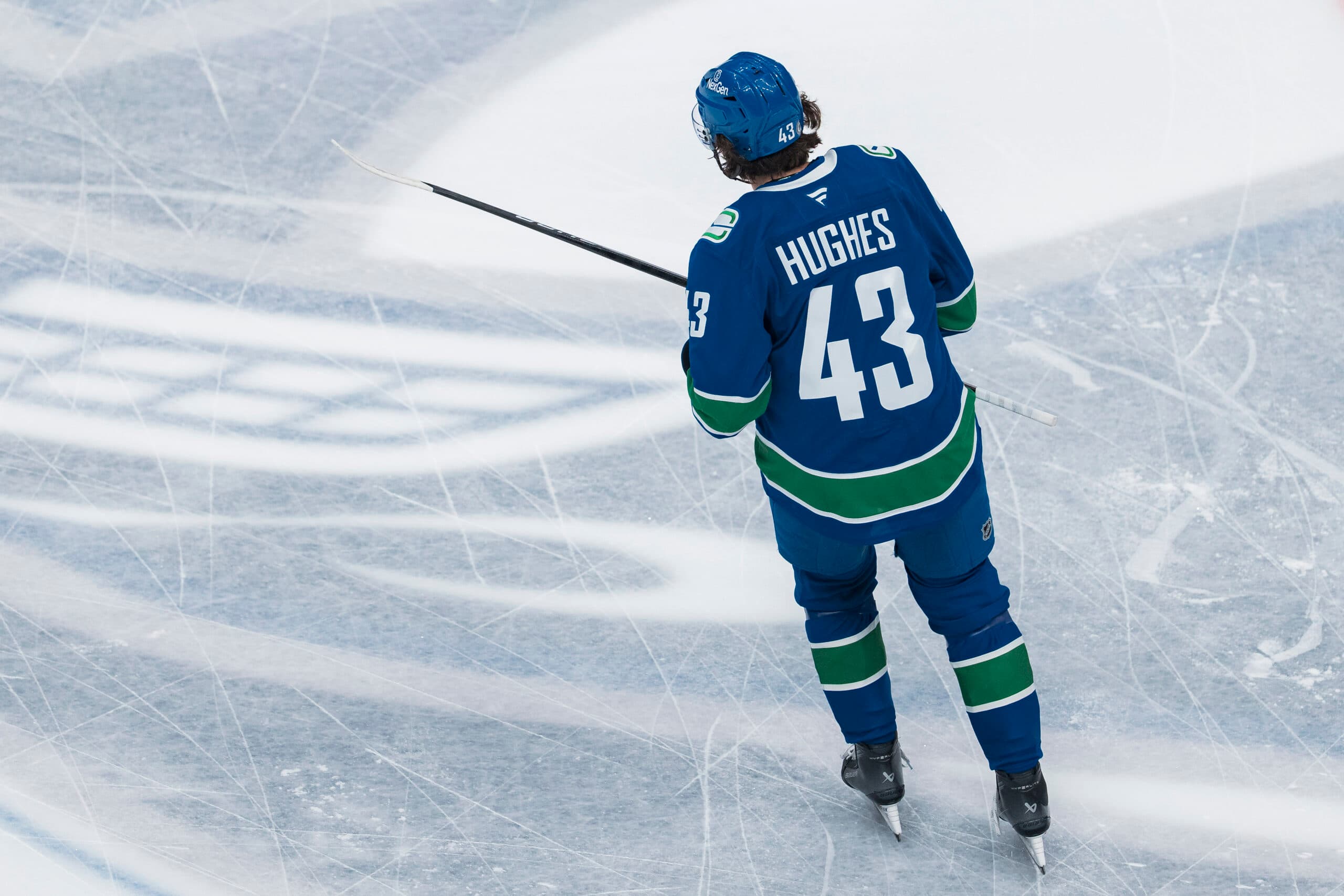
Photo credit: © Bob Frid-Imagn Images

By Elijah Ford
Sep 8, 2026, 10:00 EDTUpdated: Sep 8, 2026, 02:23 EDT


When a team goes from one win away from the Western Conference Final to the very bottom of the NHL standings within three seasons, it’s safe to say there were a few managerial errors committed.
The Vancouver Canucks’ last trio of seasons has seen the team transformed in nearly every way imaginable. From the president of hockey operations down to the players in the locker room, there isn’t much remaining from the team that took the then-Stanley Cup finalist Edmonton Oilers to their breaking point.
With a new era of rebuilding Vancouver hockey upon us, it’s a perfect time to look back on the mini-era that brought the Canucks to this point. More specifically, to reflect on which move was the most catastrophic — the one the Canucks would redo if they had the chance.
Before we get into which move that is, there are a couple of honourable mentions. First, there was the handling of the JT Miller and Elias Pettersson feud. We have done plenty of deep dives into this here at DFO Vancouver, but it’s worth a brief mention. Other recent moves that are not looked back upon very fondly in Vancouver are the Arturs Silovs trade, the Elias Pettersson extension, and the Ilya Mikheyev trade.
But all of those pale in comparison to the ultimate management miss of the last three years for the Canucks: a dynamic we have dubbed “the Quinn Hughes appeasement cycle.” In fact, as we started looking back at where the Canucks went wrong, the majority of their short-sighted moves over the last three seasons were directly or indirectly caused by this situation.
The Canucks had gone all-in during the 2023-24 season, trading for veterans on one-year deals. They dealt Andrei Kuzmenko and a first-round pick for Elias Lindholm after already acquiring Nikita Zadorov from Calgary. Both players ultimately left after the season in free agency, leaving Vancouver with nothing to show for the assets it surrendered. That gamble was understandable. The Canucks genuinely looked like Stanley Cup contenders. What came next was harder to justify.
The next season, it became apparent that the Canucks were not the same team as the year before. The team hovered around .500 for much of the year while tensions reportedly began to boil over behind the scenes. Miller eventually took a leave of absence before being traded in late January. The Canucks received Filip Chytil, defensive prospect Victor Mancini, and a first-round pick in the deal, leaving them in an awkward position. They had just traded away one of their best players and were already outside the playoff picture. But with Hughes still on the roster, a full rebuild was difficult to envision.
Just 24 hours later, Vancouver flipped that first-round pick and other assets for Marcus Pettersson and Drew O’Connor. Just hours after that, the club gave M. Pettersson a six-year extension, followed by a five-year extension for veteran goaltender Kevin Lankinen a couple of weeks later. That sequence would become the beginning of what can now be viewed as the Quinn Hughes appeasement cycle. The Canucks weren’t good enough to contend, but they were unwilling to fully commit to rebuilding because they still had Hughes. Instead of accepting that reality, they continued trying to build a team that might convince their franchise defenceman to stay. These moves did not help the Canucks in terms of their record that season, as they ended up missing the playoffs.
Heading into the next year, Hughes’ future was an overarching question around the Canucks. And, according to former president of hockey operations Jim Rutherford, the Canucks already knew the answer. After stepping down from his role in April 2026, Rutherford revealed just how long he believed Hughes had intended to leave Vancouver.
“I’ve known for some time that Quinn was not staying in Vancouver, and I’ve known before this (2025-26) season started, for that matter.”
Despite that, the Canucks continued trying to create an environment that might convince Hughes to stay. They hired Adam Foote, who had worked closely with Hughes under Rick Tocchet. Hughes had previously called Foote “one of the best coaches I’ve ever played for.” Then came the bigger commitments.
Brock Boeser, Thatcher Demko and Conor Garland were all signed to long-term extensions. Vancouver also added veterans including Evander Kane and Derek Forbort. The strategy was obvious: remain competitive and give Hughes another reason to stay. The problem was that the Canucks apparently knew he wasn’t going to. Rutherford later admitted as much when discussing the decisions to re-sign Boeser, Demko and Garland.
“It’s one of the reasons why we signed the guys, the Garlands, the Boesers, the Demkos, that had relationships with (Hughes), hoping for a little bit of a chance right down to the end, that he would decide to stay here, but I don’t think that was ever in the cards.”
In his own words, Rutherford is saying that signing those three veterans to a total of more than $112 million worth of contracts was a last-ditch effort to keep Hughes in Vancouver. This would be silly enough in itself. But these moves are somehow made even worse by Rutherford later in the interview, when he was asked about incentivizing Hughes to sign by constructing a contending team.
“He was leaving anyways, okay, and the best example I can give you is Matthew Tkachuk… He wanted to go back to the U.S., and he went.”
So which was it? Did the Canucks believe they had a legitimate chance to convince Hughes to stay, or did they know he was leaving regardless? Because those two explanations lead to very different evaluations of the decisions they made.
If Hughes was going to leave regardless, then the Boeser, Demko, and Garland extensions weren’t simply expensive attempts to improve the team. They were commitments made in service of a player the organization already believed it would lose. And the consequences were significant.
The Canucks eventually had to rebuild anyway, only now they had less flexibility to do it. Instead of entering a rebuild with a clean slate, they were carrying long-term veteran contracts and had already spent valuable assets trying to remain competitive. By the time Vancouver finally committed to rebuilding, Hughes was gone, and some of those same contracts had become obstacles to reshaping the roster. That is what makes the Hughes era so frustrating.
It wasn’t just that the Canucks lost the best defenceman in franchise history. It was that they spent years acting as though losing him was something they could prevent, despite apparently knowing all along that it was coming. Had Vancouver accepted that Hughes was going to leave earlier, they would have been negotiating from a position of far greater leverage, with more term remaining on his contract and more time to maximize his return. They also could have entered their rebuild sooner, potentially moved other veterans while their contracts were easier to sell, as well as potentially avoiding Evander Kane and Adam Foote’s tenures entirely. Instead, the organization kept kicking the can down the road. And perhaps the most frustrating part is that the warning signs were there.
The Canucks knew Hughes’ preference was to play in the United States. They knew the roster wasn’t good enough to contend. They knew their star defenceman had a natural path toward free agency. And, according to Rutherford, they knew well before the end that he wasn’t planning to stay. Still, they continued building around the possibility that he might change his mind.
That’s the real Quinn Hughes mistake. Not losing him — that may have been inevitable. The mistake was allowing the possibility of keeping him to dictate the franchise’s direction for years after they should have started planning for his departure.
Every NHL team eventually has to make difficult decisions about its stars. The Canucks’ failure was not recognizing when the decision had already been made for them. If they could take a mulligan on the past few years, it shouldn’t be on the moment Quinn Hughes left Vancouver. It should be on everything they did after they realized he was going to.
Sponsored by bet365


Breaking News
- The Stanchies: Prime Lankinen returns, Canucks still go winless on road trip with 4-2 loss to Lightning
- Instant Reaction: Canucks give up four unanswered goals in 4-2 loss to Lightning
- Canucks: D Elias Pettersson’s impressive start is more than just passing the eye test
- What’s behind Marco Rossi’s seven-game scoring drought for the Canucks?
- Canucks Game Day: Looking to close out lengthy road trip with a win vs. Lightning

Vancouver CanucksTeam Cap Summary

Cap Summary
2026-27
2027-28
Projected Cap Hit
$87,295,050
$71,329,167
Projected Cap Space
$16,704,950
$42,170,833
Current Cap Space
$18,413,411
$42,170,833
Active Players
23/23
13/23
Draft Picks
Round
'27
'28
1
1
1
2
2
2
3
1
1