
CanucksArmy has no direct affiliation to the Vancouver Canucks, Canucks Sports & Entertainment, NHL, or NHLPA
Canucks: Lessons for the Sedins from Yzerman’s shortcomings in Detroit
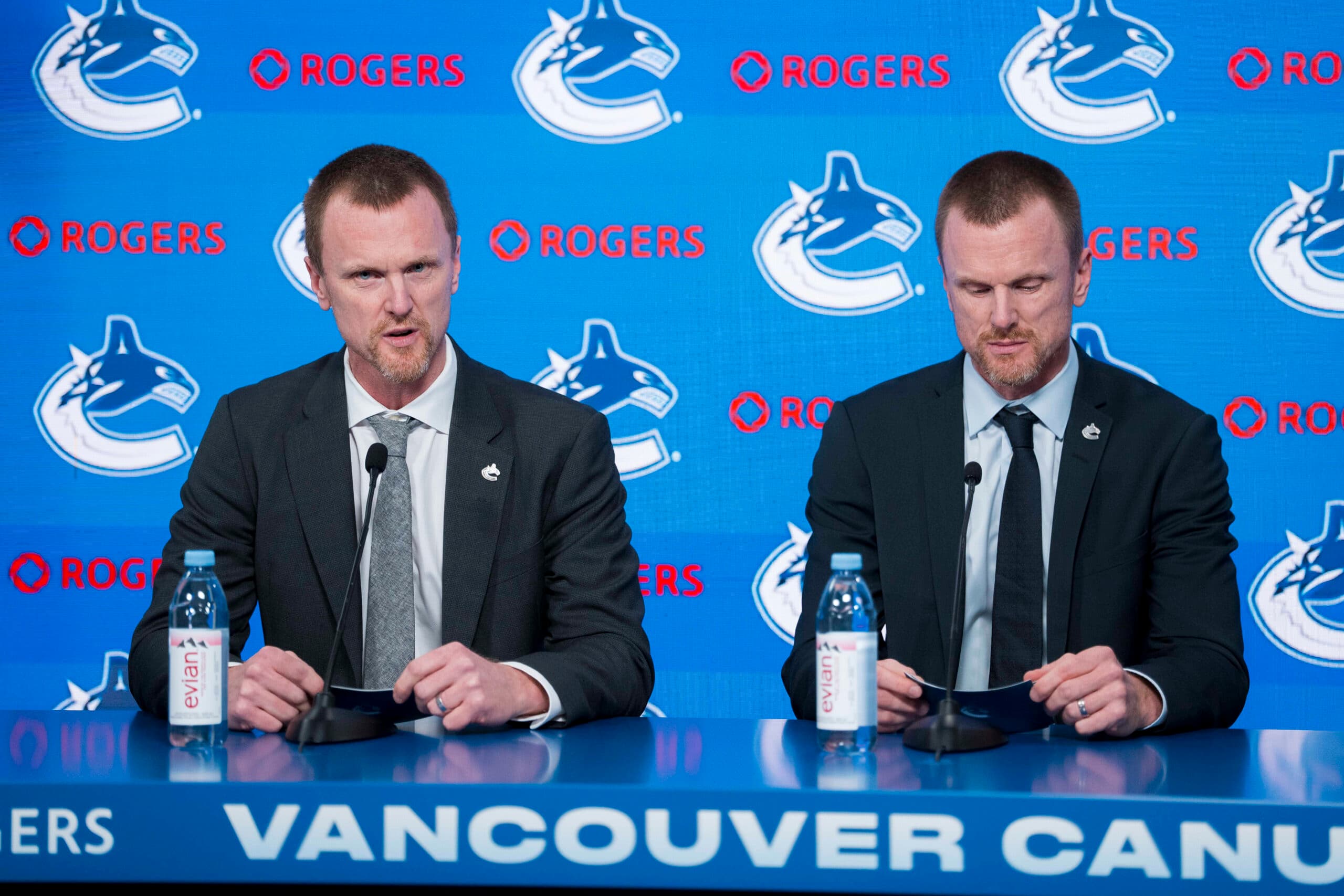
Photo credit: Bob Frid-Imagn Images

By Elijah Ford
Jul 24, 2026, 17:00 EDTUpdated: Jul 24, 2026, 15:42 EDT


When Steve Yzerman stepped down as general manager of the Detroit Red Wings last week, it brought an end to a seven-year tenure during which one of the franchise’s greatest icons was tasked with leading his former team through a lengthy rebuild. It’s a challenge that now awaits Daniel and Henrik Sedin, who have committed to helping guide the Vancouver Canucks through a rebuild of their own.
There’s an old saying that a wise person learns from others’ mistakes, while a fool learns only from their own. Yzerman’s tenure in Detroit offers a valuable case study in the challenges of rebuilding an NHL franchise in a rapidly changing landscape. While the “Yzerplan” produced both successes and setbacks, there are plenty of lessons Daniel and Henrik Sedin, along with general manager Ryan Johnson, can take from Detroit’s experience as they begin shaping Vancouver’s future.
Your players need to want to play for you
One of the primary aspects of the modern-day NHL that Yzerman struggled to adapt to was the new era of player empowerment in recent years. With no-movement clauses becoming a common part of contracts for elite players over the past half-decade, players have more control over where they can be traded than ever before. Given that reality, it’s important to establish a player-friendly environment within your organization to attract talent. Word spreads quickly around the NHL. Players, agents, and executives all know each front office’s reputation for how they treat their personnel.
Red Wings beat writer Bob Wojnowski wrote this about Yzerman: “Yzerman can be unyielding and austere, more about business, less about feelings.” No move better illustrated that than when he traded forward Tyler Bertuzzi to the Boston Bruins the day after signing Dylan Larkin to an eight-year extension. Instead of celebrating his new deal, Larkin broke down in tears while discussing the departure of his close friend. That decision did little to strengthen Yzerman’s relationship with his captain or his reputation among players around the league. Yzerman struggled to attract high-end talent to Detroit. His only acquisition of a player making more than $3 million per season was Alex DeBrincat, who wanted to return to his hometown.
It’s a small sample size, but the Sedins and Ryan Johnson seem to have done a fine job of attracting players to Vancouver despite the current stage of the club’s rebuild. They have convinced relatively low-impact veterans such as Luke Schenn, Jamie Oleksiak, and Paul Cotter to buy into what they’re trying to establish and the team they hope to build, prioritizing character and the team’s long-term vision over playing ability. Going forward, they need to continue strengthening the organization’s reputation for being player-friendly and recognize that, with free agency becoming less prevalent, one of the best ways to acquire high-end talent is to be on players’ lists of preferred trade destinations with a strong culture.
It matters who you surround yourself with
Yzerman’s tenure in Detroit also demonstrates the importance of the people you surround yourself with in the front office. The Red Wings did an excellent job acquiring draft picks early in their rebuild, but they were unable to capitalize on many of those selections. From 2018 to 2024, Yzerman drafted 18 players in the first two rounds outside the top 10. Only four of those players reached the NHL.
Acquiring draft capital is important, but eventually those picks need to become productive NHL players. The work done by scouts and amateur personnel is invaluable to a rebuilding franchise because the margin between drafting a contributor and a bust is razor-thin. The league’s best organizations consistently identify the nuances that separate great players from the rest, while also uncovering impact talent later in the draft. Who you surround yourself with matters, and the Sedins and Ryan Johnson must ensure Vancouver’s scouting department remains on the cutting edge of player evaluation, because that could determine the future of the rebuild more than anything else.
You need some luck, too
Just as teams need favourable bounces during games however, there is also an element of luck in the draft. The Red Wings never won the draft lottery during Yzerman’s tenure, preventing them from selecting a true franchise-changing player at the top of the draft. Moritz Seider and Lucas Raymond are very good players, but they’re not quite in the Macklin Celebrini tier of prospects capable of transforming a franchise. The Canucks will likely need some lottery luck if this rebuild is going to unfold the way fans hope.
When and how you accelerate matters
Drafting and developing is the best way to build the core of a young team, but there eventually comes a time when a rebuild needs to be accelerated by adding proven veterans to compete with the league’s best teams. Most organizations mistime that phase of the process, either adding too early or waiting so long that they waste valuable years of their competitive window. The Red Wings clearly fell victim to the latter.
In March 2023, Yzerman was in the fourth year of his tenure. He had already established a solid young core with Larkin leading the way, and the Red Wings sat just five points out of a playoff spot. Rather than pushing for the postseason, Yzerman chose to continue building for the future, trading arguably his best defenceman at the time, Filip Hronek, to Vancouver for a first-round pick. His reasoning was that Detroit was not yet a legitimate Stanley Cup contender, and that adding another premium draft asset would better serve the organization’s long-term vision.
Detroit selected Axel Sandin-Pelikka with that pick, and in a roundabout way, the Hronek deal cost them another first-round pick in the end. Because Sandin Pelikka (among others) wasn’t giving Detroit the stability they needed on their blueline, Yzerman acquired Justin Faulk from the St. Louis Blues for a 1st and 3rd round pick, the rights to 2022 second-round selection Dmitri Buchelnikov, and Justin Holl.
And earlier this season, when Quinn Hughes’ name surfaced in trade speculation, Detroit was rumoured to be among the teams interested in acquiring the superstar defenceman. Hughes played at the University of Michigan and is good friends with Dylan Larkin. Yzerman reportedly had interest, but Hughes had only one year remaining on his contract and was unwilling to commit to a long-term extension with Detroit or any other team at the time. Yzerman was unwilling to complete the deal without that commitment and also was rumoured to not want to part with young defenceman Simon Edvinsson in a trade. The situation seemingly further hurt morale within the dressing room as players began to feel the organization wasn’t doing enough to give them the best chance to win. Larkin made that frustration clear during his 2025 end-of-season media availability when he said, “We didn’t do anything. We didn’t gain any momentum from the trade deadline. Guys were kind of down about it.”
And of course, the “how” you accelerate matters here, too. Around 2022 and 2023 (right around the time they traded Hronek), Detroit signed veterans to bigger-ticket deals, few of which panned out. Some that come to mind immediately: Andrew Copp in 2022 (5 years, $28 million / $5.6M AAV); JT Compher in 2023 (5 years, $25.5 million / $5.1M AAV); Ben Chiarot in 2022 (4 years, $19 million / $4.75M AAV).
The Canucks should view Detroit’s experience as a reminder that rebuilding isn’t just about accumulating young talent — it’s about recognizing the moment to transition from building for the future to building to win. Vancouver has already begun assembling the foundation of its next core with players such as Zeev Buium, Tom Willander, and its recent high draft picks. The Canucks also likely need at least another bottom 3-5 finish or two in order to draft the difference makers required to win in the NHL. Then eventually, the organization will have to complement that group with proven NHL talent, even if it means sacrificing future assets. Nailing the timing on that is going to be very important. Wait too long, and you risk creating the same frustration Detroit experienced, where players begin to question whether management is as committed to winning as they are. Vancouver’s leadership group will need to strike that balance carefully, remaining patient without allowing patience to become paralysis.
And finally…
Perhaps the biggest lesson of all is that a legendary playing career doesn’t guarantee success in the front office. Yzerman will forever be remembered as one of the greatest Red Wings of all time, but his tenure as general manager ultimately came to be judged on wins, losses, and playoff success — not on what he accomplished as a player. The same standard will apply to Daniel and Henrik Sedin. Their status as franchise icons may earn them patience and goodwill early on, but those reserves are finite in a results-driven business. If the Canucks fail to build a contender, fans won’t remember the intentions behind the rebuild nearly as much as they’ll remember the outcome.
Sponsored by bet365


Breaking News
- 5 things Canucks fans can be thankful for this Thanksgiving
- How could the Canucks do “something creative” with a Connor Zary trade, and what would it mean for the team?
- 3 Canucks Stars of the Week: Elias Pettersson(s) shines despite early-season losing streak
- JPat’s Monday Mailbag: What more do we need to see from Zeev Buium?
- The Statsies: D Elias Pettersson lights up the stat sheet in Canucks’ loss to Rangers

Vancouver CanucksTeam Cap Summary

Cap Summary
2026-27
2027-28
Projected Cap Hit
$88,074,947
$71,329,167
Projected Cap Space
$15,925,053
$42,170,833
Current Cap Space
$17,068,841
$42,170,833
Active Players
23/23
13/23
Draft Picks
Round
'27
'28
1
1
1
2
2
2
3
1
1