
CanucksArmy has no direct affiliation to the Vancouver Canucks, Canucks Sports & Entertainment, NHL, or NHLPA
It’s time to set new goals and expectations for Elias Pettersson in 2026-27
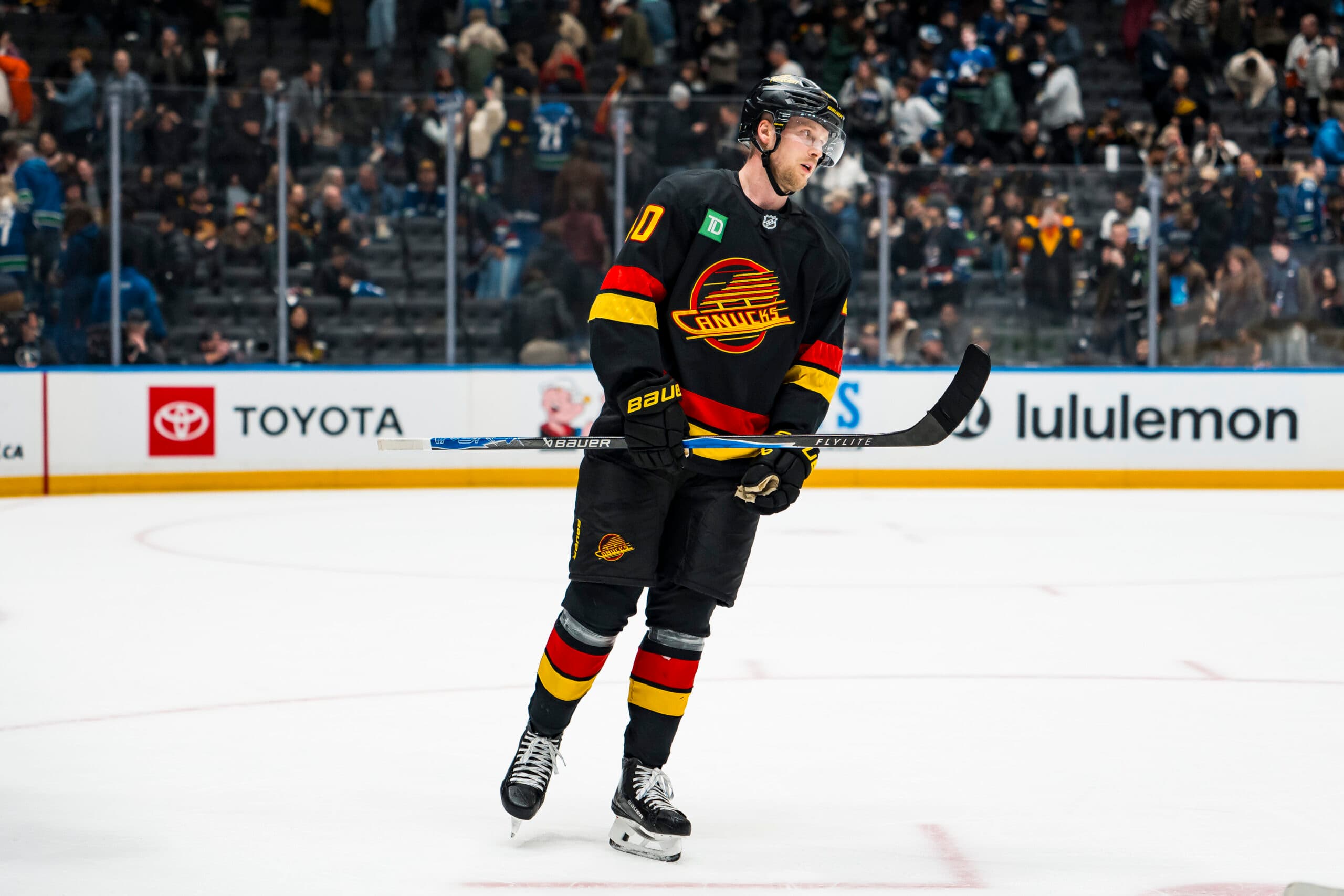
Photo credit: © Bob Frid-Imagn Images

By Elijah Ford
Aug 3, 2026, 15:15 EDTUpdated: Aug 4, 2026, 12:13 EDT


Has there been a more fascinating player to analyze in the NHL over the past two and a half seasons than Elias Pettersson?
After winning the Calder Trophy in his rookie year, Pettersson established himself as one of the preeminent young centres in the NHL. He followed up his rookie campaign with five seasons of near point-per-game hockey, while his two-way presence continued to develop. The future looked blindingly bright for the Swedish centerman, and then 2024 happened.
After the 2024 All-Star break and his eight-year, $11.6 million contract extension, Pettersson’s production started to slow down. He dropped from a 107-point pace over 82 games pre-All-Star break to a 64-point pace. Before the 2024 All-Star break, Pettersson averaged 1.03 points per game for his career, an 84-point regular season pace. Since then, Pettersson has averaged 0.71 points per game, good for a 58-point pace over an 82-game schedule. Last season, his points per game hit a new career low of 0.69
And the craziest part is, nobody truly knows why. We here at CanucksArmy have exhausted many theories, including a potential nagging injury, off-ice issues affecting on-ice play, or even just being in an all-time confidence slump. What can’t be disputed, however, is that if Pettersson wants to be a part of the solution for this new rebuilt Canucks roster, he is going to have to pick up his play significantly in 2026-27. And it might be time for fans to set new goals and expectations for their struggling star.
So what would that look like exactly?
Meeting expectations: 65-75 points while consistently driving his own line
Just two years ago, we here at CanucksArmy wrote this when setting expectations for Pettersson: “There is simply too much natural talent there for Pettersson not to have a 90-point baseline for the rest of this decade.”
As much as we would like this to be true in 2026, the expectations for Pettersson are simply not what they were heading into the 2024-25 season. Canucks fans may retort that his contract says he should be producing at a 90-point level for the rest of its term, which is fair to a certain extent. Realistically, however, Pettersson would need a nearly 40-point increase from last season to reach that 90-point threshold, so meeting expectations at this point seems a little far-fetched.
What isn’t far-fetched, however, is the expectation that Pettersson will be able to drive his own line at five-on-five, which he struggled to do last season. To be fair to Pettersson, there is no doubt that his wingers last year were mainly subpar. Still, with Pettersson’s fringe-elite defensive play, natural skill with the puck, and AAV, he should be expected to carry wingers on his side to at least respectable numbers. Pettersson’s Corsi For percentage and Goals For percentage fell to a career low of 44.60% and 36.59% respectively last year. That is simply not good enough for a team’s number one centreman, regardless of the circumstances around him.
A big reason Pettersson has not been able to create for his teammates the way he once did is his decline in ability to carry the puck into the zone and create chances off the rush. In his 102-point campaign back in 2022-23, Pettersson averaged +1.09 controlled zone entries relative to league average per 60 minutes according to Corey Sznajder’s All Three Zones project. Last season that number dropped to +0.31.
This speaks to an overall lack of confidence with the puck, which is further emphasized by the fact that Pettersson’s ability to draw penalties has declined significantly since his first five years. Pettersson was once a master at getting inside of checks, creating stress on the defence and forcing them to make undisciplined plays. Now he is much more perimeter-based, as his shots on goal from high danger areas have been nearly cut in half since 2023-24.
Penalties drawn per 60
2018/19 – 1.85
2019/20 – 1.76
2020/21 – 2.1
2021/22 – 1.38
2022/23 – 1.85
2023/24 – 1.27
2024/25 – 1.1
2025/26 – 1.15
SOG from “high danger areas” according to NHL Edge
2022/23 – 80
2023/24 – 63
2024/25 – 39
2025/26 – 39
For Pettersson to meet expectations this year, the main thing he needs to do is find his confidence and swagger with the puck again. Him getting back to being a night-to-night play driver is far more important than any specific point total.
Above expectations: Return to a 30-goal, above point per game player
A lot would have to go right for Pettersson to return to his point-per-game form, but it’s far from an impossibility, especially if new head coach Manny Malhotra is able to find a linemate who can build real chemistry with Pettersson.
Jake DeBrusk, who finished his season with the second-worst goals-above-expected in the NHL according to MoneyPuck, was on Pettersson’s wing at five-on-five more than any other player last season. His other primary winger was Evander Kane, whose lack of puck control and foot speed made for a clunky fit.
In Pettersson’s best season in 2022-23, he developed a great rapport with Andrei Kuzmenko. Although Pettersson has an elite shot, he is still a pass-first player, and his cerebral style requires the right linemate or linemates for him to play off of in the offensive zone. Malhotra will have to find the right linemates for Pettersson on a newly rebuilt Canucks roster; he has a few candidates to choose from.
Linus Karlsson is likely to be one of the first options Malhotra exercises. Karlsson played some of the best hockey of his career under the Canucks’ new bench boss, and he is unafraid to get into the dirty, high-danger areas in front of the net. Pettersson is still one of the best in the league at creating rebound chances and loose pucks in front of the net. Karlsson should be in the right position most of the time to turn those chances into goals. Drew O’Connor may also get a few looks; his foot speed and motor are a good complement on paper to Pettersson’s patient nature. Last year, Pettersson had a higher CF% at five-on-five with O’Connor than any other linemate whom he played with for at least 100 minutes.
If Pettersson is able to stay healthy and find the right winger to complement him, returning to a point per game is a reasonable mark for a season that goes above expectations.
Below Expectations: 50 points or less, still not noticeable night-to-night
It feels as though we’ve already hit the floor of Elias Pettersson’s raw production. With the former 100-point scorer still being very skilled and playing over 18 minutes a night, it’s difficult to imagine he can produce any less than what he has over the past two seasons. What would really turn this season into one that fails to meet expectations, however, would be one in which he continues his lackadaisical nature in games.
Pettersson will never instill Niklas Kronwall-level fear with his body checks, but his willingness to throw his body around has declined. As he began to gain weight after coming into the league at 165 pounds, Pettersson slowly started finishing checks at a higher and higher rate. In his last above point-per-game season in 2023-24, Pettersson recorded a career high 125 hits. After that season, his hitting numbers started coming back down to 74 in 2024-25, followed by only 67 recorded hits last year.
The Swede’s speed burst in games has also declined since the best years of his career. Last season, Pettersson ranked in only the 74th percentile of 32-35 km/h speed bursts according to NHL Edge. Early in his career, Pettersson hovered around the 85th percentile in that metric.
2026-27 goals for Pettersson
– Score 10+ more points than the next leading scorer
– Help elevate up-and-comers to their best seasons
– Log 175+ shots on goal
The new front office regime has spent the summer preaching culture, effort, and accountability. If Pettersson underwhelms in terms of points and production, that would be frustrating, but it can be tolerated. If he continues to be a passive and uninspiring player from night to night, there will be serious questions raised about his place in the future of the Canucks’ rebuild.
Next season could be a crossroads for Pettersson in Vancouver. Will he answer the bell and return to early career form? Or will he continue his underperformance as one of the highest-paid players in the league? But based on what we’ve seen over the previous two seasons, it’s time to set new goals and expectations for the once face-of-the-franchise player.
Sponsored by bet365


Breaking News
- The Statsies: Where the Canucks got dominated at 5v5 again is loss to Red Wings
- Manny Malhotra and Brock Boeser offer up slightly different theories for Canucks’ struggles
- The Stanchies: Jonathan Lekkerimäki notches a goal and an assist, and that’s all we’ll say
- ‘It’s embarrassing’: Brock Boeser brutally honest following Canucks’ ninth straight loss
- Instant Reaction: Canucks go nearly 40 minutes without a shot in 5-2 loss to Red Wings

Vancouver CanucksTeam Cap Summary

Cap Summary
2026-27
2027-28
Projected Cap Hit
$87,295,050
$71,329,167
Projected Cap Space
$16,704,950
$42,170,833
Current Cap Space
$18,951,815
$42,170,833
Active Players
23/23
13/23
Draft Picks
Round
'27
'28
1
1
1
2
2
2
3
1
1