
CanucksArmy has no direct affiliation to the Vancouver Canucks, Canucks Sports & Entertainment, NHL, or NHLPA
Zeev Buium isn’t just a smart bet for the Canucks, he’s a necessary one
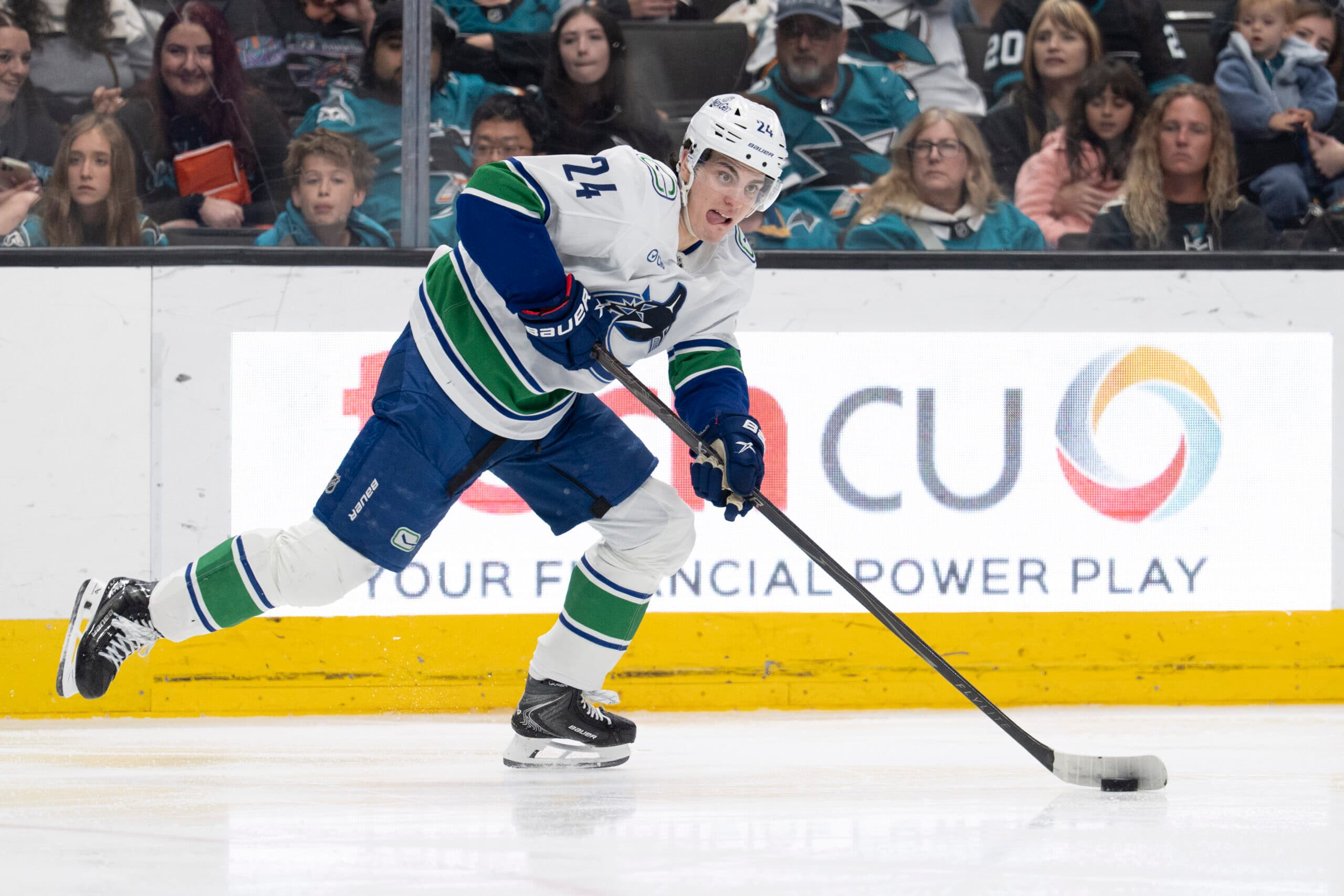
Photo credit: Stan Szeto for IMAGN IMAGES via Reuters Connect

Sep 6, 2026, 12:10 EDT


Just a couple of weeks out from Training Camp 2026, the Vancouver Canucks made one of the largest signings in franchise history, both in terms of the size of the contract and its potential importance.
Zeev Buium, the centrepiece of the Quinn Hughes return and still just 20 years old heading into his second NHL season, signed an extension of eight years at an average annual rate of $9.38 million. With one year left to go on his ELC, Buium’s new deal won’t even begin until the 2027-28 season.
And as soon as a little bit of the sticker shock wore off, the Buium contract was met with near-universal praise across the hockey mediasphere. It’s a nice change of pace from the usual discussion that follows a major Canucks contract, and it’s not hard to see what people like about this one.
In locking up Buium now, the Canucks seem to have gotten ahead of a few things. They’ve gotten ahead of Buium’s potential breakout as an NHL player. Buium had a fine rookie campaign, but almost everyone is expecting more from him moving forward. The Canucks showed here that they understand that paying for potential is always going to be cheaper than paying for potential that’s already been realized. Sign Buium a year from now, after he’s taken a major step forward in 2026-27, and the price would have increased significantly.
They also got ahead of the ongoing salary cap inflation. The cap has already shot up from the $81.5 million flat cap it was stuck at five years ago to its current $104 million, and it’s expected to climb to $113.5 million for the first year of Buium’s contract, then keep going up from there. We’ve already seen what this inflation has done to both the average NHL contract and, especially, to the salaries of star players. Even without a breakout, the price tag for Buium was destined to climb on inflation alone over the course of the next year.
Our own Jeffery Kennett already did a great job of breaking down the potential cap percentages of the Buium contract to show how it already takes up a lesser portion of the cap than it might seem in Year One, and how with each subsequent year of cap inflation that percentage is set to go down and down and down.
Kennett (conservatively) estimated that by Year Eight of the contract – otherwise known as the 2034-35 season – a 29-year-old Buium will be making just 5.69% of the total available cap.
That’s a relatively small chunk of change. At some point in his contract, Buium is going to have a cap hit that’s more in line with a second-pairing defender than anything else. And as many have already pointed out, that severely reduces the risk associated with this contract, as it means that Buium only really needs to become a top-four defender to be worth this contract, which most would call almost guaranteed at this point.
But we’re here to offer a slightly different take today, and it’s this: the risk associated with the Buium contract, high or low, doesn’t really matter. This was a bet that the Canucks pretty much needed to make, whether it ends up being a successful bet or not.
That aforementioned league inflation has really changed the dynamics of the league, especially because young RFAs like Buium have been gobbling up the vast majority of the increase. We’ve already seen the potential consequences of waiting to sign young stars in the Pacific Division, thanks to the disaster-class management the Anaheim Ducks put forth this offseason.
The Ducks had the opportunity to extend their new core to long-term extensions before they broke out, but chose a more ‘patient’ approach.
Instead of signing Leo Carlsson and Cutter Gauthier to extensions a year ahead of the expiry of their ELCs – as the Canucks just did with Buium – GM Pat Verbeek decided to wait. Carlsson put down 29 goals and 67 points in 70 games last season, and then infamously signed an $18 million offer sheet with the Philadelphia Flyers that Anaheim had to match, making Carlsson one of the highest-paid players in NHL history.
Gauthier, meanwhile, posted 41 goals and 69 points of his own as a sophomore. Now, he’s still without a contract and, despite not being offer sheet eligible, seems to be holding out for a deal similar to Carlsson’s.
And with that, what looked like a promising roster that had rebuilt the right way is now severely hampered. The Ducks are going to be giving up nearly a third of their available cap to just two players moving forward, and it’s incredibly hard to compete like that.
As salaries rise in general and the salaries of RFAs especially, it seems as though the only way to truly compete moving forward is to sign such players earlier, before they’ve truly earned those massive paydays.
Look at the Montreal Canadiens as an opposite case study. They’ve got all of Nick Suzuki, Lane Hutson, Cole Caufield, and Juraj Slafkovsky all signed long-term to cap hits of $8.85 million or less. They got there by committing to all of those players as early as possible, instead of waiting for them to break out. All of those players have since continued to grow in leaps and bounds as players, and now the Canadiens are set to compete for the rest of the decade at the very least.
Could the Canadiens have been screwed over by their strategy had all or most of these players plateaued in their development? Sure. But that misses the big picture: the Canadiens would have been screwed if these players didn’t hit their potential anyway, contracts or no contracts. A team can only ever rebuild for so long. Either the pieces they’ve rebuilt with work out, or they don’t, at which point it’s really back to square one.
And this is as true for the Canucks as it is for any team, especially when we’re talking about Buium. Is there risk in his contract, in that he may not ever live up to it? Sure.
But Buium was the centrepiece of the Hughes trade. Up until Caleb Malhotra was drafted, Buium was seen as the shining jewel of the Canucks’ rebuild, and there are plenty who would still call him their most important asset, even after the arrival of an 18-year-old centre drafted at third overall. He’s that central to their plans.
And so, we’d go as far as to say that if Buium doesn’t hit his potential, or close to it, the Canucks’ rebuild is kind of dead in the water. Or, if that’s too dramatic for you, say that it’s left severely shorthanded, at the very least. Going from a rebuild to a championship is incredibly difficult, and most teams that attempt it fall short. So much needs to go right for it to work out, and that starts with a team’s most important picks and prospects actually following through on their promise. When that doesn’t happen, a team tends to stay in the mushy middle forever or simply goes back to another rebuilding process.
For the Canucks, Buium represents a potential long-term top-pairing answer. That leaves them still probably needing to draft and develop another top-pairing defender in the next couple of years if they truly want to build up a competitive roster, and that’s already easier said than done. Imagine, now, if Buium tops out as a second-pairing guy. Sure, that might eventually match with his cap percentage, but at that point the Canucks are now looking to draft and develop two more top-pairing D, and that’s a lot to ask.
The only path which the Canucks go from this current state to a state of actual championship quality is one in which their biggest pieces work out, which at this point means, at the very least, Buium and Malhotra.
And from there, the only real way to ensure that championship quality is a sustainable one is to have locked those pieces up long-term as early as possible.
From this perspective, the Buium extension should be seen as even more low-risk, in a sense. Either it ends up being a major bargain for them down the road, or it doesn’t, at which point the rebuild probably isn’t building to where it needs to be, at which point who really cares about one single contract?
This wasn’t just a wise move for the Canucks, it was the move they needed to make to ensure this rebuild has a genuine chance to succeed.
PRESENTED BY THE CANUCKSARMY NEWSLETTER

Never miss what matters in the game. From lineup changes to breaking trades and must-read analysis, CanucksArmy delivers the insight serious hockey fans rely on—straight to your inbox. Sign up for the CanucksArmy newsletter here!


Breaking News
- The Stanchies: Brady Tkachuk’s natural hat trick extends Canucks losing streak to 6 in OT loss to Panthers
- Instant Reaction: Brady Tkachuk scores late hat trick in Canucks’ overtime loss to Florida
- Canucks trade Aatu Räty to Maple Leafs for forwards Jacob Quillan and Brandon Buhr
- What’s behind the early struggles from Canucks’ Zeev Buium and Filip Hronek?
- Canucks’ Räty clears NHL waivers, will report to AHL Abbotsford

Vancouver CanucksTeam Cap Summary

Cap Summary
2026-27
2027-28
Projected Cap Hit
$87,295,050
$71,329,167
Projected Cap Space
$16,704,950
$42,170,833
Current Cap Space
$18,206,519
$42,170,833
Active Players
23/23
13/23
Draft Picks
Round
'27
'28
1
1
1
2
2
2
3
1
1