
CanucksArmy has no direct affiliation to the Vancouver Canucks, Canucks Sports & Entertainment, NHL, or NHLPA
Why the Zeev Buium contract is a great bet for the Canucks in multiple different ways

Photo credit: © Bob Frid-Imagn Images

Sep 5, 2026, 10:00 EDTUpdated: Sep 5, 2026, 02:51 EDT


The Vancouver Canucks are betting that Zeev Buium’s best hockey is still ahead of him, and that waiting to find out would have made the 20-year-old defenceman much more expensive.
That distinction makes Friday’s deal much easier to like. Buium is coming off a rookie season with six goals and 26 points in 76 games, so the Canucks are clearly paying for projection. At 20 years old, however, his prime should hit well after the contract begins.
Salary-cap growth could make the bet even better.
$9.38 million could shrink quickly
Buium’s extension does not begin until 2027-28, when the NHL salary cap is already scheduled to rise to $113.5 million. His $9.38 million cap hit will therefore take up just 8.26% of the ceiling in Year 1.
Allan Walsh reported in March that the NHL was projecting an approximately $123 million cap for 2028-29 based on hockey-related revenue forecasts and existing revenue slack. At that number, Buium would fall to 7.63% of the cap only two seasons into the contract.
Revenue trends give that projection some credibility. The NHL’s new Canadian television agreement is worth $11 billion over 12 years, the league has expanded its schedule to 84 games per team, and the current U.S. national television deals expire after 2027-28, creating another opportunity for rights revenue to grow.
Using a more conservative 5% annual increase after Walsh’s $123 million estimate gives a rough idea of how quickly Buium’s contract could become easier to carry.
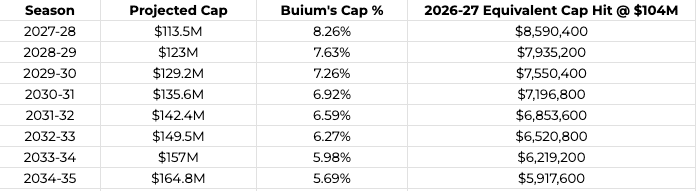
As you can see, with the rising cap, Buium’s $9.38 million drops significantly with Walsh’s projection. In year eight of the deal, Buium would be making in the range of Adam Pelech, Gustav Forsling, Matt Roy and Dylan Samberg ($5.75 million) and Sean Durzi, Michael Matheson, Martin Fehervary, and Jonas Brodin ($6 million) annually.
The main point here is that Vancouver locked in what it hopes will become a number one defenceman for what top-four defensive defencemen are making today.
The Canucks beat Buium to the breakout
Recent contracts for young defencemen show why waiting another year could have been expensive.
Jackson LaCombe signed for eight years at $9 million after breaking out for 43 points while playing more than 22 minutes per night. His contract takes up roughly 8.65% of the current $104 million cap.
Apply that same percentage to the $113.5 million ceiling Buium will play under when his extension begins, and the equivalent contract is already about $9.82 million. Under Walsh’s projected $123 million ceiling one year later, it becomes approximately $10.64 million.
Luke Hughes was a clear warning sign about what a strong season could have done to Buium’s price. New Jersey gave Hughes seven years at $9 million after he established himself as a 40-plus-point defenceman. His contract represented about 9.42% of the cap when it began. That share would equal roughly $10.69 million under the 2027-28 ceiling and $11.59 million under a $123 million salary cap.
Buium consequently lands in an interesting place. His 8.26% starting share cost less than LaCombe or Hughes once their teams had more evidence that they could handle major roles.
That is exactly where Vancouver should want the deal to sit.
One big season could have changed everything
Opportunity could have pushed Buium toward the expensive end of young defencemen in a hurry.
Quinn Hughes is long gone, and although the Canucks still have Filip Hronek, that leaves Vancouver without a superstar offensive defenceman. Buium now has a path toward more responsibility during the final season of his entry-level contract.
Another 26-point year would make the extension look aggressive, while a jump into the 40-point range would make $9.38 million far easier to defend. But reaching 50 points while showing top-pair capability could make it look cheap before the new contract even begins.
Waiting for that answer would have given Buium far more leverage. Instead of negotiating with a talented 20-year-old carrying one NHL season of evidence, Vancouver could have been sitting across from a 21-year-old breakout defenceman in a league with a $113.5 million cap.
The recent market suggests that version of Buium could easily have pushed negotiations beyond $10 million annually.
Vancouver also bought the extra year
Timing was another advantage for the Canucks.
The new CBA reduces the maximum term for players re-signing with their current teams from eight years to seven beginning Sept. 16. Vancouver completed Buium’s extension before that change takes effect.
Eight seasons carries him through 2034-35 and essentially locks down his entire twenties. Most of those years also come well after the point where the initial $9.38 million sticker price should matter.
As we’ve already covered, under the 5% cap-growth model, Buium would take up less than 7% of the cap by Year 4 and less than 6% by Year 7. That 5.69% of today’s $104 million ceiling is only about $5.92 million. That is the potential payoff Vancouver purchased.
Buium still has to develop — nobody should expect 26 points from a $9.38 million defenceman to represent good value once the extension begins — but everything about his age, opportunity and track record gives the Canucks reason to believe the rookie version will not be the finished product.
By acting now, Vancouver avoided paying the full freight for the next version.
If Buium becomes merely a solid top-four defenceman, salary-cap growth should make the contract increasingly manageable. Should he develop into the offensive top-pair player the Canucks believe they acquired in the Quinn Hughes trade, eight years at $9.38 million could turn into one of the better bets Vancouver has made in years.
Sponsored by bet365


Breaking News
- Canucks’ Räty clears NHL waivers, will report to AHL Abbotsford
- Blackfish: Romani opens strong, Cootes continues to impress and Malhotra shows his offensive potential
- Scenes from morning skate: Chytil to make season debut for Canucks vs. Panthers
- What does the younger Elias Pettersson’s breakout mean for the Canucks and their rebuild?
- Kole Lind talks signing in Abbotsford, why he’s impressed by Braeden Cootes, and more

Vancouver CanucksTeam Cap Summary

Cap Summary
2026-27
2027-28
Projected Cap Hit
$88,074,947
$71,329,167
Projected Cap Space
$15,925,053
$42,170,833
Current Cap Space
$17,259,555
$42,170,833
Active Players
23/23
13/23
Draft Picks
Round
'27
'28
1
1
1
2
2
2
3
1
1