
CanucksArmy has no direct affiliation to the Vancouver Canucks, Canucks Sports & Entertainment, NHL, or NHLPA
The Statsies: Pettersson drives play in Canucks loss to Sharks

Photo credit: Bob Kupbens-Imagn Images

Oct 30, 2026, 12:41 EDT


Apparently, the Vancouver Canucks enjoyed their comeback against the Anaheim Ducks so much that they decided to let the San Jose Sharks have a turn.
The frustrating part is that the Canucks actually played some pretty good hockey for much of the evening. They controlled 64.19% of expected goals at five-on-five and generated nearly twice as many high-danger chances as San Jose. Elias Pettersson’s line was particularly effective, while Tom Willander delivered another encouraging performance on the blue line.
But a disastrous third period, some underwhelming depth-line results and another difficult night for Leevi Meriläinen wiped out those positives.
Game Flow
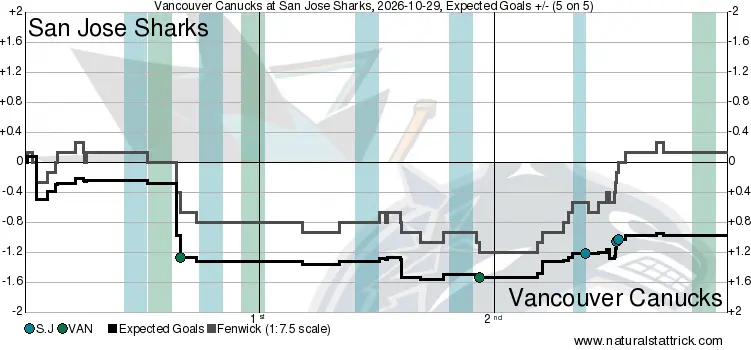
For the first 40 minutes, Vancouver’s five-on-five numbers looked pretty darn impressive.
The Canucks controlled 63.64% of shot attempts in the opening period, out-attempting San Jose 14-8, but more impressively, they generated 1.69 expected goals against just 0.36 for the Sharks, producing an 82.31 xGF%.
Vancouver kept the pressure on in the second, posting a 55.00 CF% and 69.37 xGF% while generating 0.38 expected goals and allowing just 0.17. By the second intermission, the Canucks had built a commanding 2.07-0.53 advantage in five-on-five expected goals, with a two-goal lead reflecting their control of play. Then everything flipped.
San Jose out-attempted Vancouver 17-8 at five-on-five in the third period, limiting the Canucks to a miserable 32.00 CF%. The expected-goals numbers were even worse, with Vancouver generating just 0.15 against 0.71 for the Sharks, accounting for a 17.74 xGF%.
Even with that collapse, the Canucks finished with a 2.22-1.24 advantage in five-on-five expected goals, and their overall performance was better than the final score suggested, but another inability to sustain that level for 60 minutes proved costly.
Heat Map
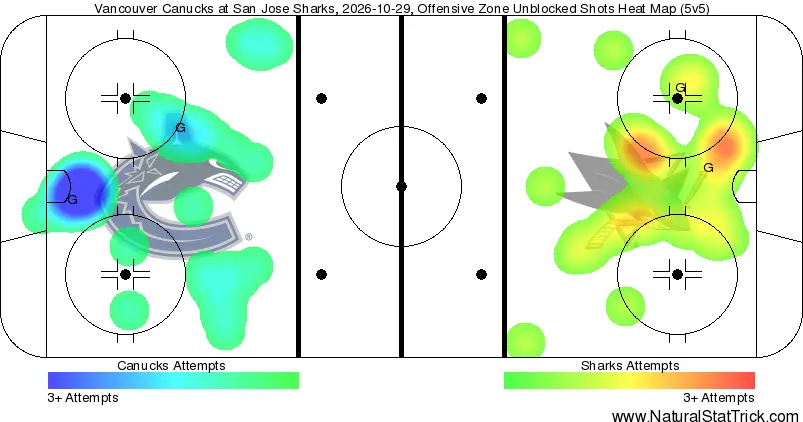
Offensive pressure for Vancouver was concentrated around the left side of San Jose’s net and into the slot, while the Sharks generated more attempts through the middle of the Canucks’ defensive zone, particularly around the crease. Despite that pressure, Vancouver held a 7-4 advantage in high-danger chances at five-on-five, good for a 63.64 HDCF%.
Much of Vancouver’s advantage came early, with the Canucks generating five high-danger chances to San Jose’s two in the opening period before holding a 1-0 edge in the second. The Sharks responded with a 2-1 advantage in the third, but the bigger concern was Vancouver’s offence being completely neutralized. After producing 14 scoring chances through 40 minutes, the Canucks managed just three in the final frame while allowing 10, giving San Jose an 18-17 edge in five-on-five scoring chances despite Vancouver’s sizable expected-goals advantage.
Individual Advanced Stats
Corsi Champ: Elias Pettersson, the centre, led all Canucks skaters with a 69.57 CF% at five-on-five, with Vancouver generating 16 shot attempts and allowing just seven during his 10:55. His relative Corsi was an impressive plus-30.93 percentage points, considerably better than the team’s performance without him. Vancouver held an 11-3 advantage in scoring chances and a 6-1 edge in high-danger opportunities with him on the ice. Additionally, his 85.74 xGF% was the third-best mark on the team, with 1.79 expected goals for against just 0.30. Vintage Petey, anyone?
Corsi Chump: Filip Chytil found himself with a team-worst 22.22 CF%, watching San Jose generate 14 shot attempts against Vancouver’s four during his 13:26 at five-on-five. His minus-36.96 relative Corsi was the lowest among Canucks skaters, and the scoring-chance differential was particularly rough at 9-2 in San Jose’s favour.
xGF: Brock Boeser led Vancouver with an 88.95 xGF% at five-on-five. During his 8:14, the Canucks generated 0.76 expected goals while allowing only 0.09, winning the scoring-chance battle 5-1 and high-danger chances 2-0.
GSAx: Leevi Meriläinen’s numbers weren’t particularly flattering, but his performance wasn’t quite as poor as they suggest. The Finnish netminder stopped 21 of 24 shots for an .875 save percentage, finishing with a minus-0.57 goals saved above expected against San Jose’s 2.43 expected goals. While two of the three goals he allowed were classified as low-danger, Meriläinen turned aside four of five high-danger shots and made several important saves before Vancouver’s third-period collapse. At the other end, Yaroslav Askarov was substantially better, stopping 23 of 25 shots against 3.28 expected goals and finished with a plus-1.28 GSAx.
Statistical Musings
The top line did its job: The combination of DeBrusk, Pettersson, and Boeser was easily Vancouver’s most effective regular forward unit. Across 6:46 together at five-on-five, the trio controlled a 61.54 CF% and an excellent 88.95 xGF%, including a 2-0 advantage in high-danger opportunities. Their 0.76-0.09 expected-goals differential was particularly impressive considering the relatively limited ice time they shared.
Öhgren-Rossi-Karlsson trio comes crashing back down: After their outstanding performance against Anaheim, Vancouver’s European trio had a much more difficult outing in San Jose. Across 8:11 together against San Jose, the trio finished with just a 15.27 xGF%, generating 0.05 expected goals and surrendering 0.26. Their 50.00 CF% looked competent on the surface, but Vancouver was outchanced 4-1 during those minutes and failed to generate a high-danger opportunity. For Rossi, the performance was another setback amid a quiet start to the season, particularly after the line’s encouraging showing in Anaheim.
Willander continues to impress: Tom Willander followed up his excellent performance against the Ducks with another productive evening at five-on-five. The young defenceman played a team-high 19:49 in those situations, finishing with a 54.84 CF% and 74.13 xGF%. Vancouver generated 1.28 expected goals against just 0.45 while Willander was on the ice, with a 5-2 advantage in high-danger chances. His performance offered another encouraging sign in Willander’s continued development, particularly given his substantial five-on-five workload.
San Jose’s adjustment produced results: The combination of Smith, Macklin Celebrini and Collin Graf was a nightmare for Vancouver. In just 4:55 together at five-on-five, the Sharks generated 10 shot attempts while allowing only one, producing a remarkable 90.91 CF%. San Jose generated eight scoring chances against just one for Vancouver in those minutes. That performance contrasted sharply with Vancouver’s most used combination at five-on-five, the O’Connor-Chytil-Lekkerimäki line, which managed only an 11.59 xGF% across 8:46. The Canucks were out-attempted 10-4 and outchanced 8-2 during those minutes.
Special teams tilted the game: San Jose received 9:01 of five-on-four power play time compared with just four minutes for Vancouver. The Sharks generated eight shots on goal and 1.01 expected goals during those opportunities, eventually converting through Smith in the third period. Vancouver managed only three shots and 0.28 expected goals across its conventional five-on-four opportunities, without generating a single high-danger chance.
As a team
CF% – 49.25% | HDCF% – 63.64% | xGF% – 64.19%
For the second straight game, Vancouver’s five-on-five expected-goals numbers offered some encouragement. The Canucks generated better opportunities than their opponents and received strong performances from several important players, particularly Pettersson and Willander.
Yet Thursday’s loss showed how quickly those gains can disappear when the team struggles to maintain its structure. A disastrous third period, another scoreless power play, and an unfavourable goaltending matchup turned a promising 40 minutes into another third period collapse.
After finally snapping their 10-game losing streak in Anaheim, the Canucks have now won just once in their past 12 games. The underlying improvements are trending up, but the results continue to show how far they have left to go.
Stats provided by naturalstattrick.com
Sponsored by bet365


Breaking News
- The Statsies: Pettersson drives play in Canucks loss to Sharks
- The Stanchies: Sharks score three goals in three minutes to erase Canucks’ two-goal lead
- Instant Reaction: Sharks score three unanswered in the third, beat Canucks 3-2
- NHL Notebook: Red Wings suspend Larkin for sitting out until trade, Oilers targeting Matt Rempe?
- Canucks interested in acquiring Capitals forward Ivan Miroshnichenko: report

Vancouver CanucksTeam Cap Summary

Cap Summary
2026-27
2027-28
Projected Cap Hit
$87,294,913
$71,329,167
Projected Cap Space
$16,705,087
$42,170,833
Current Cap Space
$19,760,896
$42,170,833
Active Players
23/23
13/23
Draft Picks
Round
'27
'28
1
1
1
2
2
2
3
1
1