
CanucksArmy has no direct affiliation to the Vancouver Canucks, Canucks Sports & Entertainment, NHL, or NHLPA
The Statsies: Willander and Öhgren’s underlying metrics stand out in Canucks’ wild comeback vs. Ducks

Photo credit: Gary A. Vasquez-Imagn Images

Oct 28, 2026, 12:45 EDTUpdated: Oct 28, 2026, 11:27 EDT


That was one way to snap a 10-game losing streak.
The Vancouver Canucks finally found a way back into the win column Tuesday night, but the underlying numbers from their 6-5 overtime victory over the Anaheim Ducks finally offer something more encouraging than an empty-calorie win.
After controlling just 26.75% of expected goals at five-on-five against Minnesota on Sunday, Vancouver flipped that figure to 59.24% in Anaheim. The Canucks generated 12 high-danger chances while surrendering seven, and a surprising combination of Liam Öhgren, Marco Rossi, and Linus Karlsson produced some of the team’s most dominant possession numbers of the season. However, a difficult outing from Leevi Meriläinen nearly spoiled the improved performance, leaving Vancouver needing six goals to secure its first victory in 11 games.
Here’s the win, by the numbers. As always, you can find our glossary guide of advanced stats here.
Game Flow
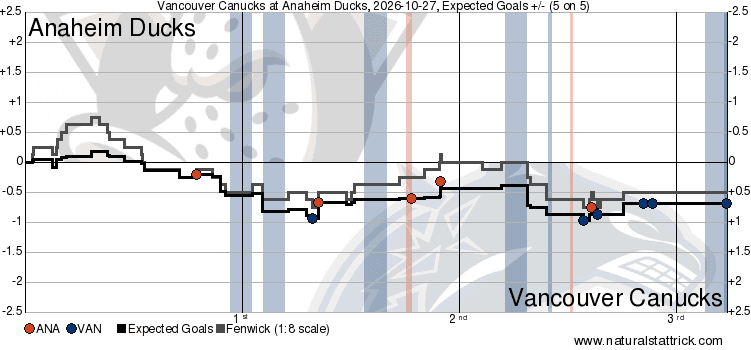
The Canucks’ five-on-five performance was a considerable improvement from Sunday’s loss, particularly in their ability to generate quality scoring chances. Vancouver finished the opening period with a 54.84 CF%, out-attempting Anaheim 17-14. That translated into a 71.92 xGF%, with the Canucks producing 0.92 expected goals while allowing 0.36.
After an early push from the Ducks, Vancouver began steadily tilting the ice in its favour. Unlike Sunday, when the Canucks controlled shot attempts without building a significant expected-goals advantage, their early pressure in Orange County produced dangerous looks around the blue paint.
Things became considerably less comfortable in the second, when the Ducks took a 63.16 CF% while out-attempting Vancouver 12-7 at five-on-five. Still, Vancouver’s underlying numbers weren’t nearly as disastrous as the scoreboard suggested after 40 minutes. Its 45.05 xGF% in the middle frame represented a relatively modest disadvantage, with Anaheim generating 0.71 expected goals compared to Vancouver’s 0.58.
Vancouver regained control during the third, generating 13 shot attempts to Anaheim’s seven at five-on-five. Its 65% CF% and 61.02 xGF% reflected a stronger territorial performance as the Canucks mounted their comeback.
By the end of regulation, Vancouver had out-attempted Anaheim 37-33 at five-on-five and produced 2.22 expected goals against 1.53 for the Ducks. It was a substantially better performance than Sunday’s, even if the defensive breakdowns and goaltending nearly
Heat Map
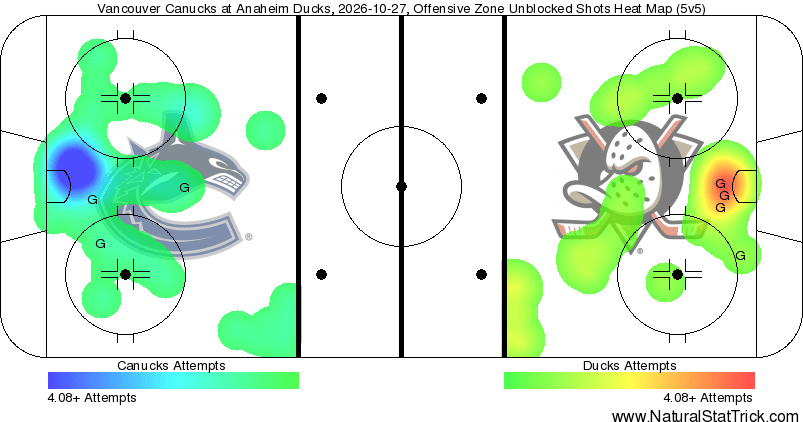
Vancouver’s improvement in shot quality becomes particularly apparent when looking at the concentration of unblocked attempts around Anaheim’s crease, with the strongest clusters extending through the low slot and into the areas surrounding the net.
That pressure translated into 12 high-danger chances at five-on-five, compared to seven for the Ducks. Vancouver controlled a 63.16 HDCF%, an impressive turnaround after surrendering 17 high-danger opportunities and generating just seven against Minnesota. The opening period was especially productive, with the Canucks generating five high-danger chances while allowing just one. They added three more in the second and four in the third, consistently finding ways to reach dangerous areas even when Anaheim carried long stretches of play.
Despite being outshot 18-15 at five-on-five, one important distinction was that Vancouver limited the quality of the chances against. Anaheim’s strongest concentration appeared around one side of the Vancouver crease, however, the Ducks couldn’t match the overall volume of high-danger chances Vancouver created. The larger concern was how frequently those opportunities became goals against Meriläinen, despite the Canucks conceding fewer dangerous chances than they generated.
Individual Advanced Stats
Corsi Champ: Liam Öhgren finished with a team-leading 73.33 CF% at five-on-five, with Vancouver generating 11 shot attempts and allowing just four during his 13:28. Vancouver generated six scoring chances and allowed only one during his minutes, and after a difficult outing against Minnesota, the winger delivered one of his strongest performances of the season.
Corsi Chump: Victor Mancini found himself at the opposite end of the spectrum. The defenceman finished with a team-low 33.33 CF% at five-on-five, with Anaheim generating 10 shot attempts against Vancouver’s five during his 11:01. Those numbers came despite reasonably favourable deployment, including one offensive-zone shift start and none in the defensive zone. Although his high-danger chances were even at two apiece, Vancouver spent too much of Mancini’s ice time defending rather than generating sustained pressure.
xGF: Öhgren’s dominance extended past the shot-attempt differential, as his 98.07 xGF% led all Canucks skaters at five-on-five. The Canucks held a 3-0 advantage in high-danger chances with him on the ice, while the overall scoring-chance battle finished 6-1. Marco Rossi wasn’t far behind at 93.35 xGF%, followed by Linus Karlsson at 93.02%.
GSAx: The final result was considerably kinder to Leevi Meriläinen than his underlying numbers. Vancouver’s goaltender stopped 18 of 23 shots for a .783 save percentage, surrendering five goals against just 2.16 expected goals, leaving him with a minus-2.84 goals saved above expected.
His numbers at even strength were particularly concerning, allowing four goals on 18 shots at five-on-five, where Anaheim generated just 1.53 expected goals, producing a minus-2.47 GSAx in those situations. Four of the five goals he surrendered were classified as high-danger, although he faced only six high-danger shots throughout the game.
Anaheim’s Lukas Dostál struggled as well, allowing six goals against 4.33 expected goals and finishing with a minus-1.67 GSAx.
Statistical Musings
The Öhgren-Rossi-Karlsson line finds its groove: In 11:41 together at five-on-five, Öhgren, Rossi, and Karlsson controlled a 71.43 CF% and an extraordinary 97.84 xGF%. In those minutes, the Canucks generated 10 shot attempts against Anaheim’s four, outshot the Ducks 5-2 and held a 6-1 advantage in scoring chances. Even more impressive was that Vancouver allowed just 0.01 expected goals against in their ice time. Rossi’s individual numbers were particularly encouraging following a difficult performance against Minnesota, where he recorded a 7.59 xGF% against his former team Sunday, before registering at a 93.35% clip on Tuesday.
Tom Willander was outstanding: The sophomore defenceman had arguably the most impressive performance of Vancouver’s blue liners. Willander finished with a 72.41 CF%, second among all Canucks skaters, while controlling an 83.55 xGF%. Vancouver out-attempted Anaheim 21-8 during his 19:48 at five-on-five and generated 1.35 expected goals against just 0.27. The high-danger differential was 7-2 in Vancouver’s favour, and its scoring-chance advantage finished 11-4.
His performance becomes all the more impressive when considering he recorded eight neutral-zone shift starts without an offensive- or defensive-zone start, indicating his results weren’t simply a product of favourable offensive-zone usage. Jamie Oleksiak enjoyed a strong outing as well, finishing with a 65.52 CF% and an 81.74 xGF% across 20:14 at five-on-five.
Anaheim’s top line struggled: Cutter Gauthier, Leo Carlsson and Judd Caulfield struggled to control play during their 12:07 together. The Ducks generated just five shot attempts while allowing 12, producing a 29.41 CF%, and their 35.28 xGF% wasn’t much better, with Vancouver holding a 6-3 advantage in high-danger opportunities. For a Canucks team that struggled to contain Minnesota’s depth players two nights earlier, limiting Anaheim’s most dangerous forwards unit was an encouraging development.
A productive power play without a goal: Vancouver generated plenty of offence with the man advantage but couldn’t convert. Across 8:15 at five-on-four, the Canucks recorded 11 shots on goal and generated 1.49 expected goals, including six high-danger opportunities, yet finished without a power-play goal. Anaheim, meanwhile, scored once during just 43 seconds at five-on-four. The Canucks generated the better chances and controlled possession as a whole, but their failure to finish those opportunities kept the game far closer than the numbers suggested.
As a team
CF% – 52.86% | HDCF% – 63.16% | xGF% – 59.24%
After 10 consecutive games without a victory, Vancouver finally found a way to win, and the five-on-five numbers prove the Canucks were full value for it. Meriläinen’s struggles and another scoreless power play left plenty to address, but the territorial improvement was substantial. For a team that spent much of Sunday’s loss chasing Minnesota around its defensive zone, Tuesday’s performance provided a far more encouraging foundation for Manny Malhotra’s squad to build upon.
Stats provided by naturalstattrick.com
Sponsored by bet365


Breaking News
- The Statsies: Willander and Öhgren’s underlying metrics stand out in Canucks’ wild comeback vs. Ducks
- The Stanchies: Lekkerimäki has arrived, Elias Pettersson goes full Macbeth, and Meriläinen gets his win
- Instant Reaction: Canucks mount unbelievable comeback on the back of Lekkerimäki to beat Ducks 6-5 in OT
- Canucks prospect Caleb Malhotra may have had his “coming out party” at NCAA level
- What’s behind Marco Rossi’s quiet start with the Canucks?

Vancouver CanucksTeam Cap Summary

Cap Summary
2026-27
2027-28
Projected Cap Hit
$87,295,050
$71,329,167
Projected Cap Space
$16,704,950
$42,170,833
Current Cap Space
$19,522,652
$42,170,833
Active Players
23/23
13/23
Draft Picks
Round
'27
'28
1
1
1
2
2
2
3
1
1