
CanucksArmy has no direct affiliation to the Vancouver Canucks, Canucks Sports & Entertainment, NHL, or NHLPA
Canucks: What the fallout of a Filip Chytil injury could mean for Sasson, Räty, and Cootes
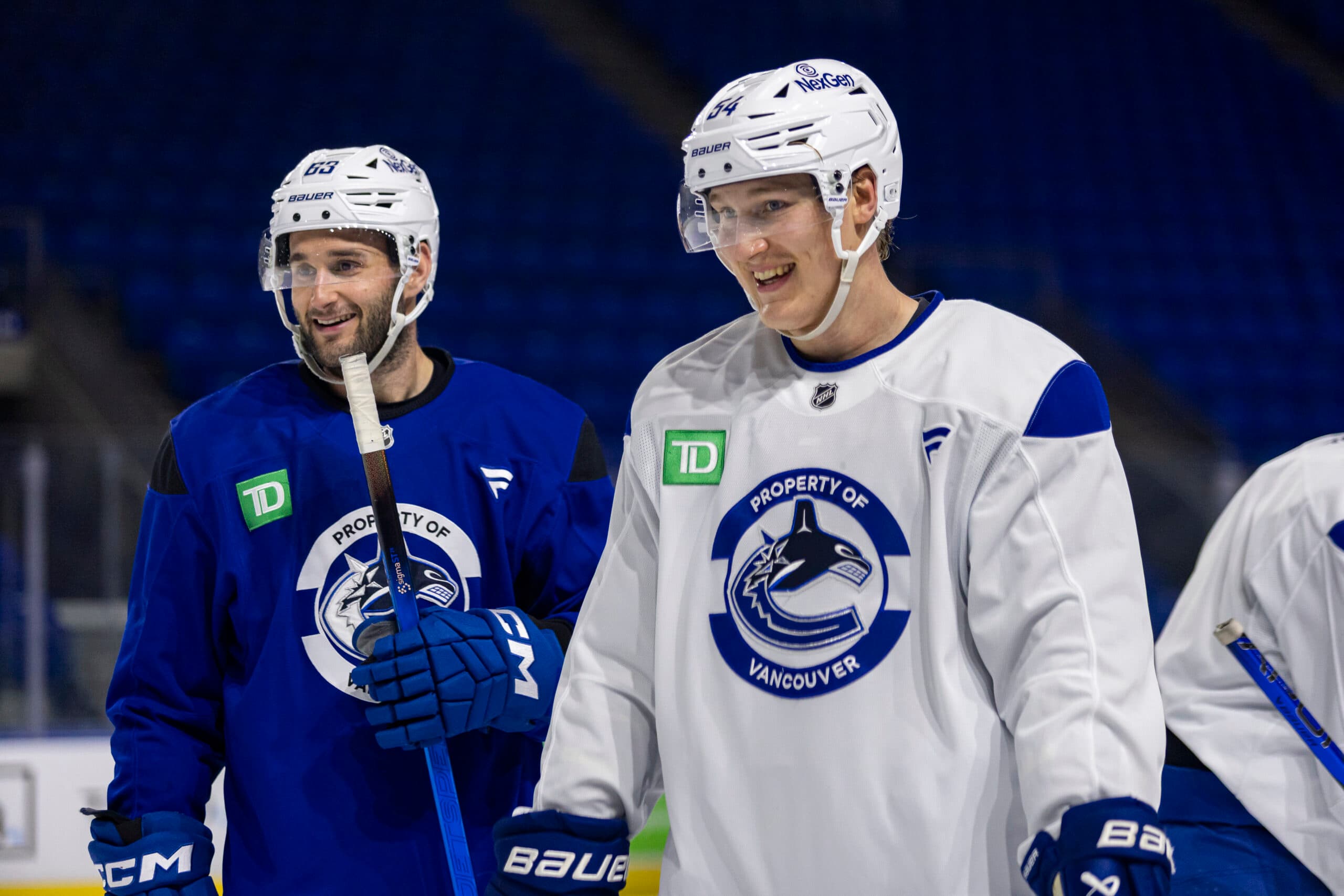
Photo credit: © Tav Morisson-CanucksArmy

By Elijah Ford
Sep 26, 2026, 11:00 EDTUpdated: Sep 25, 2026, 18:42 EDT


Filip Chytil’s latest injury could force the Vancouver Canucks to significantly adjust their plans down the middle just days before the start of the regular season.
Chytil left Thursday’s preseason game against the Edmonton Oilers after colliding with referee Riley Brace and crashing into the end boards. He was ruled out for the remainder of the game with a shoulder injury and has been placed on injured reserve. Canucks GM Ryan Johnson called Chytil’s injury “more of a week-to-week thing.” The timing could hardly be worse for a Canucks team that was already entering the season with some uncertainty at centre.
Elias Pettersson and Marco Rossi are expected to handle the top two spots, while Chytil had been slated for an important role in the bottom six. Behind him, Aatu Räty and Max Sasson were among the most obvious internal options. Braeden Cootes was another intriguing possibility after an impressive preseason, but Vancouver assigned the 19-year-old to the Abbotsford Canucks on Friday. That changes the picture, but it does not necessarily remove Cootes from it completely.
If Chytil is forced to miss significant time, Vancouver could have three players with very different paths to a larger role: Räty could move up the depth chart, Sasson could be asked to return to centre, and Cootes could get a shot at more NHL minutes sooner than originally planned.
Räty will likely move up
Räty is the most natural candidate to absorb some of Chytil’s minutes.
It’s an incredible turn of events for the Finnish centre, considering that entering training camp, Räty’s regular place in the NHL lineup was in question. He began camp centring Ty Mueller and Trey Fix-Wolansky, neither of whom will be on the Canucks’ opening-night roster. The two players he was likely competing with for the fourth-line centre role, Filip Chytil and Max Sasson, each played with established NHL forwards. Those combinations indicated that Räty may have been on the outside of Vancouver’s opening-night depth chart. Now, Räty could find himself moving up the lineup very quickly.
If Vancouver chooses to keep Cootes out of the opening-night lineup, Räty could become the team’s third-line centre, with another forward — potentially Sasson — filling the fourth-line role. The question is whether he can take advantage of it.
Räty has looked like an improved player throughout the preseason, with his game against Calgary in particular showcasing a level of intensity and play-driving ability that impressed many Canucks fans. Our own David Quadrelli has reported that his shot looked improved during training camp, while his skating looked a touch faster to our eye in game action. With his defensive reliability and faceoff prowess already established, Räty could be in position to get the most opportunity he has so far in his NHL career.
Sasson is the wild card
Then there is Sasson, whose situation may be the most complicated of the three.
Coming into training camp, it was difficult not to feel confident that he would begin the season on the wing. After spending the majority of last season on the outside, Sasson appeared to have found a position that suited his game. His speed became one of his biggest weapons, and he seemed noticeably more comfortable using it when he was not burdened with the defensive responsibilities that come with playing centre.
When Sasson was asked about his position during the team’s optional skates in August, he sounded particularly excited about the possibility of remaining on the wing.
“Last year when I went to the wing, I thought especially down the stretch there I started feeling very confident on the wall,” Sasson said. “As well as getting to use my speed maybe a little bit more and not having to run around in the D-zone as much.”
That seemed to be where his season was headed. Instead, Malhotra opened training camp with Sasson at centre between Brendan Gallagher and Drew O’Connor. He then moved him back to the wing alongside Räty for Vancouver’s preseason opener against Seattle. The result appears to be a player the Canucks view as a hybrid forward — and Chytil’s injury could make that versatility even more important.
Sasson has extensive experience playing centre under Malhotra through their time together in Abbotsford. Through that experience, he likely has a better grasp of Malhotra’s landmarks and reporting spots at centre than most Canucks do early in the system installation process. But being capable of playing centre does not necessarily mean it is the best position for Sasson’s game.
One of the obvious skills required to be consistently effective down the middle is taking faceoffs, and Sasson was far from prolific in that department last season. Among players who took at least 200 faceoffs last season, Sasson’s 42.1 percent success rate ranked 15th-worst in the NHL.
The centre position also comes with significant defensive responsibility in Malhotra’s system. The position requires players to defend the middle of the ice, support their defencemen in board battles, and cover a much larger portion of the defensive zone. Sasson has the quickness to cover plenty of ground, but his smaller frame can make it difficult to consistently win physical battles and create loose pucks from his checks. The wing gives him more freedom to utilize his skating.
Playing on the outside lets Sasson operate higher in the defensive zone, putting him in a better position to attack immediately once Vancouver gains possession. Instead of having to begin his transition from deep in his own zone, he can get moving earlier and use his speed to stretch the neutral zone. For a player whose skating is among his biggest strengths, that can make a significant difference.
That makes him different from Cootes and Räty. For those two, Chytil’s injury could simply create a clear path to more minutes down the middle. For Sasson, it could force Malhotra to decide whether his positional versatility and system experience are more valuable than keeping him in the role that may suit his game best.
Cootes’ timeline could be moved up
Cootes already cracked the Canucks’ opening-night lineup last season at 18, and he has done everything possible this preseason to put himself back in the conversation. Cootes recorded a point on each of Vancouver’s first three goals over his first two preseason games before being held pointless against Edmonton. He has also continued to showcase the offensive instincts that made him a first-round pick in 2025.
But after Ryan Johnson’s anti-yo-yo comments last week, combined with Cootes’ own admission that he did not want to “just survive” in the NHL, his starting the season in the AHL did not come as a surprise. The Canucks clearly do not need to rush him into another NHL role. But this Chytil injury, plus other potential nicks down the road, could force the organization to weigh development against an immediate need for centre depth. For now, Cootes will get the opportunity to play bigger minutes in Abbotsford. If Vancouver needs another centre later, though, his name could quickly come back into the conversation.
Cotter gives Vancouver a level of versatility
Paul Cotter could also give the Canucks some flexibility down the middle.
Cotter was listed at centre in Friday’s practice, centring a line between Arshdeep Bains and Brendan Gallagher. He has experience playing the position, although he has primarily been used as a winger throughout his NHL career.
The move is worth watching in the context of Chytil’s injury, but it is also important not to read too much into it just yet.
Räty has already played his maximum two preseason games under the NHL’s new veteran preseason rules, meaning he is not eligible to play in Saturday’s preseason finale. That leaves Vancouver with a thinner group of natural centres for the game, making Cotter a logical player to experiment with in the middle.
Still, Cotter’s ability to take centre shifts gives Malhotra another option if Vancouver’s depth is tested once the regular season begins. He is a bigger, more physical forward than the other internal options, and his experience could make him a safer short-term option than throwing a younger player into a larger role.
That does not necessarily mean Cotter is suddenly in the running to replace Chytil permanently, but his versatility could help Vancouver bridge the gap while the team determines how long Chytil will be unavailable.
Chytil’s injury has the potential to reshape the bottom half of Vancouver’s forward group. Cootes could get another chance to prove he is ready for consistent NHL minutes, potentially sooner than expected. Räty could move into a bigger role, while Cotter gives Malhotra the option of a a larger forward down the middle. And Sasson could become the ultimate swing piece, capable of filling either position depending on how Malhotra wants to construct the lineup.
The Canucks entered training camp with questions about their centre depth. Chytil’s injury has made those questions considerably more important — and given many different forwards a chance to provide an answer.
READ NEXT: Canucks’ Adam Novotný has massive 4-point night in return to OHL
Sponsored by bet365


Breaking News
- The Stanchies: Brady Tkachuk’s natural hat trick extends Canucks losing streak to 6 in OT loss to Panthers
- Instant Reaction: Brady Tkachuk scores late hat trick in Canucks’ overtime loss to Florida
- Canucks trade Aatu Räty to Maple Leafs for forwards Jacob Quillan and Brandon Buhr
- What’s behind the early struggles from Canucks’ Zeev Buium and Filip Hronek?
- Canucks’ Räty clears NHL waivers, will report to AHL Abbotsford

Vancouver CanucksTeam Cap Summary

Cap Summary
2026-27
2027-28
Projected Cap Hit
$87,295,050
$71,329,167
Projected Cap Space
$16,704,950
$42,170,833
Current Cap Space
$18,206,519
$42,170,833
Active Players
23/23
13/23
Draft Picks
Round
'27
'28
1
1
1
2
2
2
3
1
1