
CanucksArmy has no direct affiliation to the Vancouver Canucks, Canucks Sports & Entertainment, NHL, or NHLPA
Canucks: Comparing Tom Willander’s strong start to his draft peers, NHL comparables, and teammates

Photo credit: © Jayne Kamin-Oncea-Imagn Images

By Cory McQuhae
Dec 11, 2025, 09:00 ESTUpdated: Dec 11, 2025, 21:02 EST


Once the Vancouver Canucks drafted Tom Willander 11th overall in the 2023 NHL Entry Draft, there was immediate pressure on him. The 2023 draft was considered very deep, with potential impact players at every position, including in the middle of the first round. His ultimate upside was considered less than, for example, Axel Sandin-Pellikka, but his elite mobility made him a sure bet to at least play in the NHL. His profile was that of an elite puck supporter who can shut down the rush game with his legs. To justify his selection, Willander needed to demonstrate strong development in the details of his game, and early in his career, the results are promising.
Two defencemen were selected before the young Canucks’ rearguard in the draft: David Reinbacher and Dmitry Simashev. Five more were selected after him in the first round. Only Willander, Simashev, and Sandin-Pellikka have actually suited up in the NHL. Expanding this out to include the entire 2022, 2023, 2024, and 2025 drafts reveals that only 19 defencemen have played 20 or more NHL games.
xGF% = this is the difference between Expected Goals For and Expected Goals Against, represented as a percentage
SCF% = this is the difference between Scoring Changes For and Scoring Chances Against, represented as a percentage
OZ Start % = percentage of time the player starts their shift with an offensive zone faceoff (only accounts for offensive and defensive starts, not neutral zone starts)
DZ Start % = percentage of time the player starts their shift with a defensive zone faceoff (only accounts for offensive and defensive starts, not neutral zone starts)
AVG TOI = average time on ice per game
SCF% = this is the difference between Scoring Changes For and Scoring Chances Against, represented as a percentage
OZ Start % = percentage of time the player starts their shift with an offensive zone faceoff (only accounts for offensive and defensive starts, not neutral zone starts)
DZ Start % = percentage of time the player starts their shift with a defensive zone faceoff (only accounts for offensive and defensive starts, not neutral zone starts)
AVG TOI = average time on ice per game
Draft Peers
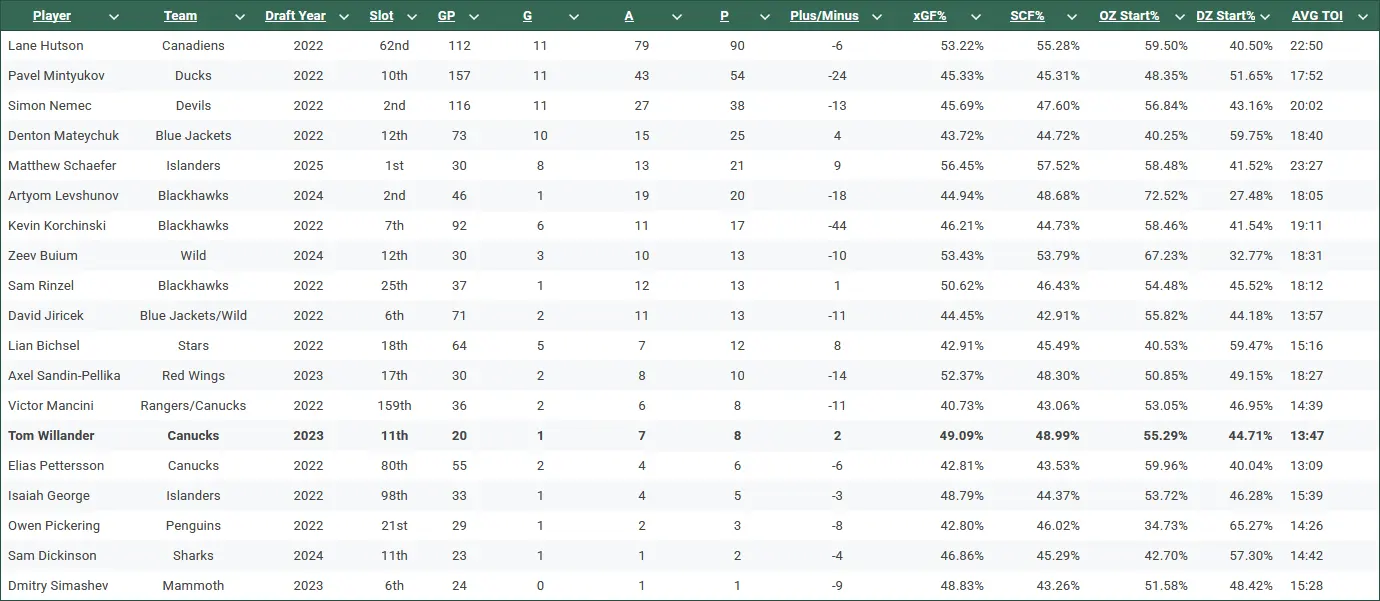
Willander is sixth in xGF% and fourth in SCF%. This means that when he is on the ice, there is an equal amount of scoring chances for and against the Canucks. It’s not so much that he is winning his minutes but holding the opposition to a draw. For a young defenceman, this is actually very good as it means he is not being taken advantage of or blowing his coverage.
Early in their careers, Willander is outperforming Simashev, who was selected five spots earlier in the 2023 draft, and is roughly on par with Sandin-Pellikka’s results and production. In stark contrast to the vast majority of his peers, however, is that Willander averages less than 14 minutes in ice time. Only teammate Elias Pettersson averages less ice time among these players. The early results and his underlying numbers show that Willander can handle more responsibility.
It’s all well and good to compare him to his peers, but how do these numbers compare to more established NHL defencemen? Well, CanucksArmy has that covered!
NHL Comparables
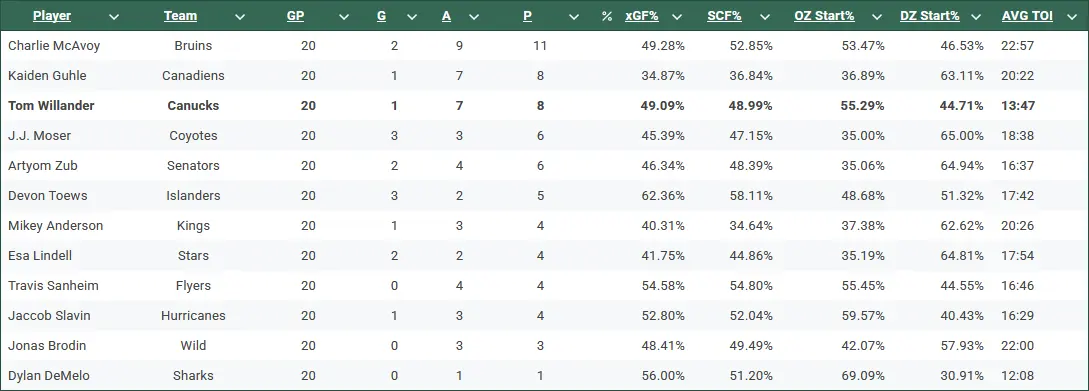
The defencemen were chosen as having a comparable playstyle to Willander. Typically, these are strong defenders who provide support in the offensive zone through one-touch passes and constant movement to keep opposing defenders on their toes. Charlie McAvoy, for instance, was frequently cited by Craig Button as an NHLer with stylistic similarities to the Canucks defender.
From a pure production standpoint, Willander is tied for second in points over this 20-game sample size. Once again, his xGF% and SCF% hold up very well, sixth and seventh, respectively. These metrics are in line with Jonas Brodin’s numbers. Brodin and Willander are roughly the same size and are both excellent skaters whose offence comes from supporting rather than driving. One primary difference, and this leads to Brodin’s counting stats being very muted, is that the offensive and defensive zone starts between the Wild and Canucks defenders are opposite of each other.
His ice time remains obscenely low with the second-lowest average. He has averaged nearly two and a half minutes less than Jaccob Slavin, the next player above him. In comparison, Brodin averaged an even 22 minutes a game through his first 20 times on an NHL surface.
For the season, the smooth-skating defenceman has provided top-four results from below third-pairing minutes.
Teammates

Willander is third in points, one of only two defencemen on the team to have a positive +/-, second to Quinn Hughes in xGF%, and third, barely behind Filip Hronek, in SCF%. In very limited icetime, he’s produced like a top-four defenceman. However, we would be remiss if we didn’t mention his rather gaudy OZ Start%.
He is second on the team with over 55% of his zone starts coming in the offensive zone. Much of this is driven by small sample size, limited ice time, and getting usage on the second unit power play. At 5v5, his OZ Start% drops to 51% which would put him in line with Elias Pettersson’s deployment.
The power play deployment does not significantly affect his counting stats, either. Seven of his eight points have come at even strength. When adjusted to 5v5, his xGF% drops to 44.67% and his SCF% falls to 45.98%. The sample size is very small, and one game, good or bad in either direction, can greatly skew his numbers.
Ideally, his icetime begins to climb. On December 8th, against the Detroit Red Wings, he saw the ice for 15 minutes. However, the previous game was a gutsy 4-2 victory over the Wild, where Willander scored his first NHL goal and added an assist; he only played 13:18.
As the Canucks’ season collapses in on itself, Tom Willander’s play has been a bright spot. Given his extremely limited icetime, his counting stats are impressive. Putting up eight points through his first 20 games while averaging under 14 minutes a night was not something any of his comparables, peers, or teammates have replicated. With how the Canucks’ season has gone, there’s no reason not to give him more responsibility.
Sponsored by bet365


Breaking News
- 5 things Canucks fans can be thankful for this Thanksgiving
- How could the Canucks do “something creative” with a Connor Zary trade, and what would it mean for the team?
- 3 Canucks Stars of the Week: Elias Pettersson(s) shines despite early-season losing streak
- JPat’s Monday Mailbag: What more do we need to see from Zeev Buium?
- The Statsies: D Elias Pettersson lights up the stat sheet in Canucks’ loss to Rangers

Vancouver CanucksTeam Cap Summary

Cap Summary
2026-27
2027-28
Projected Cap Hit
$88,074,947
$71,329,167
Projected Cap Space
$15,925,053
$42,170,833
Current Cap Space
$17,068,841
$42,170,833
Active Players
23/23
13/23
Draft Picks
Round
'27
'28
1
1
1
2
2
2
3
1
1