
CanucksArmy has no direct affiliation to the Vancouver Canucks, Canucks Sports & Entertainment, NHL, or NHLPA
The Tape: Tom Willander and the learning curve for young defencemen breaking into the NHL
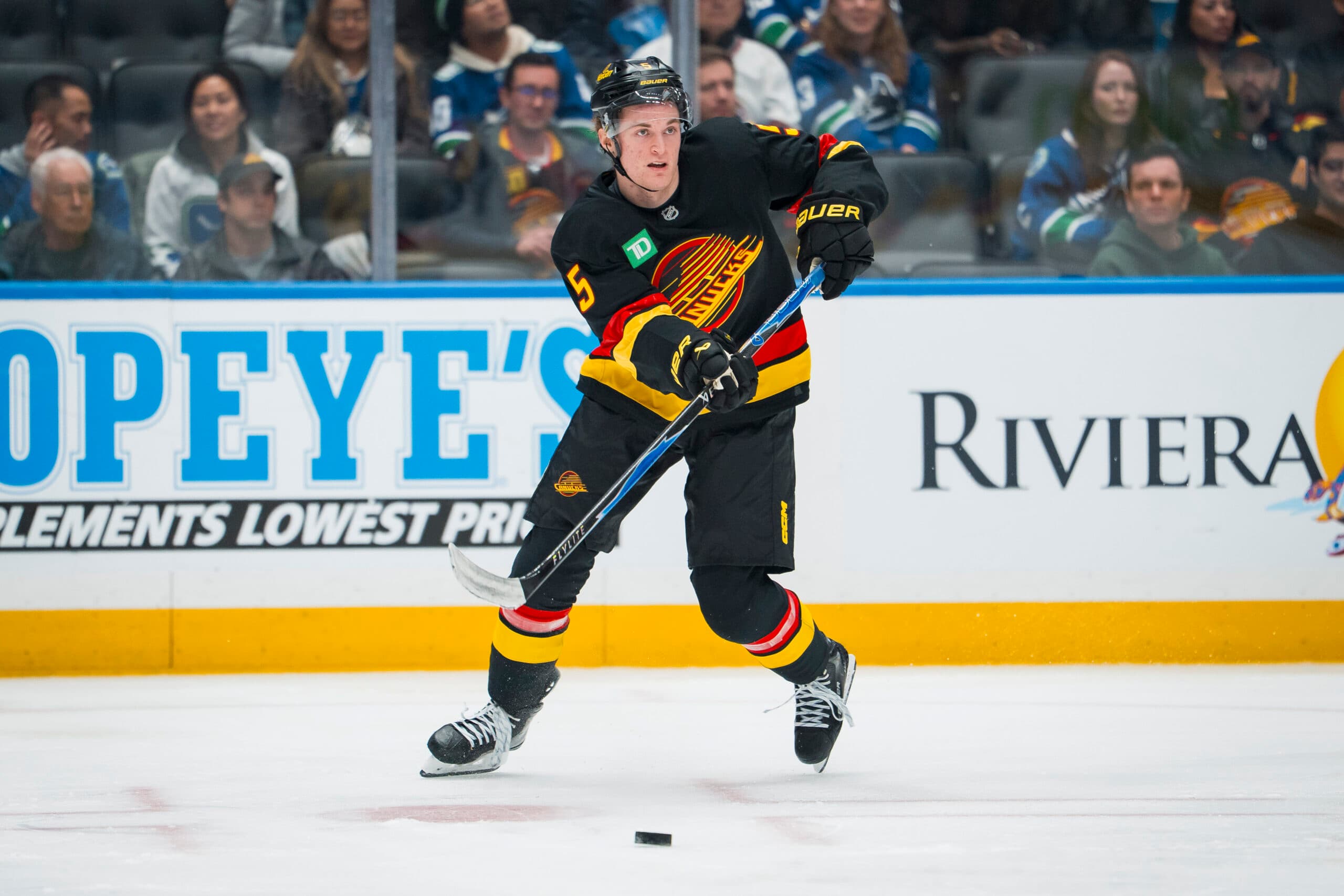
Photo credit: © Bob Frid-Imagn Images

By Tyson Cole
Nov 1, 2025, 16:00 EDTUpdated: Nov 1, 2025, 15:44 EDT


One of the Vancouver Canucks‘ top prospects, Tom Willander, made his NHL debut earlier this week against the New York Rangers.
The 20-year-old defenceman signed his entry-level contract with the Canucks in early May, but did not join the Abbotsford Canucks in their run to the Calder Cup. Training camp was the first time we saw Willander skate in a Canucks uniform. While his skating stood out as a strong suit of his game, it was clear he needed some time to acclimate to the professional game. That’s not a knock; most defencemen coming out of the NCAA do need that developmental time.
However, with the numerous injuries in Vancouver, the Canucks summoned Willander after four games at the AHL level. He was sent down and recalled after Victor Mancini’s injury, and made saw game action against the Rangers.
Willander was paired with PO Joseph and played 12:37 minutes in his debut. He saw some power play and penalty kill time, registering two shots on goal on four shot attempts. But there were certainly some rookie moments in his game.
There were instances where we caught him pinching high in the defensive zone, which allowed a Ranger all alone in front of the net.
Another example of when he pinched in the zone, which turned into a 2-on-1 headed the other way for the Rangers.
But again, this was not even 30 minutes into his first NHL game. These small mistakes are going to happen, especially for a defenceman who had five games of professional experience in North America. Of course Willander played in North America in the NCAA, but the professional ranks is different than that of Sweden.
Fellow Swede Elias Pettersson went through the same challenge last year. He spoke post-game about some of the challenges for a young defenceman to learn when breaking into the NHL:
“Going back for pucks,” Pettersson told CanucksArmy. “In Sweden, you always try to look for a play. Here, it’s much more direct, hard plays. We can’t have the puck on our stick as much.”
Forecheckers in the NHL are relentless and aggressive. On this play, Willander doesn’t get the best first step and, at first, casually goes back for the puck. However, once he realizes there’s a speedy Ranger coming in to pressure him, he now has to race for it.
He does win the race, but has no time to do anything other than shovel the puck behind the net. The Rangers end up holding the zone and dump it back behind the net.
With 39 NHL games under his belt, Pettersson has learned a bit more about puck retrievals – and you could tell. As he’s going to collect the puck, Pettersson shoulder checks and sees Jonny Brodzinski coming in to pressure him. Being aware of his surroundings, Pettersson shields the puck with his body and turns away from Brodzinski, which then buys him an extra second in order to fire the puck off the glass and the Canucks get the zone exit.
That’s what Willander will learn as he gets more games under his belt. Canucks Head Coach Adam Foote spoke post-game about the challenges for a young defenceman and mention that it’s really just experience that will help iron out those details:
“You just need games. You look at these teams that win in the playoffs, their D – you need 200 games, 250, 300. I mean, it’s just playing. He’s doing great, and he plays hard. There’s things that he would know better if he just got more games. It happens to every young D. I still think he plays hard and will get there, but he’s also put in a situation where the minutes are up against tough opponents. That’s the way it is right now; we have no choice. But hey, he’ll be better for it.”
And Foote stood by his word. In his second game, the Canucks coach relied heavily on Willander, playing him 19:12 minutes against the St. Louis Blues.
Willander learned from some of his mistakes in his NHL debut, and implemented them against the Blues. He stays aggressive and pinches in the offensive zone, but this time, he’s able to use his speed to get back and tie up the trailer and completely eliminate him from the rush chance.
Fast forward to the start of the second period for an offensive zone faceoff. Willander takes a point shot, which gets blocked. The Blues dump it down the ice on Willander’s side.
This time on the puck retrieval, he shoulder checks twice to recognize the pressure coming. Willander kicks the up to his stick and quickly sends the puck to his open defence partner Marcus Pettersson, who buys time for Willander to turn back up ice for a clean transition through the neutral zone.
Later in the middle frame, Willander heads back on another puck retrieval, knowing that Pius Suter is on him with pressure. The young defenceman uses his 6’1″, 180-pound frame to box out Suter and protect the puck against the boards. With Suter now on the opposite side of the puck, Willander pokes the puck out of danger to Aatu Räty, and Joseph moves the puck up ice for the breakout.
Here, Willander gets tied up by Mathieu Joseph in the defensive zone. However, Willander does a good job to not let Joseph escape, taking the tie up to the corner. Again, Willander does a great job to completely box his check out of the scrum, and the Canucks retake possession.
Willander finished his second NHL game playing a much more pivotal role due to him learning from some of his rookie mistakes he made in his NHL debut. He looked like he fit in well in the offensive zone, putting pucks on net when presented the opportunity. His skating is a stron suit and puts him in advantageous situations in both ends of the ice.
There’s still a long way to go for him and his development. But the improvements he made over just a one game sample size, after utilizing some of the post-game comments from his coach and teammates has him on a positive trajectory just two games into his NHL career.
PRESENTED BY VIVID SEATS



Breaking News
- The Stanchies: Canucks serve up defensive zone breakdowns in Thanksgiving loss to Rangers
- Instant Reaction: Canucks struggle defending off the rush in 6-2 loss to Rangers
- Abbotsford weekly: Cootes and Lind tally 3 points each in Canucks’ first win of the season
- NHL fines Devils’ Evan Rodrigues $5,000 for high-sticking Canucks’ Marco Rossi in the neck
- Canucks Game Day: Desperate to shore up the penalty kill against the Rangers

Vancouver CanucksTeam Cap Summary

Cap Summary
2026-27
2027-28
Projected Cap Hit
$88,074,947
$71,329,167
Projected Cap Space
$15,925,053
$42,170,833
Current Cap Space
$16,975,056
$42,170,833
Active Players
23/23
13/23
Draft Picks
Round
'27
'28
1
1
1
2
2
2
3
1
1