
CanucksArmy has no direct affiliation to the Vancouver Canucks, Canucks Sports & Entertainment, NHL, or NHLPA
Goals and expectations for Canucks defenceman Filip Hronek in 2025-2026
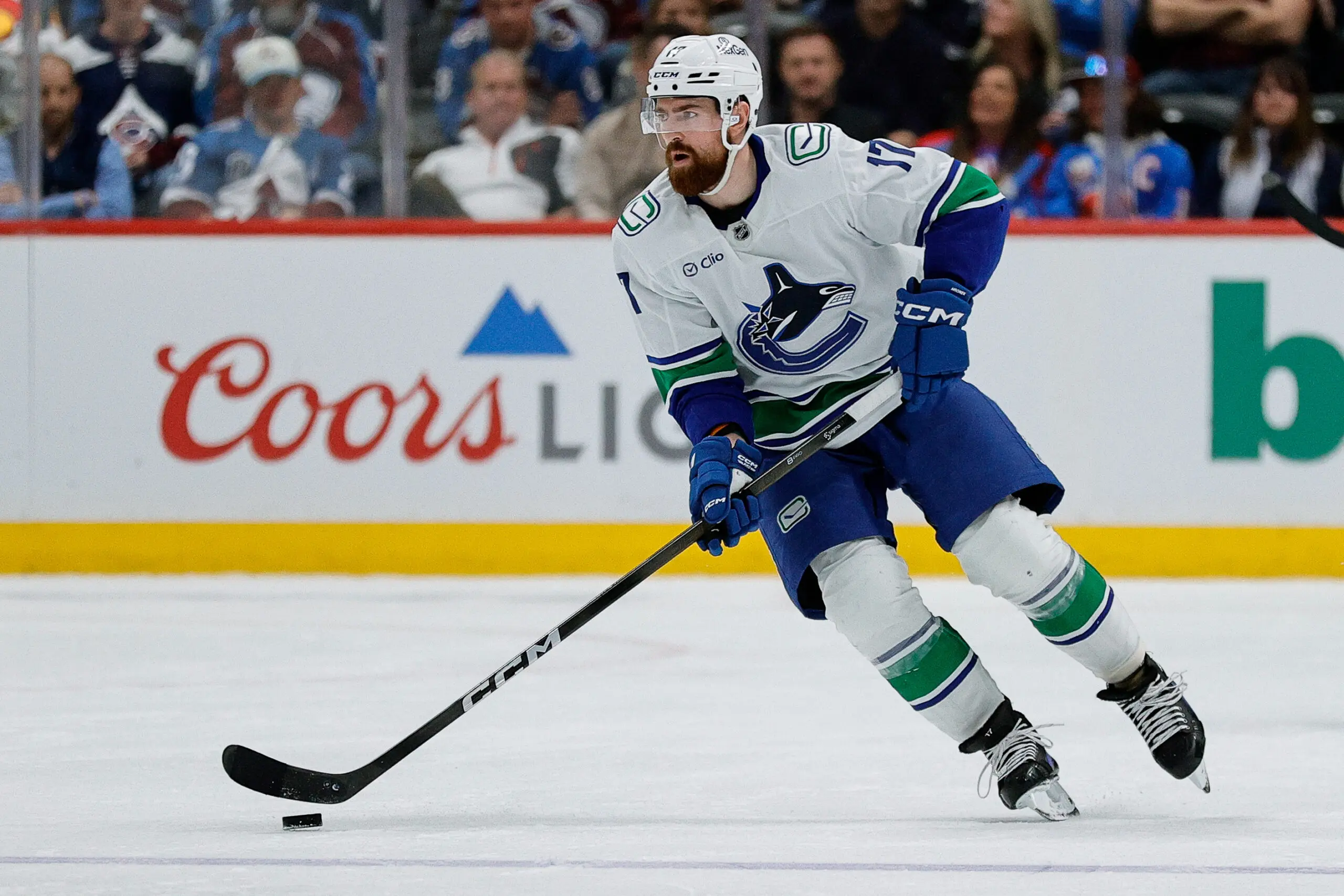
Photo credit: Isaiah J. Downing-Imagn Images

By Cory McQuhae
Aug 21, 2025, 17:00 EDTUpdated: Aug 21, 2025, 01:56 EDT


On the surface, Filip Hronek’s 2024-25 season was not up to the standard he set since arriving in Vancouver. His counting stats were decent, but lower than any of his four previous seasons, and he got dinged for more penalties, too. However, upon closer examination, it is revealed that he took numerous challenging assignments with aplomb while away from Quinn Hughes.
The right-shot defenceman has had problems staying healthy throughout his career. He was injured when first acquired, injured again in the latter half of his first full season with the team and played through that injury, and also missed 21 games last season. Staying on the ice and at full capacity has been an issue for him. Still, he finished fourth on the Vancouver Canucks in total ice time among all skaters.
Through 61 games, he averaged nearly 24 minutes per game. As a true all-situations defender, he averaged 19 minutes at 5v5, 2:18 minutes on the penalty kill, and 1:47 minutes on the power play. No other defenceman on the Canucks was as important in as many different scenarios as Hronek.
Scoring 22 points at 5v5 is excellent production for a defenceman. Conversely, his seven power play points were anemic, especially since he spent nearly 109 minutes there. Frustratingly, his entire power play production consisted of assists, failing to score a goal with the man advantage all season. As a player known for a booming slapshot, that’s disappointing.
For more advanced stats, he was one of two Canucks defencemen who played over 30 games and had a positive Corsi For Percentage (CF%). The same goes for expected goals for percentage (xGF%), scoring chance for percentage (SCF%), high danger chance for percentage (HDCF%) and high danger chances against percentage (HDCA%), while at 5v5. Essentially, regardless of his deployment, the Canucks were usually winning his assignments.
The surly Czech’s zone starts were also flat across the board; he wasn’t given easy assignments. He had 117 offensive zone starts, 243 neutral zone starts, and 164 defensive zone starts. Where this gets interesting is how this varied depending on his defensive partner.
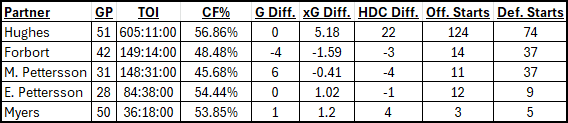
According to the chart, with Hughes as his partner, they started in the offensive zone 50 more times than in the defensive zone. However, when paired with Derek Forbort or Marcus Pettersson, those numbers are flipped with 49 more defensive zone starts. With that zone start imbalance, Hronek’s time away from Hughes, and especially with M. Pettersson, was a positive. The M. Pettersson-Hronek pairing was given the task as a shutdown unit, taking on heavy matchup minutes, and together they ran a fairly neutral high danger chance and expected goal differential. They achieved this while rolling with a positive actual goal differential. At the very least, Hronek showed that he can be a strong asset away from Hughes when at even strength.
It would be a form of malfeasance not to mention his role on the third-best penalty kill in the NHL.

Most commonly sharing the ice with Forbort, Pettersson, and Myers, only seven goals were scored with him on the ice and paired with any of those three. The penalty killing duo of M. Pettersson and Hronek was imposing. Running an expected goals against number of only 3.16, nine high danger chances against, and only one actual goal against are all great underlying numbers and results. The sample size for that pairing is smaller than with his more common partners of Forbort and Myers, but that should not be the case in the upcoming season.
Exceeding expectations for Filip Hronek
To have an exceptional season, the bearded defenceman should crest 30 points at 5v5 and 50 points total. To reach that total, he’ll need to be a weapon on the power play. Doing so would lead to a new career high of 10 goals.
As always with defencemen, there’s far more to their game than points. In Hronek’s case, he’ll need to drive his own pairing rather than be glued to Hughes’ hip. Ideally, this pair is tasked with heavy matchup minutes and wins them. This allows for a more even minute distribution between the defencemen and for a Hughes-Hronek tandem to only be used when trailing.
Just continuing the late-season penalty killing domination would be enough. Losing the key forward cog on the PK in Pius Suter will hurt, but the rest of the group is still there, and Hronek is already one of the most important components of the machine.
Finally, just stay healthy. He’s only played a complete season once, and that was in the bubble season of 2021. On two other occasions, he has played in over 80 games. However, as previously mentioned, he played through injury in the 2023-24 season despite appearing in a career-high of 81 games. For Hronek to have a truly successful season, he needs to be on the ice.
Meeting expectations for Filip Hronek
The path to meet expectations is much easier because that’s how this entire endeavour works. For counting stats, maintain his usual mid-20s 5v5 point production and hover in the high-30s for overall points. Contribute more to the power play; he doesn’t need to set a career-high, but scoring at least one goal would be a vast improvement and should be expected.
As for his deployment, alternating between Hughes and another partner would be massively beneficial for the team in both the short and long term. Everyone is well aware of how dominant the Hughes-Hronek pairing is, but siphoning time away to form an effective shutdown tandem with Marcus Pettersson or mentoring young Elias Pettersson would be a boon. Continuing to do what he and Hughes have done in the last two seasons is the floor, but keeping his head above water with different partners on a more frequent basis will lead to a more balanced minutes distribution and, hopefully, scoring throughout the lineup.
The penalty kill numbers should drop, given how outstanding the results were last season. They should remain very good overall and be a key component there.
Please, just find a way to stay healthy. Maybe asking for an entire season is too much, but playing 70 games or more would be crucial for the team.
Failing to meet expectations for Filip Hronek
Part of not meeting expectations would have him hit low-20s 5v5 points, and not contribute any offence in other situations. Not finding a way to utilize his powerful shot, and thereby leaving the second unit without an important weapon, is a failing not just on the player but on his teammates and the whole power play scheme.
As has been harped on in this writing several times, the righty needs to spend more time away from Hughes and generate positive results while doing so. The flexibility that would provide is invaluable throughout the season, and if he’s just attached to Hughes, there’s far less reliable puck-moving ability in the other defensive pairings.
If Hronek is failing to meet expectations, it will assuredly be because he hasn’t been able to stay healthy. Suiting up in under 60 games and playing through an injury, or multiple injuries, would severely hamper his effectiveness.
Filip Hronek is the Canucks’ best two-way defenceman. No one plays as much at even strength or both special teams as he does. He’s not the biggest player on the ice, but he plays angry and with purpose. If he’s having a successful season, then the Canucks will as well, since he’s seemingly on the ice at every opportunity.
Sponsored by bet365


Breaking News
- Canucks place Aatu Räty on NHL waivers
- WWYDW: Who or what has most surprised you through 10% of the Canucks’ season?
- The Statsies: Brock Boeser has his best game of the year in Canucks’ loss to Islanders
- The Stanchies: Despite growing pains on defence, Canucks battle valiantly in 3-2 loss to Islanders
- Instant Reaction: Leevi Meriläinen stands out in Canucks’ 3-2 loss to Islanders

Vancouver CanucksTeam Cap Summary

Cap Summary
2026-27
2027-28
Projected Cap Hit
$88,074,947
$71,329,167
Projected Cap Space
$15,925,053
$42,170,833
Current Cap Space
$17,163,668
$42,170,833
Active Players
23/23
13/23
Draft Picks
Round
'27
'28
1
1
1
2
2
2
3
1
1