
CanucksArmy has no direct affiliation to the Vancouver Canucks, Canucks Sports & Entertainment, NHL, or NHLPA
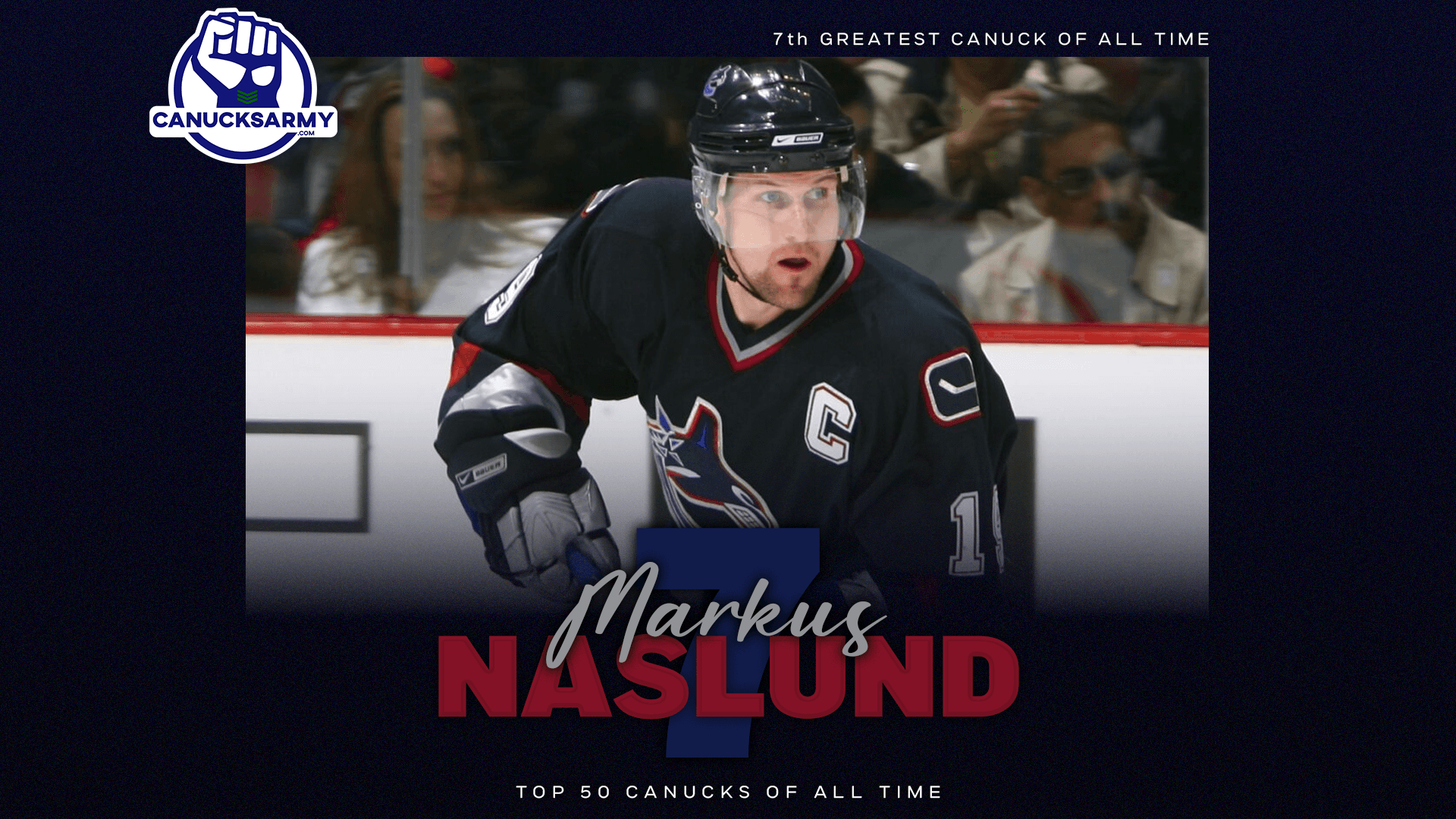
Top 50 Canucks players of all time: #7 – Markus Naslund

By Cory McQuhae
Sep 4, 2025, 12:00 EDTUpdated: Sep 4, 2025, 11:23 EDT


Join us this summer as we count down the top 50 Vancouver Canucks players of all time! #7 – Markus Naslund
If you had a toonie for every Canuck from Örnsköldsvik, Sweden, you would have six dollars. That may not seem like a lot, but this is a city with a population of around 33,000 people. Örnsköldsvik is where the journey started for Peter Forsberg, Niklas Sundström, Victor Hedman, Tobias Enström, Victor Olofsson, Henrik and Daniel Sedin, and, last but certainly not least, Markus Naslund. There must be something in that ice-cold water.
In 1991, a 17-year-old Naslund suited up for his hometown team, MODO, in the then-Swedish Elite League and scored an impressive 19 points in 32 games. NHL scouts took note, and in that summer’s draft, he was selected 16th overall by the Pittsburgh Penguins. In that same draft, the Canucks chose Alek Stojanov 7th, one spot behind Naslund’s friend and teammate, Peter Forsberg.
The nifty winger followed this up by scoring at a point per game pace in the following seasons and shattered records at the World Junior Championships. His 1992 tournament was impressive with eight goals and 10 points in seven games, but the 1993 tournament is the stuff of legend. Naslund set a WJC tournament record for goals with 13, a record that still stands. His 24 points were second in the tournament, behind Forsberg’s incredible 31 points, and still stand as the second most ever.
Looking to bring this scoring prowess stateside, the Penguins were salivating at adding the young scorer to a roster that featured two of the greatest hockey players of all time and had just recently won back-to-back Stanley Cups. Naslund’s rookie campaign did not go as expected. He spent the majority of his time in the NHL, playing in 71 games, but only reached the scoresheet 11 times. A lockout shortened his second NHL season, and he was only rostered for 14 games.
The first two seasons of his NHL career were learning experiences for the young Swede. He was someone who previously had unprecedented success in hockey. His third season in the NHL was when he seemingly broke out, scoring 52 points in 66 games while flanking Mario Lemieux.
“I wish I would have pushed myself more early on, rather than just wait for my opportunity. I did get some good chances early, but I wasn’t ready mentally. My third year I got to play with Mario, which was great, but I needed a fresh start and luckily I ended up in Vancouver,” said Naslund. “I’d asked for a trade earlier, so I knew it was coming. There were rumours I was going to Edmonton, even Dallas and LA, but I ended up in Vancouver. I had my bags packed, I just didn’t know where I was going. In hindsight, I was very fortunate to end up in Vancouver.”
Penguins traded the disgruntled Naslund to the Canucks in a one-for-one deal for the aforementioned Alek Stojanov.
Stojanov, at this point in his career, had one point, an assist, in 67 NHL games and 127 penalty minutes. The big winger went on to play 45 more NHL games, recording two goals, four assists, and 105 penalty minutes.
Naslund’s first full season as a Canuck was decent but mostly forgotten. Scoring 21 goals and 20 assists, this was good enough for fifth on the team. As a team, the Canucks disappointed and missed the playoffs. The following season, everything turned on its head for Naslund and the entire organization.
In the summer of 1997, the Canucks shocked the NHL by signing Mark Messier. With a formidable top-six that included Messier, Pavel Bure, Alexander Mogilny, Trevor Linden, and Markus Naslund, the Canucks were seen as Stanley Cup contenders. Almost instantly, they didn’t look the part. Less than two months into the season, Linden and Kirk McLean were traded, and their coach, Tom Renny, was fired. Messier brought in Mike Keenan, and the following month, Pat Quinn was out the door. Players sulked, goaltending became a carousel, and veterans were sold off. In this environment, Naslund recorded only 34 points and bounced around the lineup. This was still fourth on the team in scoring.
“It was a really unstable environment early, and it didn’t get stable until Brian Burke came in,” Naslund said. “We had so many changes in personnel and management my first few years. It tested my mind, made me focus on the right things, and not worry about the things I can’t control. Your job is to prepare and be ready when you’re called upon. I think I grew up quite a bit during those days.”
Clearly, in the midst of a rebuild, Canucks’ ownership brought in Brian Burke to steer the ship. Burke demanded accountability, and this is when Naslund began to flourish. While his 55-point season was solid, it was mostly fueled by playing with Lemieux. Scoring 36 goals and 30 helpers for 66 points and leading the team for the first time, Naslund suddenly became the future of the franchise. Team success was still far away, but the foundation of the next generation of Canucks was being put into place with Naslund as the centrepiece.
This was obvious to Burke and Marc Crawford, who had replaced Mike Keenan mid-season. To bring in the next millennium of hockey, Markus Naslund was named captain of the Vancouver Canucks. This was the first time a non-Canadian was captain of the Canucks and part of a growing trend, across the NHL, of naming Swedish captains.
The 2000-01 roster was the beginning of an exciting time in Vancouver; a Stanley Cup winning coach in Marc Crawford, Todd Bertuzzi was playing like a young Cam Neely, hometown boy Brendan Morrison had found a spot on the top line with Bertuzzi and Naslund, the Sedins made their mutch anticipate NHL debuts, three young defencemen in Mattias Ohlund, Ed Jovanovski, and Brent Sopel were the most promising the team had ever had at one time, and young goaltender Dan Cloutier was brought into the mix.
Naslund spearheaded the franchise’s resurgence by scoring 41 goals and earning 75 points in 72 games. However, tragedy struck with only 10 games left. It was the middle of March in Buffalo, and Naslund was racing against a Sabres’ defenceman for a loose puck. The two got tangled up, and Naslund slammed into the boards, breaking his leg. He underwent surgery and could not skate for three months. The Canucks lost their most dangerous scorer while in the middle of a playoff race. Due to some Harold Druken overtime heroics in the 81st game of the season, the Canucks returned to the playoffs, but their captain was on crutches. With Naslund on the sidelines, the Canucks were swept by the eventual Stanley Cup champion Colorado Avalanche.
After a stint in a hyperbolic time chamber, the Canucks’ captain returned superpowered. The most exciting line in hockey, the West Coast Express, was fully operational and dominating games. Naslund, Morrison, and Bertuzzi were able to score in all situations, being just as deadly in possession as on the rush. Naslund showed no ill effects from his broken leg the previous season, once again scoring 40 goals and leading the Canucks to the playoffs. The Canucks looked poised for a playoff upset, winning the first two games in Detroit, before dropping the next four. Naslund’s playoffs were forgettable, with only one goal and two points in those six games. This marked the beginning of a trend for the Canucks and their captain: consistently strong regular seasons but often disappointing playoff performances.
The 2002-03 followed suit, although the West Coast Express managed to put the league in its pocket. This season was the apex of Naslund’s career. Scoring 48 goals and 104 points, both were second in the NHL, and winning the Lester B. Pearson, now Ted Lindsay, Award for MVP as voted on by the players. This was the last time he would score 40 goals and his only season cresting 100 points. It was a remarkably dominant performance where he and his linemates perfectly played off each other’s strengths.
The 2002 playoffs marked the high point for Naslund as a key contributor to the Canucks playoff run. Leading the team to the second round, and in scoring with 14 points in 14 games, the Canucks came back from a three-to-one deficit against the St. Louis Blues to win the series. He scored seven points in each series but only managed one goal against the Minnesota Wild in the second round.
Naslund was at the centre of one of the most infamous events to ever take place in an NHL rink. Colorado Avalanche grinder delivered a blindside elbow to Naslund’s head. He suffered a concussion, and his elbow was injured.
No supplementary discipline was handed out, and the Canucks were not happy about it. The next meeting resulted in the Bertuzzi-Moore incident, which everybody knows by now. This incident seemed to drain any joy from Naslund. Bertuzzi was suspended for the rest of the season and the playoffs before being reinstated for the 2005-2006 season. Naslund’s shot had noticeably less zip, and he was far less engaged. He no longer possessed the killer instinct that had been such a key component of his game.
A free agent when the lockout lifted, Naslund and the Canucks reached an agreement on a new contract. His counting stats were excellent, scoring 32 goals and 47 assists, but both he and Bertuzzi clearly had lost something. Of the West Coast Express, only Morrison showed consistent determination. It did not help that Brian Burke, the architect of this team and a person Naslund credited with bringing stability to the organization, was let go before the season began. However, the Sedins had emerged as the stars of the team.
With Naslund no longer being relied upon as the key scorer and Bertuzzi traded for Roberto Luongo, the Canucks had undergone a significant transformation in a very short period. While still captain, he was much more in the background. Even in his last two seasons wearing the Orca, the sniper managed 24 and 25 goals, which were good for second on the team each season.
After the Canucks missed the playoffs at the conclusion of the 2007-08 season, Naslund left the Canucks as a free agent and signed with the New York Rangers. After 12 seasons, 931 games, 359 goals, 430 assists, and 789 points, the Markus Naslund era ended in Vancouver.
He would go on to play one more NHL season, with the New York Rangers, before, in his typical stoic fashion, quietly retiring.
In his prime, Naslund’s shot was deadly. Either with full momentum on the rush or at a standstill, he could beat goalies completely clean.
He wasn’t a one-trick pony, though. He had a great set of hands that could pull off fast, efficient dekes that left goalies overcommitting to the point of swimming out of their net.
Snazzy Nazzy, when at his best, was unafraid to crash the net. An opportunistic rebound hunter, he used his excellent sense of timing and lightning hands to bury rebounds before anybody else even realized there was one available.
In 2010, Naslund’s jersey joined Trevor Linden and Stan Smyl’s in the rafters. At the time, one of three retired by the Canucks. Naslund represented an entire generation of young Canucks fans.
He was the focal point of a team that emerged from the laughingstock wilderness and transformed into a feared competitor. His blick-and-you-missed-it shot terrified goalies and forced coaches to devise game plans around stopping him. He was at the beginning of the second wave of Swedish hockey players in Vancouver and was proud to wear the C on his chest. While the destination of his teams was always disappointing, he captained the team on wildly exciting journeys. His reign was one of continued success that directly led to the Sedins taking up the mantle. O Captain! My Captain!
Our previously ranked top 50 Canucks of all time:
#50 – Curt Fraser
#49 – Dave Babych
#48 – Martin Gelinas
#47 – Chris Oddleifson
#46 – Jannik Hansen
#45 – Ivan Boldirev
#44 – Gary Smith
#43 – Jacob Markstrom
#42 – Orland Kurtenbach
#41 – Harold Snepsts
#40 – Darcy Rota
#39 – Thatcher Demko
#38 – Geoff Courtnall
#37 – Dennis Ververgaert
#36 – Petri Skriko
#35 – Dan Hamhuis
#34 – Doug Lidster
#33 – Patrik Sundstrom
#32 – Brendan Morrison
#31 – Richard Brodeur
#30 – Sami Salo
#29 – André Boudrais
#28 – Kevin Bieksa
#27 – Don Lever
#26 – Bo Horvat
#25 – Brock Boeser
#24 – Dennis Kearns
#23 – Ed Jovanovski
#22 – Greg Adams
#21 – Cliff Ronning
#20 – JT Miller
#19 – Tony Tanti
#18 – Jyrki Lumme
#17 – Elias Pettersson
#16 – Alex Burrows
#15 – Alexander Mogilny
#14 – Mattias Ohlund
#13 – Thomas Gradin
#12 – Stan Smyl
#11 – Alex Edler
#10 – Todd Bertuzzi
#9 – Kirk McLean
#8 – Ryan Kesler
#49 – Dave Babych
#48 – Martin Gelinas
#47 – Chris Oddleifson
#46 – Jannik Hansen
#45 – Ivan Boldirev
#44 – Gary Smith
#43 – Jacob Markstrom
#42 – Orland Kurtenbach
#41 – Harold Snepsts
#40 – Darcy Rota
#39 – Thatcher Demko
#38 – Geoff Courtnall
#37 – Dennis Ververgaert
#36 – Petri Skriko
#35 – Dan Hamhuis
#34 – Doug Lidster
#33 – Patrik Sundstrom
#32 – Brendan Morrison
#31 – Richard Brodeur
#30 – Sami Salo
#29 – André Boudrais
#28 – Kevin Bieksa
#27 – Don Lever
#26 – Bo Horvat
#25 – Brock Boeser
#24 – Dennis Kearns
#23 – Ed Jovanovski
#22 – Greg Adams
#21 – Cliff Ronning
#20 – JT Miller
#19 – Tony Tanti
#18 – Jyrki Lumme
#17 – Elias Pettersson
#16 – Alex Burrows
#15 – Alexander Mogilny
#14 – Mattias Ohlund
#13 – Thomas Gradin
#12 – Stan Smyl
#11 – Alex Edler
#10 – Todd Bertuzzi
#9 – Kirk McLean
#8 – Ryan Kesler
PRESENTED BY 6IX INNING STRETCH PODCAST

Love baseball? Don’t miss The 6ix Inning Stretch — the brand new podcast from The Nation Network, presented by Betway. Hosted by Toronto sports reporter Lindsay Dunn and 3-time MLB All-Star Whit Merrifield, this weekly show delivers insider stories, unfiltered Jays talk, player interviews, and expert analysis from around the majors. New episodes drop every Wednesday — listen on your favourite podcast platform or watch on the Bluejaysnation YouTube channel.


Breaking News
- Manny Malhotra and Brock Boeser offer up slightly different theories for Canucks’ struggles
- The Stanchies: Jonathan Lekkerimäki notches a goal and an assist, and that’s all we’ll say
- ‘It’s embarrassing’: Brock Boeser brutally honest following Canucks’ ninth straight loss
- Instant Reaction: Canucks go nearly 40 minutes without a shot in 5-2 loss to Red Wings
- What’s behind ex-Canuck Conor Garland’s struggles in Columbus?

Vancouver CanucksTeam Cap Summary

Cap Summary
2026-27
2027-28
Projected Cap Hit
$87,295,050
$71,329,167
Projected Cap Space
$16,704,950
$42,170,833
Current Cap Space
$18,951,815
$42,170,833
Active Players
23/23
13/23
Draft Picks
Round
'27
'28
1
1
1
2
2
2
3
1
1