


HOCKEY M 🏒Bo Horvat s'amuse et enfile l'aiguille! C'est 3-0 pour le Canada 🇨🇦 contre la Tchéquie 🇨🇿🥳🤯 @HockeyCanada @LNH_FR #MilanoCortina2026 #rcsports #hockey #jeuxolympiques #equipecanada

CanucksArmy has no direct affiliation to the Vancouver Canucks, Canucks Sports & Entertainment, NHL, or NHLPA
An in-depth look at the ex-Canucks competing at the Milano-Cortina Olympics
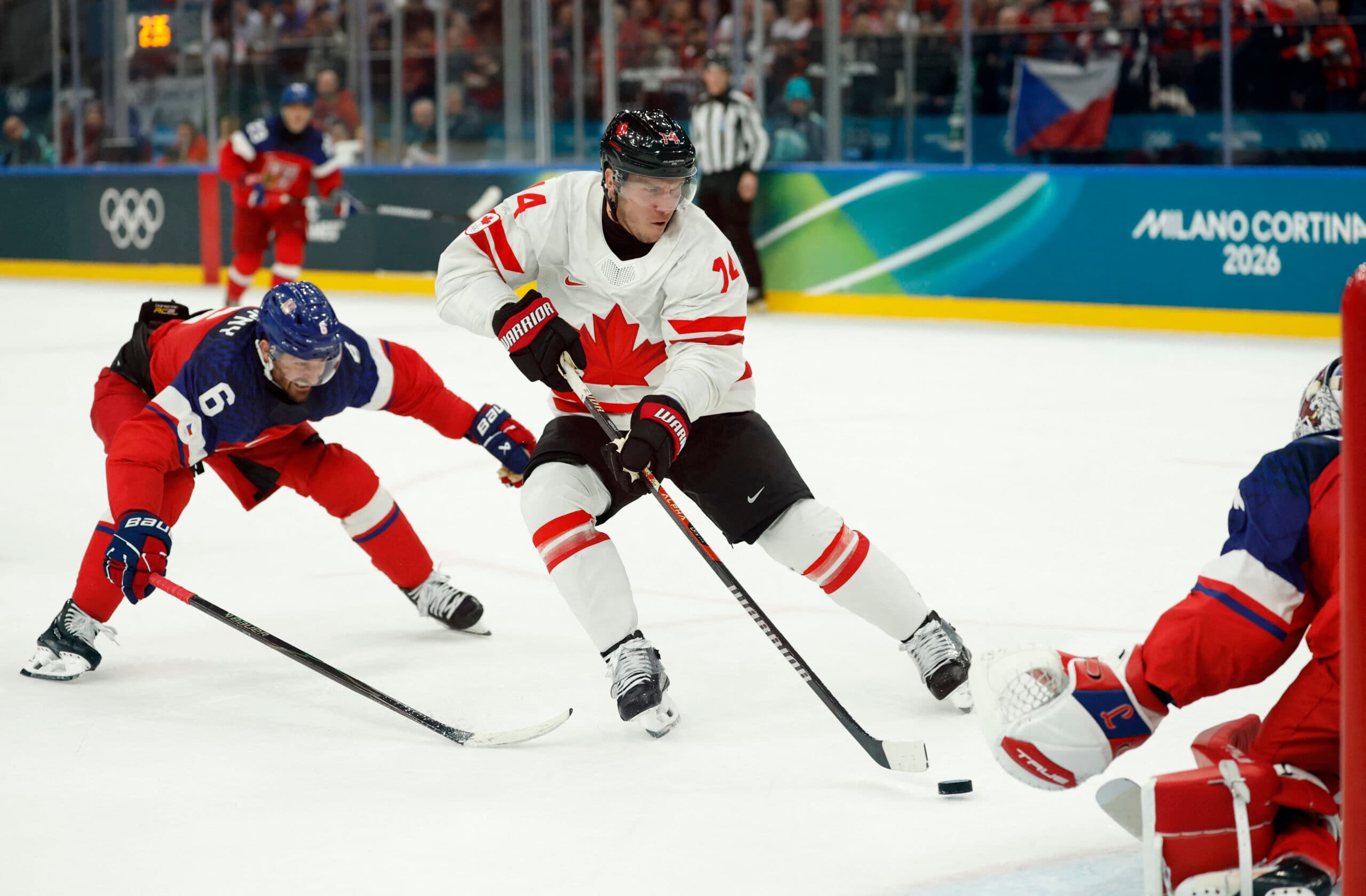
Photo credit: © Geoff Burke-Imagn Images

Feb 14, 2026, 16:00 ESTUpdated: Feb 14, 2026, 15:24 EST
Despite their numerous struggles this season, the Vancouver Canucks have still managed to send an impressive retinue of five players to the Milano-Cortina Winter Olympics to represent their respective countries.
The Canucks have never struggled to have stellar representation on the world stage, and have sent rostered players to every Winter Olympics since the NHL first allowed its players to compete in 1998. Some former and current Canucks Olympians range from undeniably memorable players to ring-of-honour inductees, to “Oh, yeah, that’s definitely a guy who played in Vancouver…probably!” notables.
Active Canucks at the Winter Olympics
1998 – Nagano, Japan
Trevor Linden (Canada), Jyrki Lumme (Finland), Pavel Bure (Russia), Mattias Öhlund (Sweden)
2002 – Salt Lake City, Utah
Ed Jovanovski (Canada), Jarkko Ruutu (Finland), Mattias Öhlund (Sweden), Markus Näslund (Sweden)
2006 – Turin, Italy
Todd Bertuzzi (Canada), Ed Jovanovski (Canada)*, Sami Salo (Finland), Jarkko Ruutu (Finland), Mattias Öhlund (Sweden),
Daniel Sedin (Sweden), Henrik Sedin (Sweden), Markus Näslund (Sweden)*
2010 – Vancouver, B.C.
Roberto Luongo (Canada), Ryan Kesler (USA), Pavol Demitra (Slovakia), Sami Salo (Finland), Christian Ehrhoff (Germany),
Daniel Sedin (Sweden), Henrik Sedin (Sweden)
2014 – Sochi, Russia
Ryan Kesler (USA), Roberto Luongo (Canada), Dan Hamhuis (Canada), Yannick Weber (Switzerland), Raphael Diaz (Switzerland),
Daniel Sedin (Sweden), Henrik Sedin (Sweden)*, Alex Edler (Sweden)
*replaced on the roster due to injury
This year, Elias Pettersson, Filip Hronek, David Kampf, Kevin Lankinen, and Teddy Blueger are representing Sweden, Czechia, Finland, and Latvia, respectively. This does not include Lukas Reichel and Anri Ravinskis, both members of the Abbotsford Canucks, who will also be representing Germany and Latvia. Following the departure of Quinn Hughes at the end of 2025, the Canucks do not have a single player on either Team USA or Team Canada for the first time in 28 years.
This may represent a shift towards more internationally born players being scouted and/or drafted starting at the junior level and beyond, thereby being represented at a higher rate in the overall NHL talent pool. However, it also serves as a reminder of the exodus of talent the Canucks have faced in recent years. Had NHL players been able to participate in the 2022 Beijing Olympics as planned before the schedule constraints brought on by the pandemic forced the league to withdraw, the Canucks would have theoretically sent Olympians J.T. Miller, Quinn Hughes, Elias Pettersson, Bo Horvat, and Oliver Ekman-Larsson – not even including players left off 2026 national team rosters like Thatcher Demko, who were once considered lock-ins.
Ultimately, the Canucks’ past representation at the Winter Olympics and ability to contribute five Olympians in 2026 despite their drawn-out downward spiral begs the question: how many players could they have sent?
Purely hypothetically speaking, in a universe without a roster maximum, hard salary cap, two-way contracts, and players who were not the right fit, how many players could an Canucks alumni Olympic team muster up? Let’s put our alternate history hats on and take a look at the former members of the Canucks organization competing at the 2026 Winter Olympics.
Bo Horvat – Canada
Starting strong with the former Canucks captain – not the last one on this list, either. The 2013 9th overall pick had a memorable nine-season run in Vancouver before he was traded to the New York Islanders ahead of the 2023 deadline. The dynamic centre has since twice surpassed his previous season point total record, which is a tough pill to swallow as the Islanders continue to improve and the Canucks continue to regress.
Horvat was essentially passed on in order to make the cap space available to re-sign J.T. Miller to an extension later that year – now, also, a former Canuck. They say hindsight is 20/20, but even at the time, this was a controversial move made during a flurry of other controversies for the Canucks. Given the haphazard way J.T. Miller was returned to the New York Rangers just two years after Horvat’s departure, it does not necessarily seem like revisionist history to say that letting go of Bo Horvat was a head-scratcher.
Horvat scored a goal in Canada’s 5-0 shutout of Czechia on Wednesday, which marked Horvat’s first-ever point as an Olympian. Not to be mistaken for a rookie on the world stage, however, Horvat has twice worn a Team Canada jersey at the World Championships in 2018 and 2025, and had his sole World Junior Championship appearance in 2014. Safe to say, Horvat is just happy to be there.

Bo Horvat: "I'd fill up water bottles to be here."
Nicklas Jensen – Denmark
The first deep cut on the list, Danish left-winger Nicklas Jensen suited up for 24 Vancouver Canucks games between 2013 and 2015. Jensen was initially selected by the Canucks in the first round at 29th overall in the midst of a successful major junior career with the Oshawa Generals of the OHL. Despite his draft selection and initial hype, Jensen remained primarily an AHL forward during his time in North America, spending most of his time with Vancouver’s affiliate teams. This may go to show that scouting is an imperfect science, but it also reflects how critical the development of prospects can be for the overall health of an organization for years to come.
Jensen was traded to the New York Rangers in 2016, which is generally never a move that bodes well on the prospect development front. Again, he became a fantastic AHL asset, but failed to put up any points in just 7 NHL games. Once Jensen became an unrestricted free agent, he opted to sign with the Finnish team Helsingin Jokerit, who had acquired Jensen’s KHL rights earlier that year – the Jokerit would withdraw from the KHL in response to Russia’s invasion of Ukraine in 2022. Today, Jensen has played with the SC Rapperswil-Jona Lakers of the Swiss League since 2022.
Realistically, Jensen could still perhaps be a bottom-to-middle-six AHL winger. But, for whatever reason, be it intensity, style of play, or personal preference to play in Europe, some players simply never pan out at the NHL level. It’s not a new story by any means, but it looks different for each player. Ultimately, Jensen is a solid piece for the Denmark roster and brings eight years of World Championship experience with him, at that. He put up seven assists in ten games at the 2025 event, helping Denmark land fourth place, their highest finish in the tournament to date.
Marc Michaelis – Germany
Everyone who was around to watch the pandemic-era Canucks should remember noted Vancouver legend Marc Michaelis.
Digging deeper into past Vancouver depth charts, Michaelis is a curious case of incredibly bad timing. Michaelis, an undrafted forward who had cut his teeth in the USHL and as captain of the Minnesota State University team at the NCAA level, signed a one-year league-minimum contract with the Canucks on March 19th, 2020. Which, funnily enough, was just about a week after the World Health Organization declared COVID-19 a global pandemic. Give it up for yet another masterclass from Jim Benning, folks. The signing, not the pandemic, to be clear. Benning may be an unpopular figure in Canucks history, but he is certainly not capable of the levels of evil required to cause a worldwide plague…probably.
One postponed postseason, bubble quarantine hockey, and shortened season later, Michaelis finally made his Canucks debut almost a full year later, in March 2021. This was during the fever dream of a time when the Northern Division existed, and the hockey season was a Groundhog Day-like event of Canadian teams playing each other, over and over again. At the end of it all, restricted free agent Michaelis would not receive a qualifying offer from the Canucks, and would play one more year at the AHL level before returning to Europe. More recently, Michaelis has played for two different teams in the Swiss League and has represented Germany no less than five times at World Championships. Michaelis now plays for Adler Mannheim in the German league, located in his hometown, where he once began his junior career. Everyone got their happy ending in the end – even Jim Benning, somehow.
All in all, Michaelis had zero points through 15 games with the Canucks. Maybe it is not the player that is forgettable, though; rather, it is a hockey season and time in recent world history that many would prefer to forget as a whole.
Artūrs Šilovs – Latvia
This one hurts. Whether it is the feel-good story of a young AHL goalie who carried his team to a first-round win and a seven-game series against a formidable Edmonton Oilers team after both Thatcher Demko and Casey DeSmith were injured, or the recent news that Demko was once again shut down for the season, Šilovs is missed within the Canucks system. This is also partially thanks to his utterly unique personality, Šilovs having the kind of goaltender oddities that can sway fans in an instant. Šilovs had the iconic shirt that made him look like Al Pacino in an 80s flick, famously sported by J.T. Miller to practice, and eventually sold by the Canucks store. There was also the time he was cooling down in the locker room with an ice pack to the head like a netminder’s crown. The man who came to be known as Arty Party had no trouble endearing himself to Canucks fans. The party bus, sadly, had to leave the station eventually.

So JT Miller took to the ice wearing Artur Silov’s dress shirt. It’s a peach/salmon paisley type of thing. Silovs was a little surprised to see it being used as a practice jersey. #canucks

Arturs Silovs just casually hanging out with a bag of ice on his head. chilling.

The Canucks former former 2019 sixth-round pick was traded in the summer of 2025 to the Pittsburgh Penguins for reliable AHLer Chase Stillman and a 2027 fourth-round pick. This came on the heels of his backstopping the Abbotsford Canucks from a historic season to the AHL Calder Cup championship and being named playoff MVP. Šilovs received his 2025 champion ring when the Pittsburgh Penguins were in town earlier this year.
Šilovs is still under 25 and has a ways to go in his development, especially in long-range shots through traffic and in his confidence, but ultimately, he needed to go where he could have a bona fide NHL spot. Between Demko and Lankinen’s contracts, the Canucks could not justify keeping Šilovs on the hook as a third-string netminder when he was ready for major-league action. Little did the Canucks know that they would later be relying on Abbotsford’s Nikita Tolopilo and Jiří Patera alongside Kevin Lankinen for the rest of the year. This is, as the kids would say, a generational bag fumble – and not the only one on this list.
While Šilovs is not starting for his national team – that honour belongs to Elvis Merzļikins of the Columbus Blue Jackets – he has made waves on the international stage previously. Šilovs led Latvia to a surprising upset of Team USA at the World Championship in 2023, securing the bronze medal and earning MVP and All-Star honours. Šilovs is the only player on this list who has played so well at the international level that he was honoured by a national holiday and commemorative artwork in his hometown. Šilovs is already a national hero before even touching Olympic hockey – something he shares with Penguins teammate Sidney Crosby, to be sure. After Latvia was blanked 5-1 by Team USA in the preliminaries on Thursday, with Šilovs starting in net for the third period, they might want to entertain splitting the net in their upcoming games against Germany and Denmark.
Elias Lindholm – Sweden
Elias Lindholm was here for a good time, not a long time. Sort of.
The forward was acquired from the Calgary Flames in 2024 as a deadline rental, with the hopes of playoff success enticing him to possibly sign a team-friendly extension. Spoiler alert: this did not happen.
While the Canucks ultimately fell in round two in seven games against the Oilers, Lindholm shone during the playoffs with 10 points through 13 games. After a fiery debut with Vancouver, he was often relegated to the sidelines due to a lingering wrist injury in his short time with the Canucks in the regular season, so his playoff production was a welcome return to form. He did not work out on the wing as intended and ended up shifting to the centre, which was difficult as the 1C and 2C spots were usually spoken for by Elias Pettersson and J.T. Miller. While Lindholm’s regular-season performance might have been somewhat underwhelming, he showed up when the stakes were high – remember, the division-leading Canucks of 2023-24 were guaranteed to make the playoffs before Lindholm even came on the scene. What a time that was.
Following Vancouver’s postseason exit, it quickly became clear that Lindholm would not be shopping for Vancouver property any time soon, as he reportedly turned down a $50-million-dollar seven-year deal. That would at least cover a 500 square foot studio apartment in Coal Harbour and a nice, sensible Toyota Prius, right?
Ultimately, Lindholm would sign a seven-year deal with the Boston Bruins worth $7.75 million a year. He has struggled to produce at his previous pace since, but seems to be recovering this season, with 37 points through 44 games thus far. Last year, he had just 47 through 82 games.
Lindholm was lucky his short pit-stop in Vancouver came during the one shining year for the franchise that stands out amongst consecutive years of mediocrity and organizational mess. Despite an attempt to retain his services, Lindholm would be a fitting replacement down the middle for an injury-plagued Filip Chytil today, but an overpaid one. With the Canucks now entering full rebuild-mode, Lindholm would already be long gone from the team or, at the very least, the next out the door in return for assets.
Oliver Ekman-Larsson – Sweden
Oliver Ekman-Larsson is the Canucks story that keeps on giving, especially considering the team will still be paying him until 2031, which is apparently a real year that exists.
The icon known as OEL was initially acquired as a piece in the same deal that also saw Conor Garland arrive in Vancouver via the Arizona Coyotes (RIP). The Coyotes captain at the time, he had a storied career in Arizona ever since they selected him sixth overall in 2009. Since leaving the Canucks in the 2023 offseason – more on this shortly – Ekman-Larsson has reclaimed his former glory, won a Stanley Cup with the Florida Panthers, and established himself as a core defensive piece and potential trade target on the Toronto Maple Leafs. So, how did a defenceman labelled as hopeless by the Pacific Division establish himself as an Atlantic Division mainstay?
That’s a great question. In June of 2023, OEL was bought out by Canucks management after a beleaguered handful of years in Vancouver. The Coyotes had initially retained 12% of his salary, which left $29 million remaining to be paid over four years. The buyout allowed for a total OEL payout of $19,333,333 over eight years – hence why Ekman-Larsson is technically on the Canucks books until the kids from Stranger Things retire. This dead cap space currently amounts to just about 5% of the team’s total cap space, which is small potatoes for a rebuilding team. The point being, however, is that the Canucks were not really rebuilding at the time of Ekman-Larsson’s buyout, but rebranding with a new coach, newer management, and a new captain. Two-and-a-half years later, it makes more sense.
Despite the headline-grabbing buyout fiasco, it was the right move for all involved. Ekman-Larsson has improved, yes, but he would not have improved in Vancouver. Keeping him on retainer would have significantly affected the team’s ability to re-sign pending free agents without much return from the single defenceman. Vancouver moved a bad contract, and OEL found success again, which surely landed him his current spot on Sweden’s Olympic roster. The Swede previously earned a silver medal at the 2014 Sochi Olympics, served as Sweden’s captain at the 2019 World Championship, and has seven medals in eleven international competition appearances. Although Ekman-Larsson did not take a shift in Sweden’s 5-2 win over Italy, he did finally see some ice time in Friday’s 4-1 loss to regional rival, Finland.
Jacob Markström – Sweden
Jacob Markström is the second “goaltender who got away” on this list. At 36, the New Jersey Devils netminder is now in the final years of his career, but it is still worth taking a trip down memory lane to recall how he got there.
Markström began his NHL career as a second-round 2008 draft pick, selected by the Florida Panthers. He found his way to Vancouver in a multi-piece 2014 trade, which mostly saw him exchanged for Roberto Luongo. At first, Markström was a young goalie finding his footing with the backup job, but soon became Vancouver’s number one choice between the pipes after some intense work over the years with Ian Clark.
Markström has always been a streaky goaltender, but during his good seasons, he was remarkable. His departure to the Calgary Flames during free agency in 2020, despite a handful of solid Canucks seasons under his belt, happened because the Canucks made it clear that they were choosing to invest in Thatcher Demko. While Markström can be inconsistent, and is extended through to 2028 at $6 million dollars on the cap, it might just beat paying Thatcher Demko $8.5 million dollars a year for the next three years for him to play less than half of a season. Demko is six years younger but has missed far more time due to injuries, enough so that he was overlooked on the USA roster far before he was shut down for the rest of the season.
Hindsight is always 2020, though, right?
Despite initial reports, Markström didn’t start in either of Sweden’s two preliminary games, with Filip Gustavsson getting the nod. Markström did start on Saturday against Slovakia though, leading his country to a 5-3 win heading into the qualifying round.
Pius Suter – Switzerland
Pius Suter is the exact kind of affordable centre depth that the Canucks have needed this season. It is a shame that he left last offseason, though.
‘Affordable’ is subjective, of course, and Suter signed a two-year contract with the St. Louis Blues with an annual cap hit of $4,125,000. The Swiss forward has a Cinderella story for the ages, initially going undrafted in the NHL. Despite camp invites by the Ottawa Senators and New York Islanders, Suter did not make an NHL roster and pursued his professional career with the Swiss League – where he would eventually win a league championship with the ZSC Lions. When Suter finally landed an NHL contract with the Chicago Blackhawks, his debut was delayed due to the pandemic, and Suter again returned to Switzerland. He would spend time with the Detroit Red Wings before landing a sensible two-year deal with Vancouver in 2023.
Suter had his career year last year, putting up 46 points, and pricing himself right out of Vancouver. This dynamic and defensively responsible centre’s sudden offensive burst was a wonderful time for Suter, less so for the Canucks attempting to re-sign him. His elite penalty killing and under-30 status made him a shiny asset to teams.
Suter might have one of the more interesting and international resumes on this list, especially for a 29-year-old undrafted player. With six seasons of European professional play before he eventually broke into the NHL, Suter was uniquely positioned for international play while the NHL were not permitted to participate in the Olympics. Despite ultimately coming in 10th place, Suter scored a hat trick on Team Switzerland at the 2018 South Korea Olympics, against the host country. In 2025, Switzerland is up against some competitive international teams – although he did manage to put up Switzerland’s lone goal against a dominant Canadian team on Friday.
HOCKEY M 🏒 La Suisse s’inscrit au pointage en avantage numérique. Le but a été marqué par Pius Suter. C'est 2-1 pour le Canada. @HockeyCanada @LNH_FR #MilanoCortina2026 #rcsports #jeuxolympiques #hockey #EquipeCanada #TeamCanada
J.T. Miller – USA
J.T. Miller left a profoundly complex and contradictory legacy behind in Vancouver, a legacy still trying to be understood a full year after his departure.
From his memorable offensive breakouts, at times lacking backcheck, and troublesome attitude that eventually saw his feud with Elias Pettersson reach the point of no return, Miller definitely will not be forgotten in Vancouver any time soon – whether he is loved by fans, hated, or met with mixed feelings. The final straw that saw the top-line centre traded to the New York Rangers in February 2025 is still unknown. At this point, the slow collapse of the 2020s Canucks is information that will only be revealed in a tell-all book decades from now.
The Rangers originally drafted Miller 15th overall in 2011, where he stayed until 2018, when the Rangers began a rebuild and an impending fire sale of assets. Miller landed with the Tampa Bay Lightning for a time before landing with the Canucks in 2019. It is only fitting that, now, all these years later, Miller is the captain of the original six franchise, who have now begun yet another ‘retool.’ Given the contentious history between the Canucks and Rangers, it feels unsettling for both teams to be reaching rock bottom alongside each other.
There was a lot to love about J.T. Miller as a Canuck, but for some, the bad taste in their mouths continues to linger. Miller’s leadership style on a floundering Rangers team has been questioned, as has his spot on Team USA, after Miller was selected in favour of younger forwards such as Jason Robertson and Cole Caufield.
But perhaps Miller could surprise everyone yet. In the USA’s defeat of Latvia, Miller factored in on a goal from former teammate Quinn Hughes, which was called back, and was then called for goaltender interference on yet another goal. It would be unfortunate if Miller’s snakebitten season followed him to the world stage – although clearly, it hasn’t held back Team USA as a whole. Miller previously has a gold World Junior Championship medal to his name and a runner-up finish at last year’s 4 Nations Face-Off, but this marks the most high-stakes international appearance for Miller yet.
Quinn Hughes – USA
They say you save the best for last – best player on the list, most definitely, but worst player-team break-up on the list? It’s a contender, close to Horvat or Miller, at least.
This is the most recent former Canuck at the Olympics, which makes objectivity difficult to muster – Canucks fans went into this season certain that Hughes would finally get to shine on the world stage after he missed last year’s 4 Nations Face-Off due to injury. This promptly led Bill Guerin, general manager of the USA 4 Nations team, the Olympic team, and the Minnesota Wild to say “Hold my beer.”
In just one calendar year, the Canucks went from possessing two Team USA stars to zero. J.T. Miller has struggled to perform, and that is putting it nicely. At least Hughes has fared far better than Miller since he arrived in the state of hockey.

i've been awake since 5:30 am and this photo of quinn hughes is the funniest thing on earth to me right now

Now, Hughes gets to play international hockey for the first time in nearly seven years, his last appearance with Team USA being at the 2019 World Championship. Hughes previously earned bronze medals in the 2018 World Junior and World Championships, silver at the 2019 World Juniors, and gold at the 2017 IIHF U18 competition – all accomplishments that came before he even made a real impact on the Canucks. In the USA’s initial game against Latvia, Hughes put up two assists, both on power play goals, and also almost scored, with the goal called back on an offside call.
Quinn Hughes is the kind of player a franchise and fans alike picture an entire future around, and that future has the potential to crumble like cheesecake crust if the franchise fails to execute that vision. Quinn Hughes did not want to be a Canuck anymore, and given the last few years, it is difficult to levy all the blame onto him alone. The Canucks invested in Quinn Hughes to a point, insofar as naming the then-23-year-old captain, and retaining him on a comparatively modest contract. They failed to do much else, but perhaps Hughes realized he was not cut out to steady the rocky ship of the current Canucks – or waste the prime years of his career on a losing team. That is the ugly truth of it, at the end of the day.
That’s the thing about the chosen ones – they rarely get the option to choose, and when they do, they might not choose you back. But Canucks fans will not soon forget that Hughes began his career in Vancouver, nor will they forget that while Hughes proudly represents Team USA, his talents were shaped on Canadian ice during his childhood.
Sponsored by bet365


Breaking News
- The Stanchies: Despite growing pains on defence, Canucks battle valiantly in 3-2 loss to Islanders
- Instant Reaction: Leevi Meriläinen stands out in Canucks’ 3-2 loss to Islanders
- NHL Notebook: Bedard returns for Chicago, and is Rick Tocchet on the hot seat?
- Demotion to third defensive pair for Canucks’ Buium ‘not a step backward’ according to Malhotra
- Scenes from morning skate: Canucks shake up D pairs and power play units vs. Islanders

Vancouver CanucksTeam Cap Summary

Cap Summary
2026-27
2027-28
Projected Cap Hit
$88,074,947
$71,329,167
Projected Cap Space
$15,925,053
$42,170,833
Current Cap Space
$17,163,668
$42,170,833
Active Players
23/23
13/23
Draft Picks
Round
'27
'28
1
1
1
2
2
2
3
1
1