
CanucksArmy has no direct affiliation to the Vancouver Canucks, Canucks Sports & Entertainment, NHL, or NHLPA
Canucks: Why Elias Pettersson is benefitting from playing under Manny Malhotra
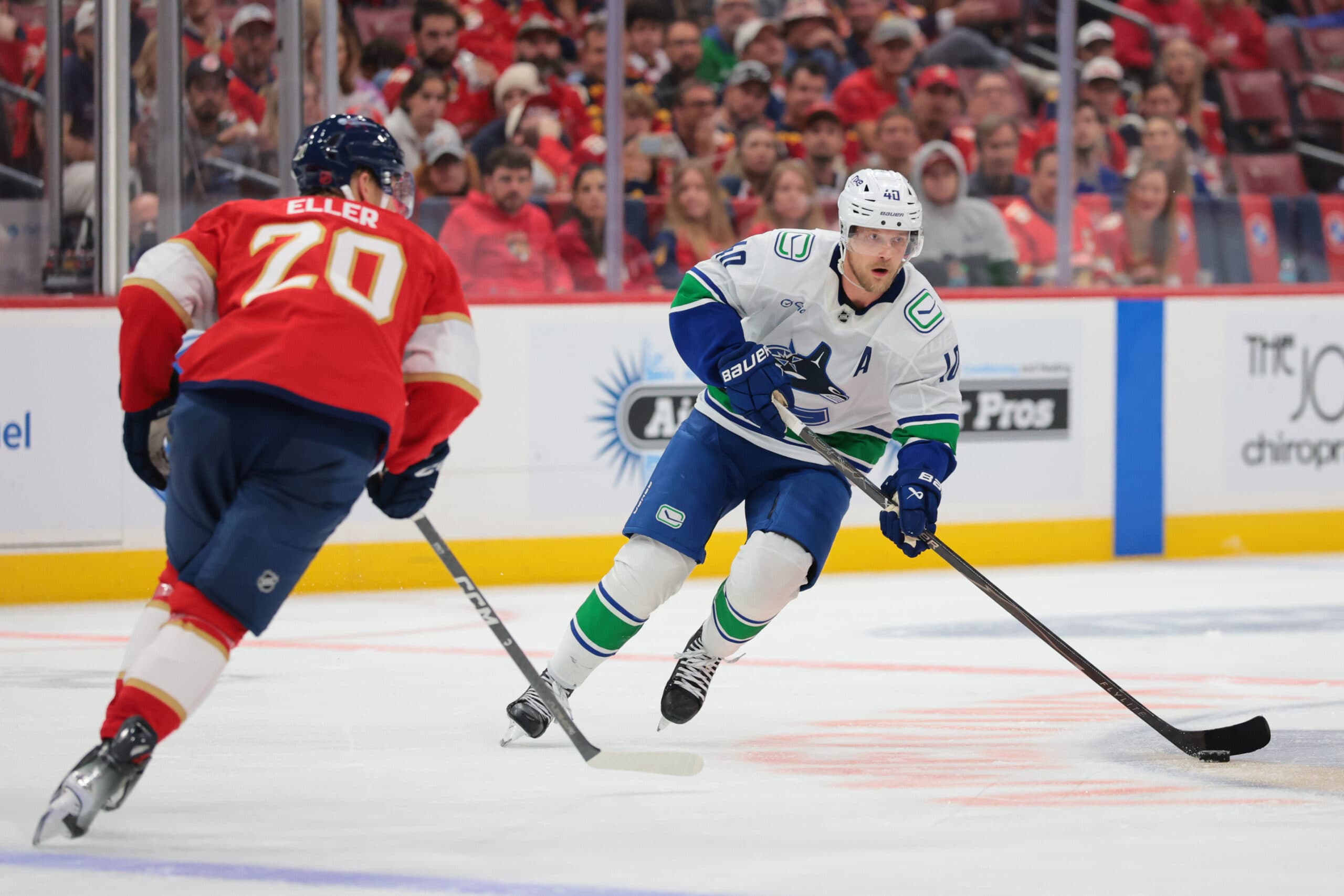
Photo credit: Sam Navarro-Imagn Images

Oct 19, 2026, 13:30 EDTUpdated: Oct 19, 2026, 12:29 EDT


The Vancouver Canucks have eclipsed the ten-game mark in the 2026-27 season. Like all rebuilding teams, the Canucks are taking their lumps, having just completed a six-game road trip that left them winless.
Despite the pain, the Canucks have had their fair share of positive stories, too. One of the bigger ones has been Elias Pettersson’s play at centre. Over the past two seasons, Pettersson has posted his worst production in his career, with 45 and 51 points in 2024-25 and 2025-26, respectively.
A combination of factors, including tough deployment, poor offensive structure, injuries, and a painfully obvious lack of confidence, created an environment that saw the $11.6M centre turn from a 35-goal, 90-point player who also happened to be top-ten in Selke Trophy voting to one who struggled to put up 15 goals and 50 points.
From behind the bench, new Head Coach Manny Malhotra has implemented an offensive structure that has the team playing a heavier brand of possession-style hockey, focusing on playmaking into the interior, winning battles along the boards, and fighting through contact to create medium- and high-danger chances around the low slot and net-front areas.
Ranking top 3 in puck battles won and top 20 in hits while also scoring at a point-per-game rate, Malhotra and the Canucks have seen great early-season returns regarding Pettersson.
Here are three examples from the recent road trip of the Canucks’ new tactics under Malhotra greatly benefiting Pettersson.
DeBrusk scores against the Rangers
Good things happen when EP40 is dialled in. Wins the faceoff against JT, then he and Lekkerimäki win the board battle and get the puck right to DeBrusk. #Canucks
— Lachlan Irvine (@lachinthecrease.com) 2026-10-11T22:42:38.386Z
Five-on-five goals were tough to come by during the Canucks’ road trip. Under Manny Malhotra, the Canucks’ offensive zone cycle sees the three forwards overload low. This system gives forwards ample support. As a result, the Canucks can create manpower advantages in small areas of the offensive zone. In a puck battle, this also lets the Canucks seal off multiple options, funnelling the opponent into a certain area of the ice before pouncing and countering.
On DeBrusk’s 1-1 goal against the New York Rangers, Elias Pettersson wins a faceoff against JT Miller, then wins a race to the slot and deflects a puck on net. Chasing the puck to the far wall, Pettersson takes on Adam Fox before Miller strips the puck from him along the goal line. Jonathan Lekkerimäki pinches Miller along the wall; Pettersson seals Miller and the puck off from the strong-side boards before switching his body positioning. Pettersson also uses his stick to fend off Fox’s attempts to move the puck from the pile.
With the strong-side and weak-side plays sealed, Miller tries to move the puck off the wall, and Lekkerimäki pounces, frees the puck, and passes to Jake DeBrusk, who wires it past Dylan Garand. Lekkerimäki and DeBrusk’s predictable positioning and actions let Pettersson attack the puck with confidence. He seals off the wall well and forces Miller into an ill-advised play that leads to a goal. Pettersson ranks second in the NHL in puck battles won amongst forwards and has been a dog on a bone all season.
While Pettersson doesn’t get an assist on this play, it shows how he can maximize his output in a structured environment, even if he doesn’t pick up a point on every goal.
Last season, Pettersson and the Canucks struggled to seal off the boards, which kept the team from moving pucks off the wall and into the middle of the ice. By keeping the puck along the boards, the Canucks can wear down the opponent physically and mentally, creating longer windows of opportunity for Pettersson to exploit gaps. Pettersson’s intelligence not only helps create this goal for DeBrusk, but his confidence in taking and holding the puck while being double-teamed helps create the chance in the first place. By drawing Fox’s attention as he tries to go down the wall, he frees up DeBrusk, who can gain inside positioning on the Rangers’ defence, giving him just enough space to get the loose puck and wire it home.
It’s an example of how mastering the “little things” can directly impact a goal.
DeBrusk’s first goal vs. Carolina
Vancouver goal!Scored by Jake DeBrusk with 15:57 left in the 2nd. Assisted by Jonathan Lekkerimäki and Elias Pettersson.CAR: 4 | VAN: 1#VANvsCAR #CarolinaCulture #Canucks
— NHL Goals (@nhlgoals.bsky.social) 2026-10-09T00:14:57.052730Z
The Canucks’ rush offence has been a mixed bag so far, but Pettersson has shown he can generate chances as the high man and switch between the low-and-high cycles. When Pettersson gets the puck from DeBrusk, he maximizes his time and space, letting DeBrusk attack behind the defence while overloading the strong side of the ice and stretching the Carolina Hurricanes’ defence.
With Ehlers back on DeBrusk, Pettersson draws Hurricanes defenceman Jaccob Slavin up to the wall, and with no Hurricanes in the middle, he feathers a pass into space for Lekkerimäki, generating a rebound for DeBrusk, who deposits it behind goalie Pyotr Kochenkov. By creating two-on-ones in tight areas, Pettersson scans defences and makes plays in and out of coverage, and once DeBrusk beats Ehlers off the wall, the Canucks strike. With a pass followed by a shot on goal, the Canucks bypassed both two-on-ones low and capitalized.
While Lekkerimäki gets the primary assist, Pettersson’s initial pass at the blue line, his half-wall positioning, and the pass itself laid the foundation for the goal. Pettersson’s offensive game has always centred on efficiency. Pettersson focuses on breaking the structure and generating extremely high-danger chances. By being predictable in his positioning, he becomes a better passing option for DeBrusk and gives himself more time to scan the ice and make the highest-danger play possible.
While Lekkerimäki gets the primary assist, Pettersson’s initial pass at the blue line, his half-wall positioning, and the pass itself laid the foundation for the goal. Pettersson’s offensive game has always centred on efficiency. Pettersson focuses on breaking the structure and generating extremely high-danger chances. By being predictable in his positioning, he becomes a better passing option for DeBrusk and gives himself more time to scan the ice and make the highest-danger play possible.
Last season, the Canucks often reloaded the puck up high, looking for the Canucks to create havoc in front of opposing netminders before pouncing on any loose pucks around the net. Getting to the slot was difficult for the club; as NHL defensive schemes evolve, offences are forced to attack the space that is available. Under previous head coaches, Pettersson would have taken DeBrusk’s pass and delayed until a point man opened up. After making a pass, Pettersson would have crashed the slot, looking for a rebound or deflection in front.
Malhotra, however, wants players to play to their strengths within the club identity, rather than forcing them to change to fit it. Pettersson excels when he can create controlled chances with direct passes, so once the middle of the ice opens up, he has the confidence in himself to attempt a play into a high-danger area without consequence. As the season progresses, Pettersson should make quicker, more instinctual decisions with the puck, which should lead to more chances for him and his linemates.
DeBrusk’s second goal vs. Carolina
The most encouraging element of this goal is Lekkerimäki's work to protect the puck. That's an element he needed to improve. #Canucks
— Daniel Wagner (@passittobulis.bsky.social) 2026-10-09T01:20:31.617Z
An underrated part of Elias Pettersson’s game is his cheekiness and creativity. As the season has gone on, Pettersson has expanded his offensive toolset. Stickhandling in a phone booth, attacking laterally, and making indirect plays are just a few examples of skills that have returned to Pettersson after a two-year absence. It may be the biggest indicator of Pettersson’s returning confidence, and it has already led directly to goals.
In the Canucks’ low cycle, they use an overload. Their high-cycle, however, sees them work a 2-3 up high. With two players on the flank and a true quarterback, the Canucks stretch their opponents by putting two forwards close to the net. On this goal, Pettersson plays the primary net-front forward, while DeBrusk swings across the low slot. As the puck cycles up high, Pettersson reads the play early, getting behind K’Andre Miller just as Zeev Buium makes a bank pass off the end wall. With DeBrusk swinging behind the net and Lekkerimäki crashing the slot, Pettersson chips a pass into the low slot, where DeBrusk beats Mark Jankowski to the puck and puts it past Kochetkov for his second goal of the game.
Pettersson’s willingness to try these cheeky, unorthodox tactics marks a major shift in both Pettersson and the team’s overall thinking. Under Adam Foote and Rick Tocchet, the Canucks would likely have reloaded the puck up high after the attempted bank pass or moved it to the net to create an offensive-zone faceoff. Under the two previous head coaches, the offensive process was a bit more straightforward. With north-south attacking prioritized, Pettersson was forced to play a more basic, cookie-cutter style to fit the team’s identity.
For some superstars who focus on power and speed, like the JT Millers of the world, playing that way can exacerbate those traits, but for players who rely on intelligence and finesse, not only do they need to be given more freedom to work the puck east-west, but they need to be given clear instructions on when it is and isn’t appropriate to break the team’s structure to create scoring chances. Under Manny Malhotra, Pettersson and the Canucks have more opportunities to break structure and create with the puck, which helps the players play looser and with more confidence.
Despite drawing some of the hardest possible deployment and being dominated in the shot share this season, Pettersson is first in xGF% on the Canucks, largely due to his ability to generate the highest danger chances possible. With a modern yet tight offensive structure to rely on and read off, Pettersson has scanned defences, spotted more opportunities to break the structure, and generated offence.
While Pettersson has also produced quite a bit on the man advantage, he is on pace for twice as many medium-danger chances and slightly more high-danger chances than last year. If Pettersson can convert on the higher-quality chances he gets while DeBrusk and Lekkerimäki start converting on their own high-danger chances, Pettersson should see a notable uptick in five-on-five production.
While Pettersson has also produced quite a bit on the man advantage, he is on pace for twice as many medium-danger chances and slightly more high-danger chances than last year. If Pettersson can convert on the higher-quality chances he gets while DeBrusk and Lekkerimäki start converting on their own high-danger chances, Pettersson should see a notable uptick in five-on-five production.
It’s only a ten-game sample, but Elias Pettersson’s performance has been one of Vancouver’s brightest stories this season. With Manny Malhotra behind the bench, Pettersson has thrived in a more structured and positive offensive environment. If this continues, it could mark the start of a new, prosperous chapter in EP40’s career.
Sponsored by bet365


Breaking News
- Canucks: Why Elias Pettersson is benefitting from playing under Manny Malhotra
- 3 Canucks Stars of the Week: Pettersson and Willander stand out on the blue line
- JPat’s Monday Canucks Mailbag: Why is Brock Boeser playing so much on a rebuilding team?
- 10 statistics that stand out from the first 10 Canucks games
- Could the Vancouver Canucks and Ottawa Senators hook up on an in-season forward trade?

Vancouver CanucksTeam Cap Summary

Cap Summary
2026-27
2027-28
Projected Cap Hit
$87,295,050
$71,329,167
Projected Cap Space
$16,704,950
$42,170,833
Current Cap Space
$18,518,630
$42,170,833
Active Players
23/23
13/23
Draft Picks
Round
'27
'28
1
1
1
2
2
2
3
1
1