
CanucksArmy has no direct affiliation to the Vancouver Canucks, Canucks Sports & Entertainment, NHL, or NHLPA
As the Canucks attempt to close trades in 2025-26, they’ll have to navigate extra roster freezes and deadlines
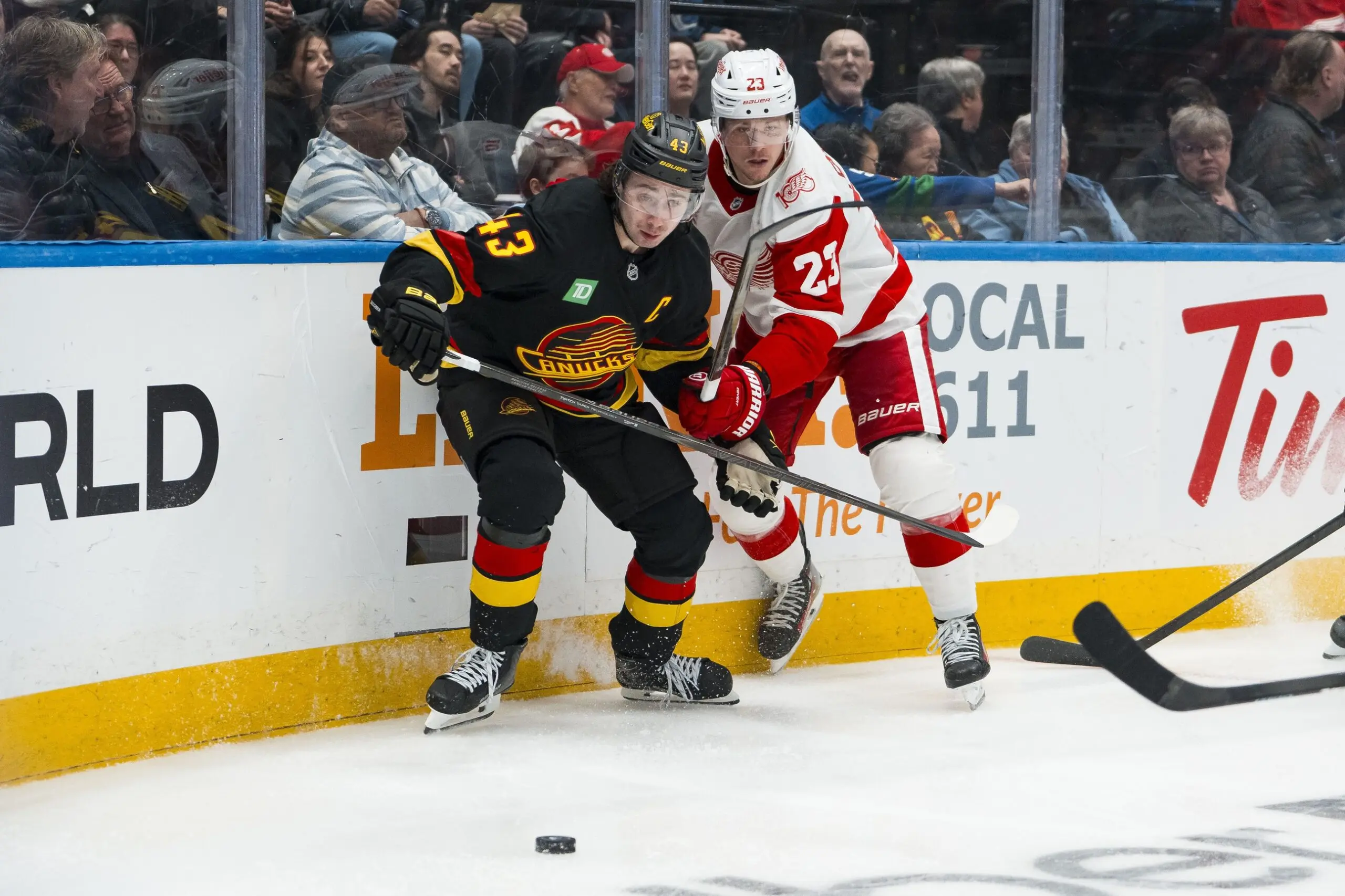
Photo credit: © Bob Frid-Imagn Images

Dec 10, 2025, 10:00 ESTUpdated: Dec 10, 2025, 01:35 EST


The 2025-26 season has been a big one for trade rumours, particularly as far as the Vancouver Canucks are concerned, but a slow one for actual trades.
Since the regular season began in October, there’s been exactly one trade involving a full-time NHLer, with that being the Canucks’ own acquisition of Lukas Reichel on October 24 – and we’re probably being a bit generous with “full-time NHLer” there. Other than that, it’s been a handful of minor league transactions and a whole lot of whispers, insinuations, and speculation.
But, if virtually anyone with an opinion on the matter is to be believed, those trades are coming, and perhaps sooner rather than later. In fact, the timing of impending trades is something worth digging into a bit, because the 2025-26 season is going to be a little trickier on that front than most.
We are, as of this writing, about 10 days away from the standard NHL roster freeze. That’s something that happens every year, and teams are not allowed to conduct any trades, signings, or reassignments during that time.
This year, the holiday roster freeze takes effect at 11:59 PM local time on December 19 and lasts until 12:01 AM on December 28.
So, if the Canucks are hoping to get any deals done before the calendar flips to 2026, they’re really running on borrowed time. Otherwise, Vancouver fans are going to have to sit on this expectation throughout the entire holiday season.
Even after the holiday roster freeze is lifted, however, the Canucks are going to be operating within a limited timeframe. That’s because there’s another, even longer roster freeze coming this year, and it’s going to span the entirety of the Olympic break.
The Olympic roster freeze will work much like the annual holiday freeze, except this one will run from February 4 through February 22, nearly the entire month of February. Once again, no transactions of any kind will be happening during that time.
And then, after that, it’s on to the regular ol’ NHL Trade Deadline. This season, that’s scheduled for March 6, 2026, at 12:00 PM PST. That’s just 12 days after the Olympic roster freeze. That’s not a lot of time within which to operate.
So, on the one hand, one could look at the deadline as being about three months away and reckon that the Canucks have plenty of time on their hand, but that would be a bit misleading. It’s more accurate to say that the Canucks are going to have three windows of varying sizes within which they can make some trades. They have between now and December 19 (10 days or so, depending on when you read this), then between December 28 and February 4 (37 days), and then between February 22 and March 6 (12 days).
That’s still plenty of opportunity to make a trade, but it’s a more limited opportunity than teams normally get, and that’s potentially impactful in a season in which the Canucks hope to make some deals that will alter the future of their franchise for the better.
Which is sort of par for the course in this excessively complicated 2025-26 regular season, what with its already-condensed schedule and its preponderance of fresh rules brought on by the newest CBA.
Another example of that comes from the new rules on retention. Previously, double-retention deals were common: a team would trade a player at 50% retention to a middleman team, who would then retain a further 50% on that player before sending them to their final destination, for a grand total of 75% retention. Such trades happened every deadline. But now, there’s a mandatory 75-day wait between retentions on the same contract, which means, if anyone is going to be traded with double-retention this year, that first transaction has to come at least 75 days prior to the Trade Deadline.
This year, ’75 days prior to the Trade Deadline’ equates to December 21, which falls within that holiday roster freeze. So, any planned double-retention transaction must be completed before December 19, or it will be too late.
There was some talk of the Canucks acquiring someone at some point soon, with retention, and then flipping them for a profit nearer the deadline. If that’s something they’re going to do, they’ve got about 10 days to get that done.
That seems unlikely at this point. But even just regular, retention-free trades will have to be negotiated within a tighter series of windows than ever, and that presents an extra layer of difficulty on an already complex situation.
We don’t want to get too into the apocalyptic scenarios here, but it’s hard not to find more layers and wrinkles the longer one looks at this. The fact that the second roster freeze runs concurrently with the Olympics is definitely a factor worth considering.
Say, for example, that the Canucks do decide to trade captain Quinn Hughes before the Trade Deadline. Then, say that the trade hasn’t happened yet by the Olympic roster freeze, and then imagine that Hughes gets injured while participating in the Olympics.
All of a sudden, the Canucks would have to figure out the complicated nature of trading an injured player, probably start receiving lesser offers as a result, and would still have to close out that deal within a span of 12 days. That does not sound easy.
In many ways, though, this feels like just standard Canuck luck in a year already full of it. Of course, the season in which they’re going to start selling off pieces coincides with the most restrictive trading schedule. That’s just the way these things tend to go.
Fortunately, as far as Canuck luck goes, this is pretty light. The condensed and interrupted schedule might make trading more difficult, but it doesn’t make it impossible. And added difficulty, particularly when it comes to the NHL’s rules and regulations, is something this franchise and its fans are all too familiar with.
Sponsored by bet365


Breaking News
- The Statsies: Canucks dominated at 5v5 in 4-2 loss to Lightning
- The Stanchies: Prime Lankinen returns, Canucks still go winless on road trip with 4-2 loss to Lightning
- Instant Reaction: Canucks give up four unanswered goals in 4-2 loss to Lightning
- Canucks: D Elias Pettersson’s impressive start is more than just passing the eye test
- What’s behind Marco Rossi’s seven-game scoring drought for the Canucks?

Vancouver CanucksTeam Cap Summary

Cap Summary
2026-27
2027-28
Projected Cap Hit
$87,295,050
$71,329,167
Projected Cap Space
$16,704,950
$42,170,833
Current Cap Space
$18,413,411
$42,170,833
Active Players
23/23
13/23
Draft Picks
Round
'27
'28
1
1
1
2
2
2
3
1
1