
CanucksArmy has no direct affiliation to the Vancouver Canucks, Canucks Sports & Entertainment, NHL, or NHLPA
Wagner’s Weekly: Is Canucks’ Jim Rutherford pulling off a stealth tank?
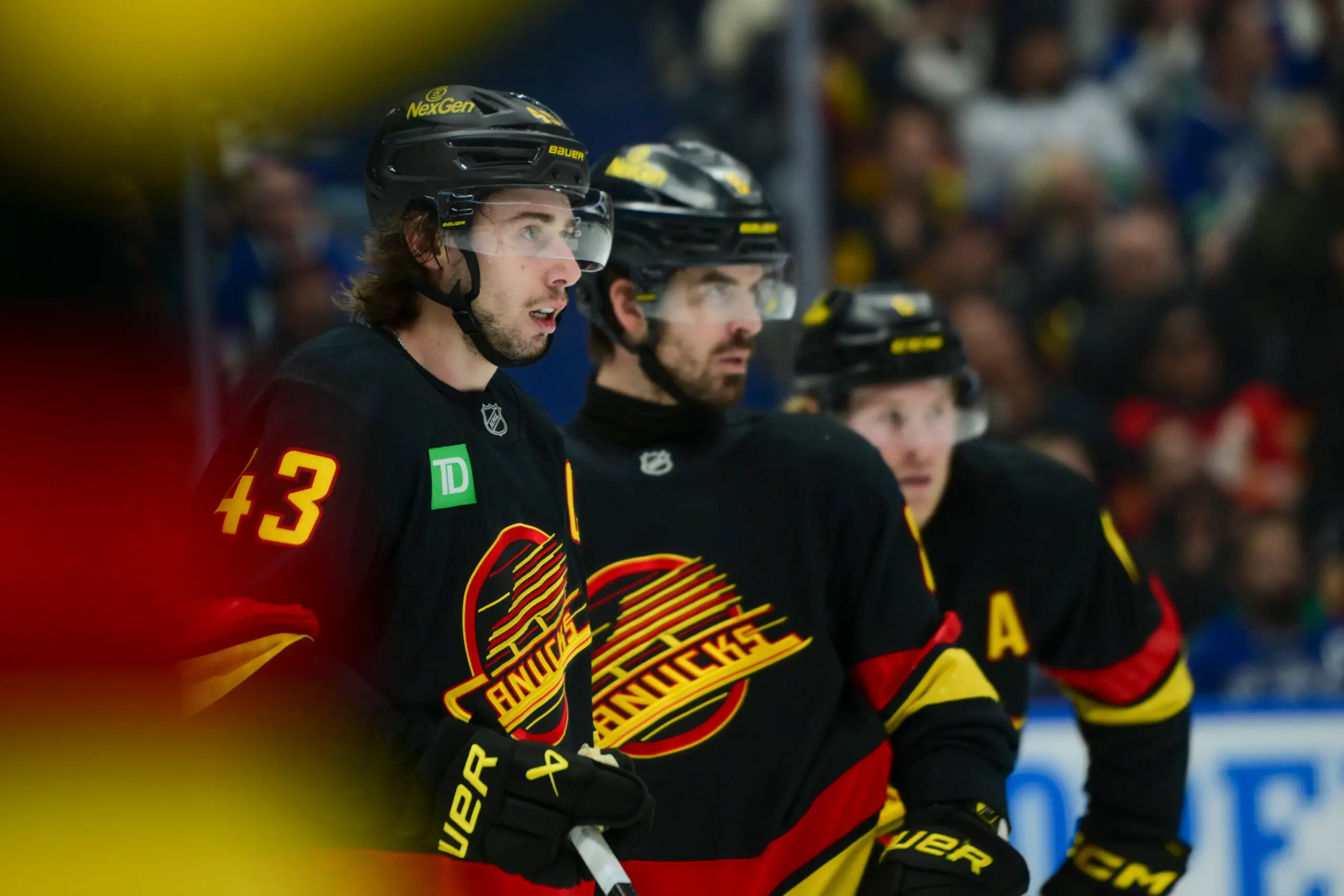
Photo credit: © Simon Fearn-Imagn Images

Dec 7, 2025, 14:53 EST


Despite an against-all-odds win against the Minnesota Wild on Saturday night, the Vancouver Canucks are still in dire straits.
They’re 31st in the NHL standings, have some of the worst underlying statistics in the league, trade rumours are surrounding their captain, and, pending an MRI, they might be adding Elias Pettersson to their list of injured players just when they might be getting a couple of players back.
When things get this bad, sometimes all you can do is cope. After all, this is Christmas: the season of perpetual cope.
So, here’s some premium-grade, uncut copium for you: what if none of this was by accident?
What if all of this is a masterful strategem by a veteran hockey man, Jim Rutherford, and his aide-de-camp, Patrik Allvin, to sneak a rebuild past an owner who has steadfastly refused to rebuild in the past?
Stick with me, here.
Canucks ownership has resisted rebuilding at every turn
The simple truth is that Canucks ownership has no stomach for a rebuild, even if the Canucks’ refusal to rebuild has led to missing the Stanley Cup Playoffs as much, if not more, than if they had committed to a rebuild years ago.
Anyone who argues for a rebuild doesn’t last long in the Canucks’ organization.
Mike Gillis argued for a rebuild back in 2013, but was told by ownership that it wasn’t going to happen. He and his scouting staff made plans for a rebuild anyway, with the Cory Schneider trade and drafting of Bo Horvat intended to be the first step.
Gillis then argued more firmly for a rebuild after a disastrous 2013-14 season, with plans to trade Ryan Kesler and Alex Burrows to the Philadelphia Flyers in a pair of deals that would have netted the Canucks three first-round picks.
Gillis was subsequently fired.
When the Canucks were undergoing their quasi-but-not-really-rebuild under general manager Jim Benning, president of hockey operations Trevor Linden made a case for a slower, steadier rebuild. Benning argued that the team could turn things around more quickly.
Linden was subsequently fired — or, rather, there was an “amicable” parting of ways.
So, let’s say that Rutherford and Allvin took a cold, hard look at their team and came to a difficult conclusion: they need to rebuild. How do you express that to your boss, the owner of the team, without also getting fired?
Well, maybe you don’t tell him; you show him.
The Canucks’ offseason was not the offseason of a contending team
Rutherford and Allvin certainly spoke in public like the management of a team with playoff aspirations, but let’s ignore what they’ve said in favour of what they actually did.
They talked about the need to acquire a top-six centre, but then they let Pius Suter walk and didn’t acquire a top-six centre.
The Canucks chose to instead go into the season counting on Filip Chytil to stay healthy, a longshot bet that, unfortunately for Chytil and the Canucks, didn’t pay off. Even if it did, Chytil has yet to prove he can actually be a second-line centre even when he is healthy.
Instead of getting a centre, the Canucks’ big offseason acquisition was a 34-year-old winger, Evander Kane, who didn’t even play in the regular season last year because he was recovering from multiple surgeries.
One could argue that Kane isn’t exactly the type of player you acquire in order to make the Stanley Cup Playoffs, but might be one that a team already playoff-bound would give up a draft pick for at the trade deadline to help them in the playoffs.
It helps that the Canucks’ ownership group was, let’s just say, not opposed to acquiring Evander Kane.
The Canucks acquired no one else of note in the offseason — just a couple of depth pieces. Does that really sound like a team pulling out all the stops to push back to the playoffs and prove to Quinn Hughes that they can build a Cup contender around him?
Then there’s the head coaching hire.
The Canucks could’ve hired a veteran head coach who has already proven himself in the NHL — someone with the experience necessary to guide a team out of the drama of last season back into the playoffs. Or they could have gone with a young, up-and-coming coach who already has a Calder Cup under his belt in Manny Malhotra.
Instead, Rutherford and Allvin hired Adam Foote, who had never been a head coach in professional hockey before and whose only head coaching experience was one-and-a-half years in the WHL — a coaching stint that ended disastrously.
There’s certainly a case to be made that Foote’s coaching and systems have played a role in the team sinking to the bottom of the NHL standings.
All part of the plan.
Now that the Canucks’ season has started off so disastrously, there will be far less resistance to trading veteran players for prospects and draft picks, sparking the proper rebuild that has needed to happen for years.
Right?
Okay, maybe this is all a little far-fetched
For some Canucks fans, this might be a comforting fantasy: that the team’s management is playing 4-D chess to maneuver around an over-involved owner to build a true Stanley Cup contender, even if it might take years to come to fruition.
But there is, of course, another, much less comforting possibility: that Rutherford and Allvin made all of those moves (and non-moves) with the intent of actually being competitive this season.
If Rutherford and Allvin were actually trying to prove to Quinn Hughes that this team is just a few pieces away from winning a Stanley Cup, it sure looks like they have failed.
The proof will be in whatever trades the Canucks end up making. If they move veterans for draft picks and quality young prospects — and keep those draft picks and prospects without flipping them for other veterans — maybe this fantastical theory has some merit. Or perhaps they were forced into a rebuild against their will.
If Rutherford and Allvin instead move veterans for win-now pieces to try to salvage this season, then the Canucks are in real trouble.
Of course, the real problem is that even if this coping mechanism were true, and Rutherford and Allvin have been stealthily tanking to position themselves for a rebuild, they’ll have another challenge: avoiding getting fired for failing to meet their stated goals.
Sponsored by bet365


Breaking News
- Checking in on 16 former Canucks one week into 2026-27 season
- Blackfish: Malhotra’s NCAA debut, Cootes’ AHL debut, and more
- Scenes from practice: Mancini appears set to make season debut as Canucks start road trip in Carolina
- What a $127.5 million NHL salary cap could mean for the Canucks in 2028-29
- Breaking down how the Canucks have had so much success on the counterattack

Vancouver CanucksTeam Cap Summary

Cap Summary
2026-27
2027-28
Projected Cap Hit
$88,074,947
$71,329,167
Projected Cap Space
$15,925,053
$42,170,833
Current Cap Space
$16,610,002
$42,170,833
Active Players
23/23
13/23
Draft Picks
Round
'27
'28
1
1
1
2
2
2
3
1
1