
CanucksArmy has no direct affiliation to the Vancouver Canucks, Canucks Sports & Entertainment, NHL, or NHLPA
Did David Kampf’s plan to restore his deadline value with the Canucks work out?
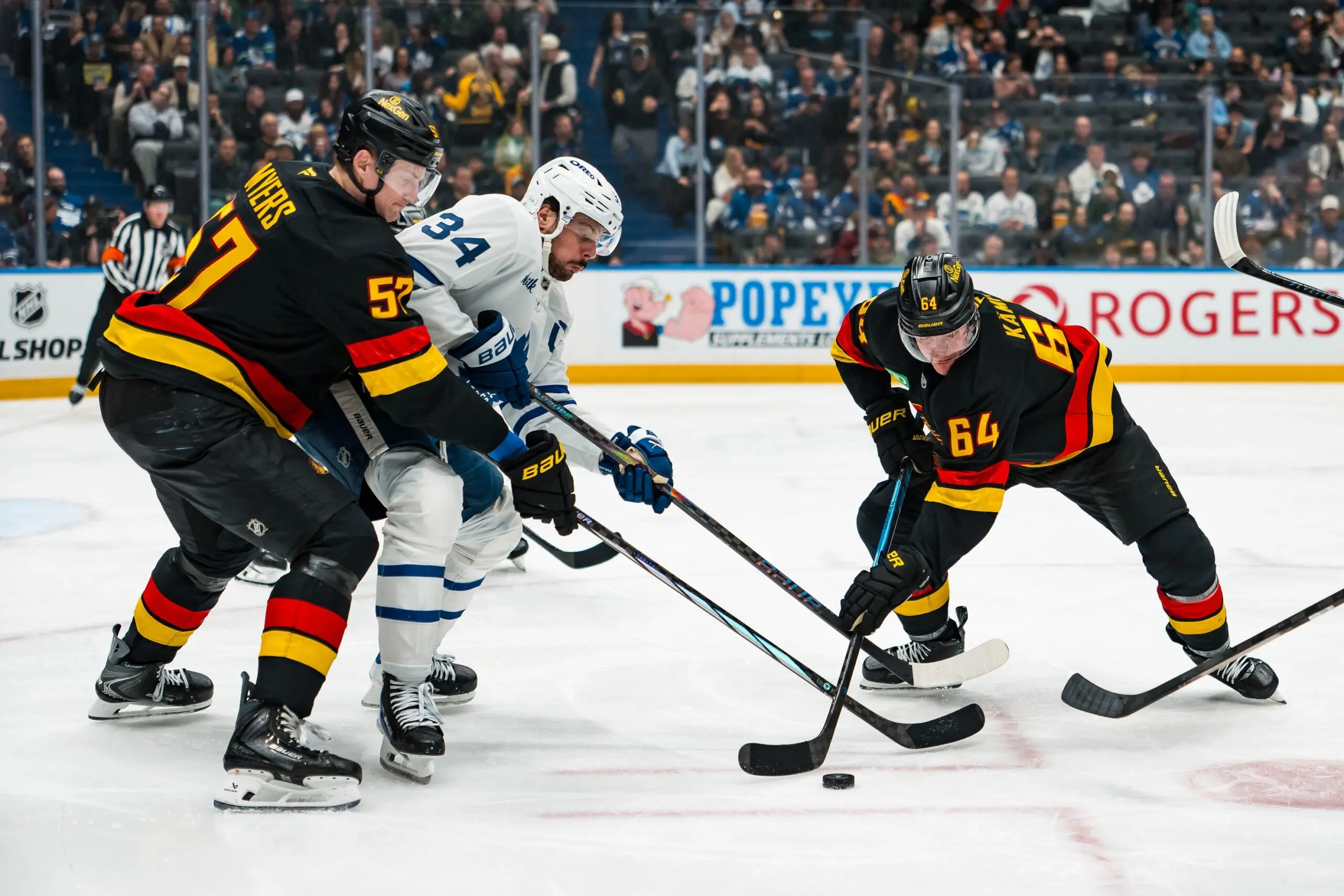
Photo credit: © Bob Frid-Imagn Images

Mar 5, 2026, 10:00 ESTUpdated: Mar 4, 2026, 19:38 EST


Few plans related to the Vancouver Canucks have worked out well this season.
But if there is one that has, it’s David Kampf’s personal plan. Continuing into Trade Deadline Week, Kampf is extremely likely to be dealt somewhere else within the next few days. He stands out as one of the few individuals who probably planned on that exact outcome when he joined the Canucks in the first place.
It has been a strange season for Kampf. He started it out on an entirely different team and on an entirely different contract. Like the Canucks, the Toronto Maple Leafs went into 2025-26 with intentions – or perhaps delusions – of contending, only to find themselves falling severely short. Unlike the Canucks, however, part of the Leafs’ shortcomings involved a shortage of cap space, and that’s what led to their parting of ways with Kampf.
Kampf had been operating under a four-year, $2.4 million AAV contract that he’d signed with the Leafs back in June 2023. That contract was meant to run until 2027. But the Leafs deemed it too rich for their budgetary purposes and so, without much to-do, they cut Kampf late in Training Camp and placed him on waivers.
With that salary and at that point in the preseason, it’s no real surprise that Kampf passed through waivers unclaimed. But what happened next was decidedly unusual. Kampf did indeed go down to the Toronto Marlies and played four games with them before deciding that not only did he really want to get back to the NHL, but that he was literally willing to pay the price in order to do so.
Kampf reached a decision in early November to leave the Marlies, but this was all part of a plan. The Toronto Maple Leafs first suspended Kampf without pay on November 7, and then a week later put him through the process of a contract termination.
This worked out fine for the Maple Leafs, who were incurring a $1.25 million buried cap charge with Kampf in the minors. But it also worked out for Kampf, who was willing to give up the last two years of his contract – and almost $3.5 million in lost salary and signing bonuses – in order to have the freedom to sign somewhere else.
Kampf wasn’t just looking for a new home. He was looking for an opportunity to restore his NHL value, and his NHL job, that he wasn’t getting in Toronto. So, he looked out at the league landscape and saw the incredibly-centre-starved Vancouver Canucks, and decided to hop on board.
Kampf signed a one-year deal with a $1.1 million AAV on November 15. In doing so, he scraped back a little less than a third of the salary he had foregone in Toronto. In order to make back the rest, Kampf was going to need to play well enough to secure his next contract – and, probably, also to secure a trade out of town by deadline time.
When Kampf joined the Canucks were already four points out of the playoffs and fading fast. The writing seemed to already be on the wall regarding the Quinn Hughes trade. There may have been some lingering hope of a turnaround at that point, but not much. Kampf did not join the Canucks to lead them back to the postseason. He joined them to fill in with some badly-needed NHL minutes down the middle, and to springboard that into a chance with another team on another playoff run that would hopefully translate into his next contract.
So, how did that mission go for Kampf?
If we were to look at just raw stats, the answer would be “not well.” Kampf has just two goals and six assists in 37 games for the Canucks. Even for a player who has never been known for his offence – and with a career high of just 27 points – this is by far the lowest rate of production Kampf has ever experienced, even back to his rookie year.
Then again, there’s always a lot of context to apply with the 2025-26 Canucks. For one, Kampf joined a team that was struggling to score with the season already in progress. Virtually every other Canuck is experiencing their career-worst year or close to it, so why not Kampf?
For another, Kampf has never been employed to score. And of the things he has been employed to do, he’s done them fairly well in Vancouver. His average ice-time per night is up to 15:03, almost a minute above his career-average and more than two-and-a-half minutes more than he was getting with Toronto last year. Kampf has been a positive faceoff-taker his entire career, but he’s operating at 52.7% in Vancouver, which puts him over and above his career-average there, too.
Defensively speaking, it’s true that Kampf has been hammered at five-on-five play, being outscored 12-21 as of this writing. But then again, Kampf has been asked to take on what equate to shutdown minutes since joining the Canucks, with the majority of his matchups coming against opposing top-sixes. That’s probably not a fair deployment to give to someone who is, essentially, a fourth-line centre. But Kampf has handled them better than the likes of a Jay Beagle used to, that’s for sure. Kampf’s fancy stats, including a 49.82% Corsi, a 48.20% rate of expected goals, and a dead-even 50.00% control of scoring chances, all look surprisingly decent, and especially so under the context of his team and his role on that team. Quietly, and without much fanfare, Kampf has been one of the Canucks’ most sound defensive players in 2025-26.
That he took many of those matchups away from Elias Pettersson upon arriving carries value in and of itself, even if that value hasn’t translated into any extra success for Pettersson as of yet. Teams with similarly overburdened centres will be paying attention.
In terms of penalty kill, what else can we say but “mixed results”? Kampf joined a PK unit that was already among the league’s worst, and that has continued to tank since. That said, he’s third among the team’s (remaining) forwards in shorthanded ice-time per game with 1:33, and that’s not terribly far off of Conor Garland’s 1:52 or Teddy Blueger’s 1:47. Clearly, Kampf is still a trusted PKer, and that’s another thing that adds considerable value come deadline time.
In summation, Kampf has not set the world on fire since coming to the Canucks. But he has done a relatively good job of doing the things that a David Kampf-type is expected to do, and the fact that he’s been able to do those things even within the context of the messy 2025-26 Canucks is an additional feather in his cap. It tells teams that might be considering adding him that they’re going to get the same Kampf, no matter what the shape of their roster. His play with the Canucks is a testament to his adaptability, and that’s huge for a team hoping to integrate him into a roster just a few months ahead of the playoffs.
The Olympics probably also added a touch of this value to Kampf’s profile. He scored three points in five games for Team Czechia, and played a little higher in their lineup than he does for Vancouver. If anything, it was one more piece of evidence for Kampf’s ability to quickly adapt to a new situation. It was also a testament to the possibility of him looking better away from the Canucks.
If the mission was to play well enough to earn a trade to a postseason-bound team, we’ll say that it’s a mission accomplished for Kampf, pending the actual trade. If it’s playing well enough to earn another contract next year, we’ll say that’s also probably mission accomplished, though how Kampf does in a subsequent playoff run will do a lot to determine the term and salary.
What about the mission from the Canucks’ perspective? Has Kampf restored his value enough to be worth their while at the deadline?
It’s true enough that Kampf was acquired for free, and that anything he returns at the deadline constitutes a profit. But not all profits are created equal. A mid-round pick, rather than a late-round pick, would be a not-insignificant step in the right direction for this franchise.
In what is being called a bit of a buyer’s market at the Trade Deadline, centres remain at a premium. There just aren’t that many out there for sale, and playoff teams are always looking to add at least one. Even a deep team might want an improvement on their fourth line centre, or even to acquire a fifth line centre with experience to cover potential injuries. Everything Kampf has done well in Vancouver – defensive play, faceoffs, killing penalties – are the exact attributes that teams go looking for in their depth centre additions.
One has to imagine that such teams ask for Blueger first, given his higher skill level and the Canucks’ ability to bring him down to just a $900,000 cap hit via retention. But as soon as Blueger is gone, or as soon as a team comes calling for a cheaper option, Kampf should go, too.
Chances are best that the return is still something like a fourth round pick – the middest of mid-round picks in a seven-round draft. But the scarcity of the position and Kampf’s underlying stats may push an analytics-conscious team to offer up a little more to close the deal. Is a third too rich? Maybe. But a fourth and a long-shot prospect would still make for a very solid return for someone who started out the season with a contract termination, and who the Canucks subsequently picked up for nothing more than a spare bit of salary.
PRESENTED BY THE DAILY FACEOFF TRADE DEADLINE SPECIAL
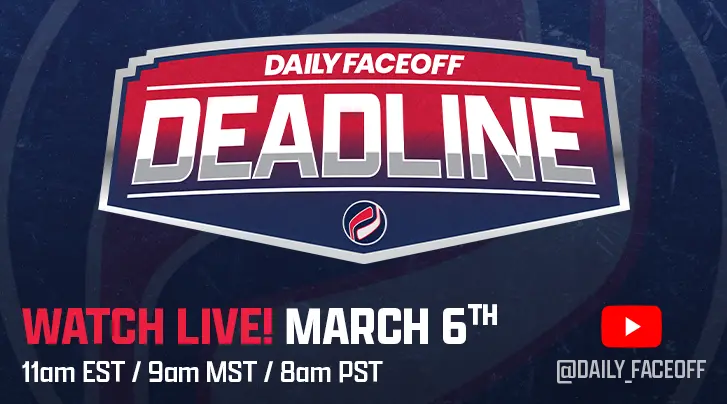
The 2026 Trade Deadline Special is going LIVE March 6th. Join the Daily Faceoff crew on Friday, March 6th from 8 AM-12:30 PM PT for wall-to-wall coverage of every single move as it happens. Get instant reaction, expert analysis, and exclusive insights from special guests throughout the day. Tune in LIVE on the Daily Faceoff YouTube channel and don’t miss a second of deadline day chaos.


Breaking News
- Canucks Game Day: Looking to close out lengthy road trip with a win vs. Lightning
- Vancouver Canucks practice in Tampa Bay; Abbotsford signs defenceman to PTO
- Why did Canucks fans rate Aatu Räty higher than the rest of the league?
- What the Canucks are getting in new trade acquisitions Jacob Quillan and Brandon Buhr
- The Statsies: Tom Willander leads Canucks in xGF in overtime loss to Panthers

Vancouver CanucksTeam Cap Summary

Cap Summary
2026-27
2027-28
Projected Cap Hit
$87,295,050
$71,329,167
Projected Cap Space
$16,704,950
$42,170,833
Current Cap Space
$18,309,380
$42,170,833
Active Players
23/23
13/23
Draft Picks
Round
'27
'28
1
1
1
2
2
2
3
1
1